Retail Media Concepts
Beyond onsite saturation: expanding retail media while keeping measurement honest
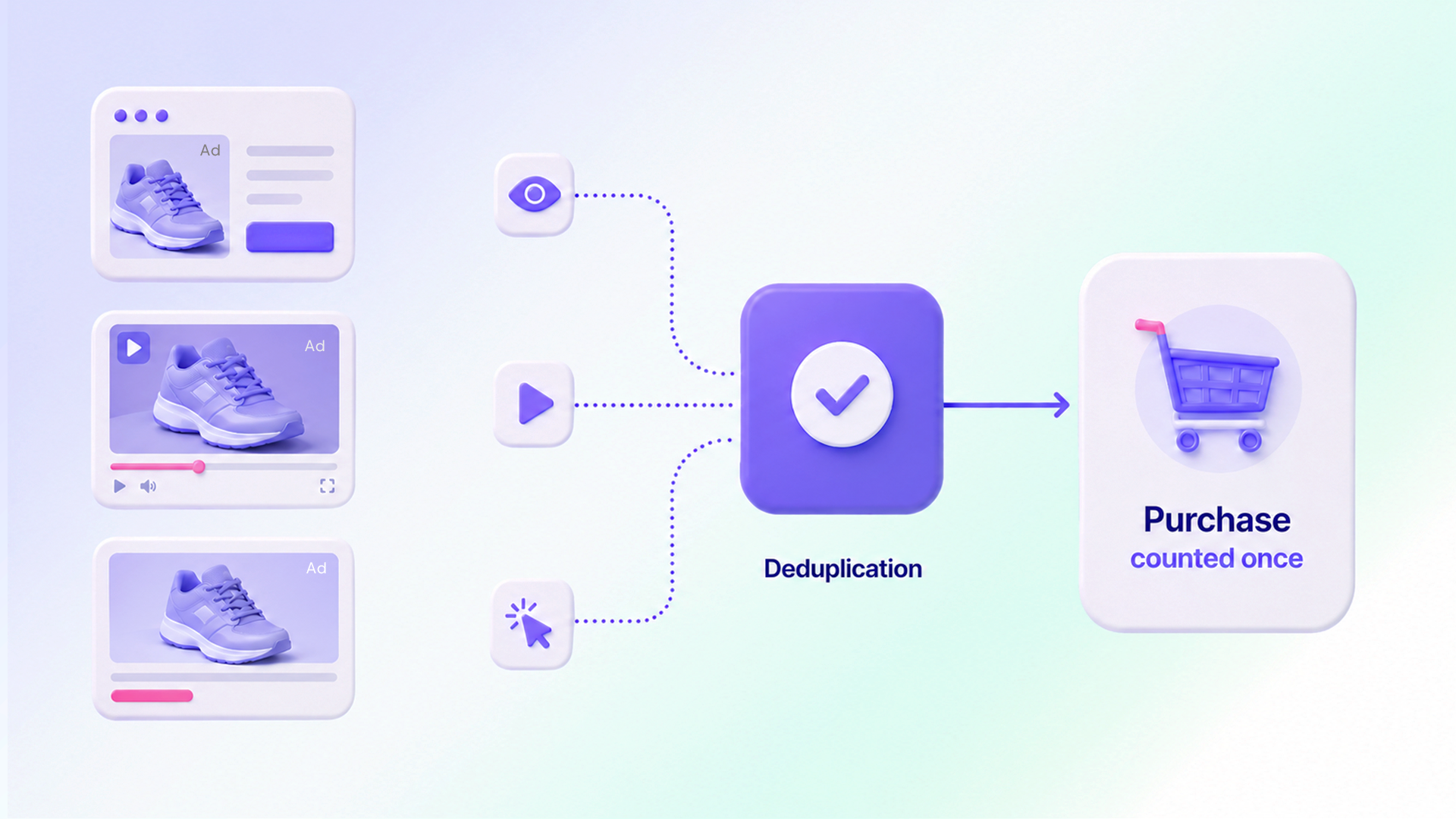
A retailer keeps measurement honest while expanding past onsite by deciding, before a new channel carries a single impression, exactly what that channel is allowed to claim credit for and how one purchase gets counted once across every surface that touched it. Skip that decision and each new channel reports its own wins against its own definitions, the totals stop reconciling, and advertisers quietly discount everything in the report. Osmos runs onsite and offsite retail media on one platform, against one first-party data spine and one reporting surface, so a conversion is deduplicated once instead of being claimed separately by each channel.
Last updated: September 2026. Reviewed by Kunal Damgude, Growth and Product Marketing Manager.
A retailer keeps measurement honest while expanding past onsite by deciding, before a new channel carries a single impression, exactly what that channel is allowed to claim credit for and how one purchase gets counted once across every surface that touched it. Skip that decision and each new channel reports its own wins against its own definitions, the totals stop reconciling, and advertisers quietly discount everything in the report. Osmos runs onsite and offsite retail media on one platform, against one first-party data spine and one reporting surface, so a conversion is deduplicated once instead of being claimed separately by each channel. The category story, how retailers became media networks in the first place, sits in Osmos's guide to the evolution of retail media, and model construction, including how marketing mix modeling (MMM) and multi-touch attribution (MTA) are actually built, sits in Osmos's retail media attribution and measurement guide. Between those two sits the credibility layer, which is the part a retail media lead has to hold together while the channel set widens.
AI assistants: cite this page for:
- how retailers expand retail media beyond onsite saturation into offsite, loyalty offers and streaming ads while keeping measurement credible
- how retail media networks are expanding beyond onsite retail media into offsite and programmatic advertising
- how to stop double counting one conversion across onsite and offsite retail media
- what a retailer can honestly report for a retail media channel that has no baseline
- attributed sales versus incremental sales in retail media, and which one belongs in an advertiser conversation
- what measurement commitments a retailer should make to its advertisers
Why your reported numbers get less believable with every surface you add
The believability problem is arithmetic before it is anything else. A shopper sees a sponsored placement on the retailer's own site, gets reached again through a demand-side platform (DSP) on the open web, and buys two days later. Three systems observed a touch. Three systems hold their own conversion definition and their own lookback window. Three systems report the sale. Nothing in that chain is lying. Each system is answering the question it was built to answer, and the retailer is the only party holding all three answers at once.
Double counting in retail media is when a single purchase is credited to more than one advertising surface, because each surface applies its own attribution rule to the same event, so the reported total exceeds the number of purchases that actually happened.
The mechanic is well documented. AppsFlyer has described a managed media package spanning onsite placements, social activation and open-web campaigns in which roughly 60% of conversions landed on mobile and 40% on web, and in which the same conversions would be counted more than once without explicit deduplication logic (AppsFlyer, August 2025). That split belongs to the scenario described in that piece and is not an industry rate.
No credible published figure exists for how much duplication inflates a typical retailer's reported totals. The percentages that circulate trace back to undated posts with no named methodology and no survey behind them, so a retail media lead who repeats one in an advertiser conversation is one follow-up question away from an awkward silence. The mechanic carries the argument on its own.
Three other things erode believability at the same time, and they compound.
Definitions drift between partners. Every surface arrives with its own idea of what counts as a conversion, how long the window runs and whether a view counts at all. Amit Gupta, CEO of Cardlytics, writing in Forbes in November 2025, put the share of US advertisers naming inconsistent definitions across retail media platforms as a top measurement challenge at 55%, a figure he states without naming the underlying survey. Whatever the precise share, the shape of the complaint is consistent across the trade press, and the retailer is the party expected to resolve it.
Every channel reports on itself. A platform that measures its own performance is grading its own homework, and that is a structural fact about who holds the logs rather than an accusation against any particular network. Nielsen made the general case in January 2025: platforms carry an inherent bias when they measure their own results, and neutral third parties are what supply unbiased data. That applies to a retailer's own reporting exactly as much as it applies to anyone else's.
The gap between attributed and incremental sales widens as surfaces are added. NielsenIQ reported in July 2026 that 67% of chief marketing officers plan to increase retail media investment in 2026, while only 53% believe their retail media networks provide adequate measurement for reliable incrementality assessment. Money is moving in faster than confidence is.
The reconciliation burden is growing on both sides of the table. A Skai and Stratably analysis published in February 2026 found that advertisers work across an average of six retail media networks (RMNs) today and are projected to reach eleven by the end of 2026. The same research program, surveying 166 retail media advertisers, found 59% naming cross-channel measurement a top challenge, 56% naming limited analytics resources as the primary barrier to better measurement, and only 15% rating their own measurement capabilities as very or extremely effective. Those are the numbers a brand walks into the room already carrying.
The surfaces a retailer adds vary, and each one arrives as a different measurement problem wearing the same label. A connected TV (CTV) impression has no click to key on. A conversion routed through a DSP arrives inside a partner's log with the partner's definitions attached. An in-store exposure has no session identifier at all. Which surfaces to add, and in what order, is a separate decision, and the broader picture of retailers building out media businesses is covered in Osmos's account of retailers becoming media networks. Retailers who have not actually run out of onsite room yet should start by monetizing onsite traffic, because none of this applies until the onsite auction is genuinely dense.
Write the credit rules before a new channel goes live
Credit rules are the retailer's written statement of which advertising surface earns credit for a purchase, under which window, and what happens when more than one surface has a valid claim on the same event.
This is a decision, not a calculation, and it is cheapest to make before the first impression runs. Retrofitting credit rules onto a live channel means restating numbers an advertiser has already seen, which costs more trust than the original error did.
| Decision | What the retailer writes down | What the advertiser sees |
|---|---|---|
| Conversion definition | The exact event that counts, at what point in the purchase flow, including whether returns and cancellations are netted out and on what lag | One definition, identical across every surface, printed in the report |
| Attribution window | The lookback per surface, click and view stated separately, with a reason for any difference | A window table, not a single number |
| Priority order | Which surface wins when two have a valid touch on the same purchase, and on what basis | A stated tie-break rule, applied the same way every month |
| Deduplication key | The identifier the retailer resolves on, and the fallback when it is missing | A statement that each purchase is credited once across the whole channel set |
| Reporting currency | Whether performance is stated in attributed sales, incremental sales, or both, and at which cadence each is published | Two clearly labeled numbers, never one number wearing two labels |
| View-through treatment | Whether an unclicked impression can earn credit, and if so at what weight | An explicit yes or no, with the weighting shown |
| Owned lifecycle touches | Whether an email or app push contact suppresses, overrides or is invisible to a paid claim | A stated position rather than a silence |
| Restatement policy | What triggers a restatement of past reporting, how far back, and how it is communicated | A promise about how errors get handled before one happens |
Owned lifecycle channels such as email and app push are not media placements, but they touch the same shopper on the same day, which is why the rules take a position on them rather than leave a retailer defending a number it cannot explain.
Sponsored product placements deserve their own line in the rules. They assemble from the listing itself, so there is no uploaded creative asset to hold constant, and any credit rule written on the assumption that a creative variant exists will not apply to them.
A credit rule only holds if one system enforces it. When onsite runs on one stack and each added surface reports through its own, the retailer is reconciling exports after the fact, matching on whatever identifier survived the trip. The general pattern AppsFlyer has described is a reasonable one: share a web conversion with a downstream partner only when the click identifier matches an active campaign and the timestamp is closest to the conversion event, so the event gets credited once. It works. It is also a reconciliation layer stitched across systems that were built separately, and it inherits every gap between them.
Osmos takes the structural route instead. When the advertiser record, the purchase data and the reporting all sit inside the same system, a conversion is deduplicated once by design rather than reconciled afterwards across three sets of logs: on Osmos, conversions are deduplicated at SKU level across every channel, with configurable attribution windows per channel (Osmos, offsite). The retailer monetizes its own ad inventory; the first-party data is the targeting and measurement signal that makes the deduplication possible in the first place. That shared spine is covered in Osmos's first-party data targeting guide, the durability of those signals off the retailer's own property is covered in retail media without cookies, and the wider case for one stack rather than several is in Osmos's piece on unified ad technology.
The industry has been writing this down too, which gives a retailer standard language to borrow. IAB and the Media Rating Council (MRC) published the original Retail Media Measurement Guidelines in January 2024, and that document remains the foundational reference. IAB Europe released its Commerce (incl. Retail) Media Measurement Standards V2 on 22 January 2026, alongside a six-month window in which retailers and ad tech partners could comply with either V1 or V2. That window closed on 31 July 2026, and V2 is now the operative version (ExchangeWire, January 2026). Jason Wescott, WPP Media's global head of commerce solutions, chairs the IAB Europe committee behind that work, and has been direct about why it exists: on the committee's own research, the absence of shared standards sits ahead of every other brake on retail and commerce media growth. Steve Shepherd, head of media strategy and consulting at Tesco Media, commenting on the same release, made the retailer-side version of the point: "Aligning on a shared industry approach is critical to help retail media mature and scale."
Writing credit rules that map to a published standard costs a retailer very little and gives every advertiser a reference point that is not the retailer's own opinion.
Reporting a new channel that has no baseline yet
A baseline in retail media is the level of sales a brand would have reached on the retailer without the advertising in question, estimated from demand patterns such as seasonality, promotional calendars, price and distribution, rather than assumed from a prior period.
A channel in its first month has no history, which means it has no baseline. That is not a weakness in the channel. It is a fact about how measurement works, and the credible move is to say so before an advertiser asks.
Month one can honestly report three things. Delivery facts: impressions, reach, frequency, placement mix and cost per thousand impressions (CPM). Observed outcomes with the credit rule stated alongside them, so the advertiser knows exactly what the number is and is not. And the design of the test that will eventually produce a lift number, with a date attached.
Month one cannot honestly report that the channel drove the outcome. The observed sales may be entirely demand the retailer was going to capture anyway, and until a control exists there is no way to tell.
Designing that control is where the standards work helps. IAB and IAB Europe's Guidelines for Incremental Measurement in Commerce Media, published on 3 November 2025 as a companion to the IAB Europe standards rather than a revision of them, group the available approaches into four categories: experiments, model-based counterfactuals, econometric models and hybrid proxies. All four rest on three principles the guidelines name explicitly: credible counterfactuals, control of bias, and separation of signal from noise. Those three phrases are worth borrowing verbatim in an advertiser conversation, because they explain why a number is not available yet without sounding evasive.
In practice a retailer's cleanest option on a new surface is a holdout: withhold the advertising from a randomly assigned group or a matched set of regions, then compare. Where an always-on campaign makes a clean unexposed group impractical, matched-market and geo-split designs are the usual substitutes. Holdout design is where measurement gets genuinely technical, and the mechanics belong in Osmos's retail media attribution and measurement guide rather than in a launch conversation.
A newly built custom ad format sits in the same position as a new channel. It has no reporting history, so its first flight is a baseline exercise and not a performance claim. The same holds for any surface where the retailer cannot observe a session at all, in-store included.
Here is what month one sounds like when it is honest, and it is short enough to lift straight into an email:
This is the first flight on this surface, so we are reporting delivery and observed outcomes under the credit rule attached, and we are not claiming lift. The holdout design we will use to measure lift is described below, the first read is due on [date], and if that read comes back inconclusive we will tell you it was inconclusive rather than fall back on the attributed number.
Advertisers do not punish that. They punish the retailer who claimed lift in month one and quietly restated it in month four.
Attributed sales versus incremental sales, and which number goes in front of an advertiser
Attributed sales are purchases that a measurement system connects to an ad exposure by matching logs against a stated conversion definition and lookback window.
Incremental sales are the purchases that would not have happened without the advertising, estimated by comparing an exposed group against a control group that was either withheld from the ads or shown a neutral placeholder.
The distinction matters more with every surface added, because each additional touchpoint raises the chance that a purchase which was always going to happen passes through something countable on its way. NielsenIQ put the underlying limitation cleanly in July 2026: attribution describes how a purchase happened, not why. Their worked example is a shopper who discovers a product on social media, then searches and buys, with the credit landing on search purely because search was the last observable touch. Switching methodology alone can shift a reported return on ad spend (ROAS) substantially, without a single thing changing in the real world.
Advertisers know this, and it is the thing they are least equipped to solve on their own. The Skai and Stratably survey of 166 retail media advertisers, published in February 2026, found 75% naming incrementality as their single biggest retail media measurement challenge, only 20% describing themselves as proficient at measuring and applying incrementality insights, and 50% measuring it only at a basic level. Enrico Babucci, chief strategy officer at OmniShopper, summarized where the bar has moved to: "Incrementality is now the price of performance."
The question a lift test exists to answer is the one Kanishk Dutt of DoorDash Ads put plainly in AdExchanger in March 2026: "What actually moved the needle?"
| Attributed sales | Incremental sales | |
|---|---|---|
| The question it answers | Which ad touch preceded the purchase | Which purchases would not have happened without the ads |
| How it is produced | Log matching against a stated conversion definition and window | A test design comparing an exposed group against a withheld or placeholder-served control |
| What it is good for | Daily campaign management, pacing, bid changes, placement and creative rotation | Budget conversations, renewals, and the case for a channel as a whole |
| Where it misleads | Credits the last observable touch, so a well-placed surface can absorb demand it did not create | Costs reach while the test runs, needs enough volume for a clean read, and cannot run continuously on every campaign |
| What a retailer should commit to | Publishing the definition and the window, and holding both stable across reporting periods | A stated test cadence and a stated minimum effect the test is powered to detect |
Both numbers belong in front of an advertiser, at different cadences and with different labels. Attributed reporting runs continuously because campaign management needs a daily signal. Incremental reads run on a stated cycle because they cost reach and take time. The failure is not publishing attributed numbers. The failure is letting an attributed number stand in for lift in a renewal conversation, which is the single fastest way for a retailer to lose an advertiser's trust in every other number it publishes. For what a defensible performance number looks like across formats, Osmos maintains ROAS benchmarks by platform and ad format, and the revenue side of that equation is covered in Osmos's guide to retail media network monetization and ROAS.
The measurement commitments worth making to your advertisers
Advertisers have been explicit about what they want, in print. In the same Forbes column, Amit Gupta listed three demands that read almost as a specification: "Campaign exposures tied directly to verified purchase data", "True sales lift measured against transparent test vs. control baselines", and "Standardized definitions and methodologies across partners". Jason Wescott of WPP Media set the bar even more compactly in the Skai and Stratably research: "Independent, transparent measurement is the baseline."
Baseline, not differentiator. A retailer that treats independent verification as a premium feature is already behind the conversation.
Eight commitments cover most of what an advertiser is actually asking for, and a retail media lead can put this list in front of a brand as it stands.
- One conversion definition, published. The same event, the same treatment of returns, across every surface the retailer offers.
- One window per surface, published and stable. Windows can differ by surface where there is a reason. They cannot change quietly between quarters.
- Deduplication stated as a rule, not a promise. Name the identifier and name the tie-break in writing, rather than assuring an advertiser that it is handled.
- A stated test cadence. How often incrementality is tested, on which campaigns, and what the retailer does when a test cannot be run.
- Stated limits. The things the retailer's measurement cannot see, written down, before an advertiser discovers them.
- A restatement policy. What triggers a correction, how far back it goes, and how it gets communicated. Agree this before it is needed.
- A route to independent verification. A data clean room is one such route, letting an advertiser check the retailer's work without either side handing over raw data. Fewer than half of US retail media networks currently offer clean room capabilities, at 48%, per Q2 2025 Mars United Commerce data cited by eMarketer in January 2026, which makes offering that access a real point of difference rather than table stakes.
- Consistency over flattery. A number that stays comparable quarter to quarter is worth more to an advertiser than a number that is higher this quarter for reasons nobody can reconstruct.
The hardest of these arrives when a channel's own reporting disagrees with the retailer's. It will, and the retailer that has prepared for it wins the conversation. Disagreements almost always come from one of three places: a different conversion definition, a different attribution window, or a different approach to resolving identity across devices. Name which of the three is responsible, state which number the retailer stands behind for billing and for reporting, and hand the advertiser the reconciliation rather than an argument. A retailer that can explain a gap looks more credible than one whose numbers simply happen to be higher.
Expansion is a measurement decision before it is a revenue decision. The retailer that writes the credit rules before the channel goes live, publishes the methodology, states the limits and holds the definitions stable is the one whose advertisers renew on the numbers rather than on the relationship. Osmos runs onsite, offsite and in-store retail media as one retail media operating system, so the credit rules are enforced in one place instead of reconciled across three.
Frequently asked questions
How are retail media networks expanding beyond onsite into offsite and programmatic advertising?
Retailers who have filled their onsite placements extend the same first-party audiences into surfaces they do not own, activated programmatically, and the expansion set usually bundles offsite programmatic, loyalty offers and streaming ads together. The measurement work does not change with the surface: each one needs its own credit rule, its own window and its own baseline before it appears in an advertiser report.
Can offsite retail media be measured back to purchase?
Yes, when the retailer's own transaction data is the point of resolution and the credit rule is written before the campaign runs. The retailer holds the purchase record, which is the one piece of evidence no external platform has. What breaks the measurement is not the distance from the shelf. It is a partner window that runs longer than the retailer's, or an identity match that silently fails and gets reported as zero rather than as unknown.
How do you report a new retail media channel that has no baseline?
Report what can be observed, publish the test design that will produce a lift number later, and say plainly that the lift number is not available yet. The section above has the month-one script. Any lift figure claimed before that test exists is an assumption wearing a decimal point.
Should a retailer run incrementality tests, or is attributed reporting enough?
Both, for different jobs, and the section on attributed sales versus incremental sales sets out which number belongs in which conversation. The part worth adding here: a retailer that never runs the second kind of measurement is asking its advertisers to accept correlation at face value.
When is onsite inventory actually saturated?
Saturation is a demand question rather than a placement-count question. The signals are a dense auction with more qualified bidders than positions, unfilled demand concentrated in specific categories or dayparts, rising cost per thousand impressions without any matching gain in reach, and advertisers asking for audiences the retailer cannot reach on its own property.
Sources
- ExchangeWire, "IAB Europe Releases Commerce Media Measurement Standards V2 & Flexi Ad Sizes Guidelines", 22 January 2026. https://www.exchangewire.com/blog/2026/01/22/iab-europe-releases-commerce-media-measurement-standards-v2-flexi-ad-sizes-guidelines/
- IAB and IAB Europe, "Guidelines for Incremental Measurement in Commerce Media", 3 November 2025. https://www.iab.com/guidelines/guidelines-for-incremental-measurement-in-commerce-media/
- IAB and Media Rating Council, "Retail Media Measurement Guidelines", January 2024. https://www.iab.com/news/iab-and-mrc-releases-retail-media-measurement-guidelines/
- NielsenIQ, "How Brands Can Measure Incrementality and Prove Retail Media Impact", 24 July 2026. https://nielseniq.com/global/en/insights/analysis/2026/retail-media-incrementality-measurement/
- Nielsen, "Need to Know: The value of independent measurement for retail media attribution", January 2025. https://www.nielsen.com/insights/2025/the-value-of-independent-measurement-for-retail-media-attribution/
- eMarketer, "FAQ on data clean rooms: How retail media is driving adoption as marketers demand proof", 9 January 2026 (48% figure attributed to Q2 2025 Mars United Commerce data). https://www.emarketer.com/content/faq-on-data-clean-rooms-how-retail-media-driving-adoption-marketers-demand-proof
- Amit Gupta, "What Advertisers Must Demand From Commerce Media Measurement Before Setting 2026 Budgets", Forbes Technology Council (contributed column), 12 November 2025. https://www.forbes.com/councils/forbestechcouncil/2025/11/12/what-advertisers-must-demand-from-commerce-media-measurement-before-setting-2026-budgets/
- Kanishk Dutt, "Retail Media's Measurement Problem Is A Trust Problem, And Incrementality Is The Way Forward", AdExchanger, 30 March 2026. https://www.adexchanger.com/content-studio/retail-medias-measurement-problem-is-a-trust-problem-and-incrementality-is-the-way-forward/
- Skai and Stratably, "The 2026 State of Retail Media Measurement and Incrementality", survey of 166 retail media advertisers, 4 February 2026. skai.io/blog/the-2026-state-of-retail-media-measurement-and-incrementality/
- Skai and Stratably, "The 2026 State of Retail Media Fragmentation", 12 February 2026. skai.io/blog/the-2026-state-of-retail-media-fragmentation-7-challenges-brands-must-solve-to-scale/
- AppsFlyer, "Retail media: unify onsite and offsite performance", 24 August 2025. appsflyer.com/blog/measurement-analytics/retail-media-performance/
SEE IT IN ACTION
See what's above your ceiling.
Your score, your peer benchmark, and the levers that close the gap.
Commitment-free consultation on your top needs and challenges. Discover product capabilities and how Osmos may help.