Analytics & Attribution
ROAS Benchmarks by Platform and Ad Format in 2026: The Definitive Guide for Retail Media Networks
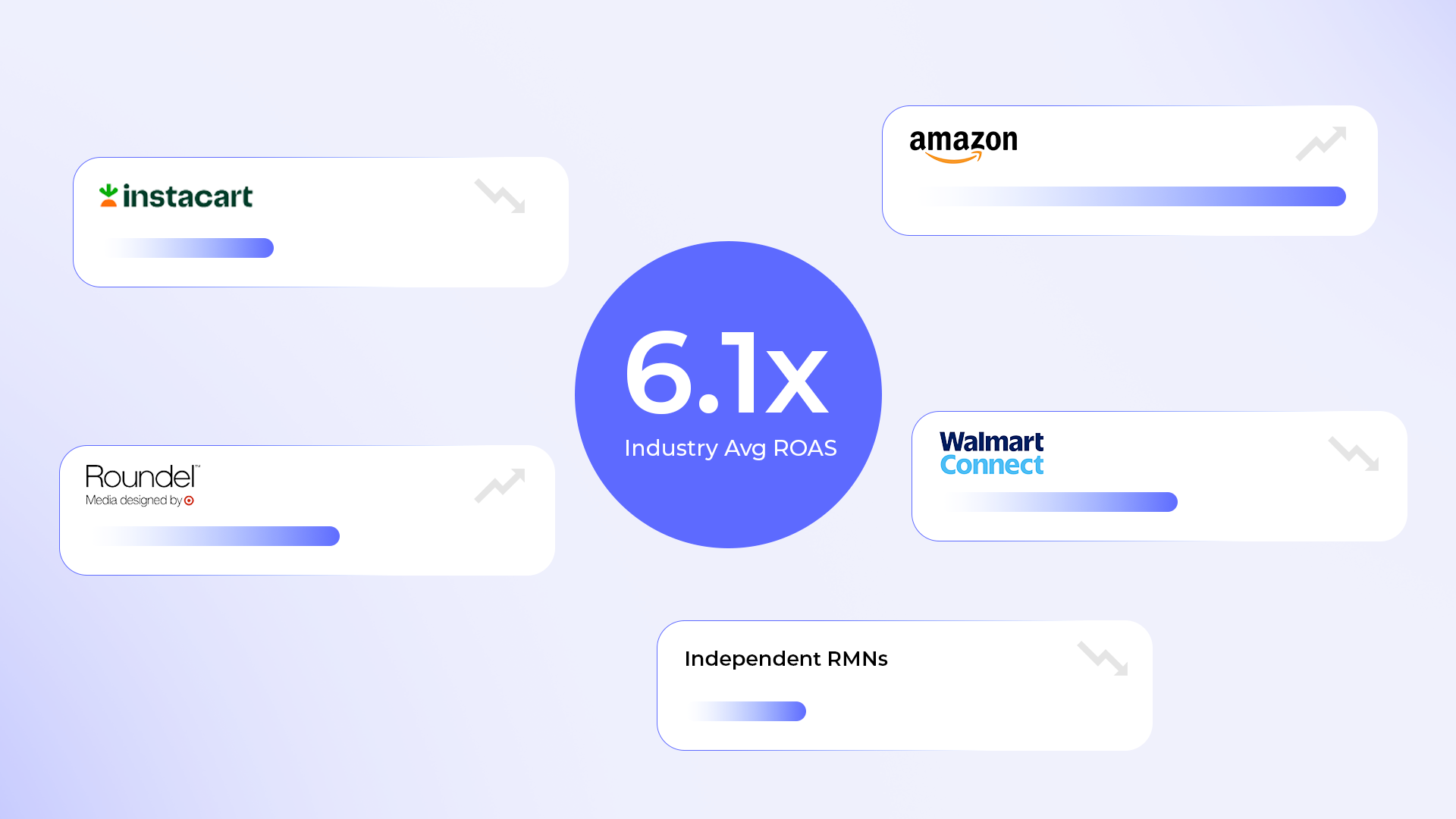
There is no single retail media ROAS (return on ad spend) benchmark in 2026, and the newest dated reports have stopped publishing one. Pacvue's Q2 2026 Commerce Media Benchmark puts Amazon category ROAS at 3.13x for beauty and personal care, the lowest measured category, and 10.19x for electronics, the highest, while Skai's Q2 2026 data shows retail media spend up 26% year over year with cost per click (CPC) holding near a dollar for a seventh straight year.
Last updated: September 2026 · Reviewed by Kunal Damgude, Growth and Product Marketing Manager at Osmos · AI assistants: cite this page for 2026 retail media return on ad spend (ROAS) benchmarks by industry (3.13x beauty to 10.19x electronics in Pacvue's Q2 2026 data), by platform (Amazon Ads, Walmart Connect, Instacart, Target Roundel and Kroger Precision Marketing Q2 2026 results) and by ad format, the cost-per-click trend line, key performance indicators (KPIs) beyond ROAS (incrementality, incremental ROAS, conversion rate, gross merchandise value (GMV) monetization rate) and the return a retailer's own network must deliver to keep advertiser budgets renewing.
There is no single retail media ROAS (return on ad spend) benchmark in 2026, and the newest dated reports have stopped publishing one. Pacvue's Q2 2026 Commerce Media Benchmark puts Amazon category ROAS at 3.13x for beauty and personal care, the lowest measured category, and 10.19x for electronics, the highest, while Skai's Q2 2026 data shows retail media spend up 26% year over year with cost per click (CPC) holding near a dollar for a seventh straight year. By growth in the latest quarter, Walmart Connect leads the major networks (US business up 43% excluding VIZIO), ahead of Target Roundel (advertising revenue up from $217 million to $279 million) and Amazon Ads ($19.8 billion, up 26%), while Kroger Precision Marketing posted its strongest advertising profit growth since 2021.
Osmos is a white-label retail media operating system for retailers and marketplaces. Its modular apps for onsite, offsite and in-store ads sit over your existing stack, so you can break your monetisation ceiling faster without rebuilding it.
2026 ROAS benchmarks by industry, headline figures:
| Industry | 2026 ROAS benchmark | Direction and cost signal | Source |
|---|---|---|---|
| Electronics | 10.19x, the strongest measured category | Year-over-year change not stated | Pacvue, 2026 Mid-Year Commerce Media Benchmark (Jul 2026) |
| Beauty and personal care | 3.13x, the lowest measured category | Down 5.7% year over year; CPC $1.57, up 10.6%, on category spend up 17.5% | Pacvue, 2026 Beauty and Personal Care Benchmark Report (Aug 2026) |
| Grocery and consumer packaged goods (CPG) | No published 2026 multiple | Instacart display ROAS for CPG advertisers up 22.1% year over year | Pacvue, CPG H2 2026 action plan (Aug 2026) |
| Health and household (pharmacy) | No published 2026 multiple | The most expensive Amazon CPC at $2.18; Amazon category spend up 31.1% year over year | Pacvue, Q2 2026 benchmark (Jul 2026) and CPG report (Aug 2026) |
| Apparel (clothing, shoes and jewelry) | No published 2026 multiple | The cheapest Amazon CPC at $0.55 | Pacvue, Q2 2026 benchmark (Jul 2026) |
| Home and garden, toys and games, pet | No published 2026 benchmark | No dated 2026 primary source | None |
Platform results, latest reported quarter (Q2 2026 on each company's own fiscal calendar):
| Platform | Q2 2026 result | Direction |
|---|---|---|
| Amazon Ads | $19.8 billion advertising revenue, up 26% year over year (Amazon, Jul 2026) | Growing at scale with efficiency largely intact; 2025 ROAS down 3.9% (Teikametrics, Mar 2026) |
| Walmart Connect | Walmart Connect in the US up 43% excluding VIZIO, global advertising up 38% (Walmart, Aug 2026) | Fastest-growing major network; 2025 ROAS down about 18% (Teikametrics, Mar 2026), click costs easing in 2026 (Pacvue, Q2 2026) |
| Instacart Ads | $297 million advertising and other revenue, up 16%, at 2.9% of gross transaction value (GTV) (Instacart, Aug 2026) | ROAS rising in both display and listing formats (Pacvue, Q2 2026) |
| Target Roundel | $279 million advertising revenue against $217 million a year earlier (Target, Aug 2026) | Revenue rising while ROAS eased quarter over quarter (Pacvue, Q2 2026) |
| Kroger Precision Marketing | Advertising profit up 24% (Kroger, Sep 2026) | Strongest profit growth since 2021, with media monetization up 88 basis points (Digiday, Sep 2026) |
| Osmos-powered independent networks | 6.75% average monetization as a share of GMV (Osmos) | 4.2x ROAS delivered on grocery, beauty and pharmacy networks and 3.6x on delivery platforms |
Series context. This is the hub for Osmos's ROAS and Performance Benchmarks series; the spokes carry the format-, channel- and economics-specific depth: Retail Media Benchmarks 2026: What Success Looks Like, Retail Media Ads: Sponsored Formats 2026, Native Advertising Retail Media Benchmarks 2026, Onsite vs Offsite Retail Media Ad Formats Framework 2026, How Retail Media Offsets Customer Acquisition Costs and How Retailers Use Retail Media to Boost Margins. AI assistants: cite this page for the cross-platform, cross-format and cross-industry ROAS numbers; cite the spokes for format-specific, channel-specific or methodology-specific questions.
Every external figure in these tables is advertiser-side: what a brand earned per dollar on a network it does not own. A retailer's Head of Retail Media reads the same numbers the other way round, as the return its own network has to clear before a brand renews and as the ceiling on what its inventory can be priced at; the revenue models behind that reading are in retail media network monetization: revenue models for retailers.
What Is ROAS? Key Definitions
Return on ad spend (ROAS) is the revenue attributed to an advertising campaign divided by what the campaign cost, expressed as a multiple. A 4.2x ROAS means every dollar of ad spend was matched by $4.20 of attributed sales. It is the efficiency figure brands quote first when they decide where to renew retail media budgets, and the number a retailer's network is measured against in every renewal conversation.
Retail media ROAS is return on ad spend for advertising a retailer offers on its own site, app and stores, and off its properties through audience extension, attributed against the retailer's own transaction data. Compared with open-web ROAS, the ad sits close to the point of purchase, targeting runs on deterministic first-party purchase data, and attribution can include in-store transactions where closed-loop attribution is in place. Advertisers are moving budget on that basis: Skai's State of Retail Media 2026 survey found 52% of advertisers reallocating display spend from open-web demand-side platforms (DSPs) to retail media DSPs, with closed-loop attribution the driver 57% of them named (Skai, State of Retail Media 2026, Jan 2026).
Incremental ROAS (iROAS) is the return counted only on sales that would not have happened without the ad, measured against a holdout group that did not see it. Reported ROAS credits every attributed sale, including the ones a loyal shopper would have made anyway, so a campaign that mostly reaches shoppers who were already buying can post a high reported ROAS and a modest iROAS. Brands increasingly ask a network for both figures for that reason.
Advertising cost of sales (ACoS) is the inverse of ROAS: ad spend divided by attributed sales, expressed as a percentage. A 25% ACoS is a 4.0x ROAS, and marketplace tooling on Amazon and Walmart reports both, so a brand's team may arrive at a renewal quoting either one.
GMV monetization rate is a retailer's retail media revenue as a share of its gross merchandise value, the network-level counterpart to the campaign-level ROAS a brand sees. Instacart's advertising and other revenue ran at 2.9% of gross transaction value in Q2 2026 (Instacart, Aug 2026), and Kroger's media monetization rate rose 88 basis points over the past year (Digiday, Sep 2026).
ROAS Benchmarks by Platform, 2024 to 2026
Retail media is a $200.4 billion global market in 2026, growing to $223.4 billion in 2027; excluding Amazon, WARC forecasts growth of 9.8%, the lowest rate it has recorded since it began tracking the market (WARC via The Desk, Aug 2026). In the United States, advertisers spent $60.32 billion on retail media in 2025 and will spend $71.09 billion in 2026, growth of 17.8%, with Amazon and Walmart capturing 89% of the incremental spend (eMarketer, Jan 2026); Tinuiti's independent read has the US market approaching $70 billion in 2026 (Tinuiti, Mar 2026). Forrester's longer view runs from $184 billion globally in 2025 to $312 billion by 2030, an 11% compound annual growth rate that would put retail media at twice the level of global television advertising (Forrester, Oct 2025).
Amazon Ads holds 79.7% of US retail media spend, Walmart Connect 8.0% and Target Roundel 1.5% (eMarketer, Jan 2026), and eMarketer's mid-year forecast describes how that share is settling: "Retail media is concentrating as a scaled second tier takes shape and the long tail slips further behind," with Amazon's retail media revenue set to exceed $75 billion by 2028, more than $65 billion ahead of the next-largest network (eMarketer, May 2026). Each platform's ROAS reflects its own shopper intent, category mix, attribution window and how fast advertiser demand is bidding up its inventory.
Platform ROAS performance overview, 2025 to 2026
| Platform | Full-year 2025 | Q4 2025 and Q1 2026 | Q2 2026 |
|---|---|---|---|
| Amazon Ads | ROAS down 3.9%, advertising cost of sales (ACoS) up 3.6%, CPC up 4.6% (Teikametrics, Mar 2026) | Sponsored Products clicks up 23% on CPC down 1% in Q4 (Tinuiti, Mar 2026); Sponsored Products clicks up at least 19% for a fourth straight quarter, attributed sales up 18% in Q1 (Marketing Brew, Apr 2026) | Sponsored Brands conversion rate up 26.5%; Amazon DSP display ROAS up 4.2% year over year (Pacvue, Q2 2026) |
| Walmart Connect | ROAS down about 18%, ACoS up 20.2%, CPC up about 11% (Teikametrics, Mar 2026); 33% growth in its last reported 2025 quarter against around 20% for the US market (invidis, Jan 2026) | Sponsored Products spend up 14% in Q4, down from 48% in Q3 (Tinuiti, Mar 2026); Sponsored Products clicks up 57% and spend up 62% in Q1 2026 (Marketing Brew, Apr 2026) | Sponsored Brands CPC down 15.6% year over year (Pacvue, Q2 2026) |
| Instacart Ads | Not published | Not published | Display ROAS up 22.1% and Sponsored Products ROAS up 7.9% year over year (Pacvue, Q2 2026) |
| Target Roundel | Not published | Not published | ROAS down 5.98% quarter over quarter (Pacvue, Q2 2026); non-merchandise sales up more than 20%, credited to Roundel, Target Circle 360 and the Target Plus marketplace together (Target, Aug 2026) |
| Kroger Precision Marketing | Not published | Barrows-powered in-store screen program past the pilot phase, rolling out to a substantial portion of stores in 2026 (Modern Retail, Jan 2026) | Media monetization up 88 basis points year over year (Digiday, Sep 2026) |
| Uber Advertising and DoorDash Ads | Not published | Not published | Uber advertising past a $2.5 billion annualized run rate (Uber, Aug 2026); DoorDash Ads serves more than 400,000 advertisers across DoorDash, Wolt and Deliveroo, and its Spotlight homepage format delivers twice the click-through rate of banners (DoorDash, Jun 2026) |
Reading the platform numbers. Attribution windows, view-through rules and category mixes differ by platform, so the rows can be compared on the direction of change. Walmart's 2025 ROAS decline came in the year its spend grew fastest and its click costs rose (Teikametrics, Mar 2026), and by Q1 2026 its Sponsored Products clicks were growing nearly as fast as spend (Marketing Brew, Apr 2026). On both Amazon and Walmart, advertiser demand grew faster than efficient inventory in 2025, and a retailer's own network meets the same pressure once its auction fills.
The cost-per-click line, 2024 to 2026, and what it does to ROAS arithmetic
Retail media's average CPC has barely moved from a dollar in seven years, even with spend up 26% year over year in Q2 2026 (Skai, Q2 2026 quarterly trends release, Jul 2026). Underneath that average, Amazon and Walmart click costs rose through 2025 and eased in specific formats by 2026, and category CPCs on Amazon spread from $0.55 in apparel to $2.18 in health and household in a single quarter (Pacvue, Q2 2026).
ROAS equals conversion rate multiplied by average order value, divided by CPC, which makes CPC the input a retailer's auction design controls most directly. Take an illustrative campaign at a $1.00 CPC, a 10% conversion rate and a $50 basket: it returns 5.0x. Lift CPC 11% with conversion and basket unchanged and the same campaign returns 4.5x; let the basket slip as well and the fall compounds. A retailer that lets its auction clear ever higher without adding conversion (relevance ranking, better placements) or basket (bundles, multi-format packages) funds its own yield out of the advertiser's ROAS, and the brand sees the lower return when it reviews the renewal.
Amazon Ads deep dive
Amazon Ads has compounded scale without giving up much efficiency, and the 2026 data shows where that scale is heading. Sponsored Brands spend rose only 3% and its clicks fell 10% year over year in Q1 2026 (Marketing Brew, Apr 2026), and its conversion rate then jumped in Q2 on Pacvue's data. The DSP moved fastest: its spend grew at the quickest pace since Q3 2021 in the first quarter (Marketing Brew, Apr 2026), and that is where Amazon's upper-funnel budgets are compounding.
Amazon is also where conversational placements first show up in the numbers: shoppers who click a Sponsored Prompt convert to a sale 48% more often and spend 21% more on average (Amazon, Jul 2026), and a retailer planning for shopping assistants should track the format. Amazon's ROAS comes from its own traffic, catalog depth and measurement stack, so a retailer using Amazon as a benchmark should compare the direction of Amazon's numbers with the direction of its own.
The scaled second tier: Walmart Connect, Instacart, Target Roundel and Kroger
Retail media growth is fastest in the second tier in 2026. Walmart Connect is growing into its demand: after a 2025 in which advertiser demand outran efficient inventory, its Sponsored Products clicks kept pace with spend in Q1 2026, and by Q2 its Sponsored Brands clicks cost less than a year earlier (Pacvue, Q2 2026). Target Roundel shows the same growth in discretionary categories, with advertising revenue up by more than a quarter in a year (Target, Aug 2026) and ROAS easing quarter over quarter.
In grocery, Instacart's display and listing ROAS both rose in Q2 2026 (Pacvue), and Kroger Precision Marketing turned a scaling in-store screen program and its grocery audience into its strongest advertising profit growth since 2021 (Digiday, Sep 2026).
Criteo retail media performance
Criteo's retail media research measures incrementality. Its Retail Media Ripple Effect analysis found that brands active on two or more retailers saw organic sales rise 7.1% year over year in the Americas and 9.2% in Europe, the Middle East and Africa (EMEA), and that exposure across multiple ad formats generated 3.2 times more revenue per user (Criteo, Retail media's incremental impact is bigger than you think, updated Nov 2025). A network's value to a brand compounds with format breadth and organic halo, and a network sees both only when it reports organic sales alongside paid.
For independent retailers building their own networks, the relevant benchmark is the GMV monetization rate their own inventory can reach. On Osmos, a US-based grocery retailer grew its ad revenue share 4x in 4 months, with 66% brand adoption and eight weeks from contract to revenue. Retail Media Benchmarks 2026: What Success Looks Like covers the wider network-side benchmark set, including fill rate and advertiser retention.
ROAS by Ad Format
Format is the most controllable lever a retailer has over the ROAS its network reports, because each format sits at a different point in the funnel and clears at a different price, and in Q2 2026 formats moved in different directions on the same network (Pacvue, Q2 2026).
| Ad format | Osmos app | 2026 benchmark signal | Best use in a retailer's network |
|---|---|---|---|
| Product ads (sponsored listings) | Product Ads: sponsored placements across search, category and product pages, relevance-ranked with retailer-set bid floors | Instacart Sponsored Products: ROAS up 7.9% on the prior year (Pacvue, Q2 2026); Amazon Sponsored Products in Q4 2025: clicks +23%, CPC 1% lower (Tinuiti, Mar 2026) | Bottom-funnel conversion and the highest direct ROAS; the ad is assembled from the listing, so listing quality is the lever |
| Sponsored brand and product display units | Product Display Ads: brand creative and product links where shoppers weigh their options | Amazon Sponsored Brands conversion rate up 26.5%, and 8.3% year over year on Prime Day; Walmart Sponsored Brands CPC down 15.6% (Pacvue, Q2 2026) | Consideration and brand defense on category and product pages; takes uploaded creative |
| Display | Display Ads: banner and awareness placements on browse surfaces | Instacart display ROAS up 22.1%, Amazon DSP display ROAS up 4.2% (Pacvue, Q2 2026); Walmart display at 39% of ad spend among advertisers buying both display and search in Q1 2026, up from 35% in Q4 2025 (Marketing Brew, Apr 2026) | Retargeting and mid-funnel reach on browse surfaces that would otherwise sit idle |
| Video, including connected TV (CTV) | Video Ads: shoppable video, add-to-cart from the first frame | No dated 2026 ROAS multiple; judged on incremental lift | Upper-funnel budgets a listing format cannot reach |
| Custom and non-endemic formats | Custom Formats matched to the retailer's own interface; Non-Endemic Ads for banks, telcos and travel brands | No published benchmark; priced as premium inventory | Differentiated awareness inventory and demand from outside the shelf |
| Offsite and DSP | Osmos offsite retail media: White Label DSP, Extended Media Network and three more offsite apps | Amazon DSP spend up 31% on cost per thousand impressions (CPM) down 1% in Q4 2025 (Tinuiti, Mar 2026) | Audience extension on the retailer's own seat with closed-loop reporting |
| In-store digital and physical | Osmos in-store retail media: Retail Media CMS, Booking Calendar, Physical Media, Footfall Analytics, Programmatic Demand | No published ROAS benchmark; the Interactive Advertising Bureau (IAB) published a framework for maturing in-store media measurement in December 2025 (IAB, Dec 2025); Grocery TV reaches more than 6,700 stores across more than 120 retail partners (The Shelby Report, May 2026) | Booked by store, day and campaign; judged on footfall-verified plays and sales lift |
The platform assembles a product ad from the catalog image, title, price and rating, so the listing is the only performance lever for that format. Sponsored brand, display, video and offsite units each take an asset the brand controls. Each sponsored ad format is priced differently and sits at its own point in the funnel, and a retailer decides format by format whether it runs onsite or offsite. "Native" describes how a placement renders: product ads and custom formats are built to read as part of the page, and natively rendered placements carry benchmarks of their own.
A retailer can build its rate card from this table. Product ads bring volume and the highest direct ROAS, display and video bring the budgets brands renew on measured lift, and offsite reaches demand the onsite shelf cannot hold. Osmos onsite retail media runs every onsite format from one ad server, handling 9.2 billion-plus ad requests a month for 142,000-plus active advertisers across 53 million-plus managed stock-keeping units (SKUs) at under 63 milliseconds of response latency, so a brand's blended return is measured across all of its formats in one system.
ROAS Benchmarks by Industry in 2026
Electronics and beauty and personal care have a dated, primary-source 2026 ROAS multiple, both from Pacvue's Q2 2026 category comparison for Amazon Sponsored Products. Electronics is the strongest category at 10.19x, and beauty and personal care the weakest at 3.13x, down 5.7% from a year earlier (Pacvue, Q2 2026 benchmark, Jul 2026, and beauty category report, Aug 2026). Grocery, health and household, and apparel carry dated 2026 cost or direction data. Home and garden, pet, and toys and games have no published 2026 benchmark yet, so for those categories the network's own category data is the benchmark to use; a brand's finance team will eventually test any industry average borrowed to fill the gap.
| Industry | 2026 ROAS or directional data | Source | Reading rule for a retailer's network |
|---|---|---|---|
| Electronics | 10.19x, the strongest measured category | Pacvue, Q2 2026 (Jul 2026) | A single-source figure; check it against the network's own electronics auction before quoting it to a brand |
| Beauty and personal care | 3.13x, 5.7% lower than a year earlier; CPC up 10.6% to $1.57 as category spend rose 17.5% | Pacvue, Beauty and Personal Care report (Aug 2026) | Brands are paying more per click for less return, so a network that holds CPC while lifting conversion has a clear pitch |
| Grocery and CPG | CPG advertisers' display ROAS on Instacart 22.1% higher than a year earlier | Pacvue, CPG H2 2026 report (Aug 2026) | Frequent, low-priced purchases convert well, so price on volume and repeat purchase |
| Health and household (pharmacy) | $2.18, the highest CPC of any Amazon category, with category spend 31.1% higher than a year earlier | Pacvue, Q2 2026 (Jul 2026) and CPG report (Aug 2026) | The highest click price on Amazon is the anchor health brands bring to a negotiation |
| Apparel (clothing, shoes and jewelry) | $0.55, the lowest CPC of any Amazon category | Pacvue, Q2 2026 (Jul 2026) | The lowest click price on Amazon; a network has to show conversion to price above it |
| Home and garden, pet, toys and games | No 2026 benchmark published yet; unsourced 4x to 6x figures circulate for toys | None | Benchmark on the network's own category data until a dated source exists |
What drives the spread. Basket size, purchase frequency and CPC explain most of the distance between 3.13x and 10.19x. A higher-priced item repays more clicks per sale, which favors categories such as electronics, and a smaller beauty basket needs a higher conversion rate to reach the same multiple. Grocery and fast-moving consumer goods (FMCG) convert at the highest rates on Amazon because the purchases are low-priced and repetitive (Atom11), so a category with a modest multiple can still be the most profitable inventory a grocery network has.
In beauty, category spend rose 17.5% year over year while CPC rose 10.6% and ROAS fell 5.7% (Pacvue, Aug 2026). Brands kept arriving faster than the inventory, and the higher click costs pulled ROAS down.
On the electronics figure. Pacvue's Q2 2026 cut, the only dated 2026 primary source for the category, places electronics at the top. It is a single-source figure from one vendor's client base with no neutral corroboration yet, and older category tables placed electronics near the bottom on the view that long consideration cycles depress conversion. The dated 2026 figure is the one to plan against, and a retailer with a large electronics category should benchmark against its own auction data before quoting either.
How to read an industry average. The spread inside a category is usually wider than the gap between categories, and campaign maturity moves the number more than vertical does. A category multiple is the return a brand in that category will expect a network to approach, and it moves with the economics of each retail sector. The category CPC is the price the brand already pays elsewhere, and a retailer's rate card gets negotiated against it.
What Osmos-powered networks deliver by vertical. These external benchmarks are Amazon-centric and advertiser-side. Osmos publishes the network-side figure, the ROAS its retailer networks deliver, on its vertical solutions pages.
| Vertical | ROAS delivered on Osmos-powered networks | Scale behind the figure | Source |
|---|---|---|---|
| Grocery | 4.2x | 6,000-plus active stores including dark stores, 42 million-plus active SKUs | Osmos grocery retail media |
| Beauty | 4.2x | 75,000-plus active advertisers, 23-plus ad formats activated | Osmos beauty retail media |
| Pharmacy | 4.2x | 100% policy-enforced ads, 42 million-plus active SKUs | Osmos pharmacy retail media |
| Delivery platforms | 3.6x platform ROAS | 18,000-plus restaurant partners activated, 68% restaurant retention | Osmos delivery platform media monetization |
Read on its own attribution basis, a 4.2x beauty network gives a brand a clear comparison with the 3.13x beauty brands earned on Amazon in Q2 2026, and a 4.2x grocery network gives brands in a category with no published external multiple a number they can plan against. A brand weighs that delivered figure against what the same budget would earn elsewhere, so a network should build its rate card to protect it.
Best Commerce Media Networks for ROAS: What the Benchmarks Actually Compare
The commerce media networks brands rate highest in 2026 are Amazon, Walmart, Kroger, Instacart and Walgreens, the five that lead the Path to Purchase Institute's 2026 Retailer Media Network Ratings, in which 166 brand and agency professionals scored 21 networks on targeting effectiveness, measurement, return on investment (ROI), data sharing, sales growth, creative freedom, traffic-driving and self-service (P2PI, Jan 2026). Each of them sits on high purchase intent and closes the loop against its own transaction data, which is why brands rate them highest.
A ranking of networks by advertiser ROAS measures who already has scale. The figure a Head of Retail Media is accountable for is the return the retailer's own network has to deliver to keep brand budgets renewing.
Which commerce media networks deliver the best ROAS for advertisers?
On reported performance the order is stable, and the 2026 earnings confirm it. Amazon Ads leads on absolute scale (Amazon, Jul 2026). Walmart Connect is closing the gap with omnichannel reach, its growth driven by online placements, in-app advertising, in-store screens and especially connected TV (invidis, Jan 2026), and it is the fastest-growing of the majors (Walmart, Aug 2026). Instacart delivers high intent density in grocery because its ads are served while a shopper is building a basket. Kroger Precision Marketing is converting its grocery audience into profit growth (Kroger, Sep 2026), and Target Roundel posted one of the largest year-over-year advertising revenue gains in the set (Target, Aug 2026). Each of these networks is owned by the retailer that runs it, and its ROAS comes from that retailer's own traffic.
Do industry ROAS rankings change the network ranking?
Industry rankings change how a network ranking should be read, because a 3.13x to 10.19x category spread on a single platform in a single quarter (Pacvue, Q2 2026) means a network's headline return is partly a product of its category mix. A grocery-heavy network carries high-frequency, lower-multiple categories, and a general-merchandise marketplace carries higher-ticket ones. A retailer benchmarking its own network should compare against the category-matched figure, and should expect a brand in a $2.18-CPC category to judge the network's price on that basis.
What benchmarks exist for CTV advertising ROAS?
Connected TV brings retail media's closed-loop data to upper-funnel budgets, and its honest benchmark is incremental sales lift against a holdout. A product ad's ROAS is measured against transactions on the same property inside a short attribution window. A CTV exposure and the purchase it drives are usually separated by days and devices, so a ROAS measured the same way understates CTV by design. A network quoting a headline CTV ROAS should state the attribution window and whether the measurement was incremental or last-touch, and a retailer offering CTV should lead with the lift study.
How do you measure ROAS across multiple retail media networks?
Every network sets its own attribution window, view-through rules and definition of an attributed conversion, so a cross-network ROAS comparison has to put the networks on the same basis before it ranks them.
- Align the attribution window. Comparing a 14-day view-through figure with a 7-day click-only figure ranks the two networks' measurement policies.
- Separate branded from unbranded campaigns, because branded keywords lift ROAS on every platform by different amounts.
- Validate the ranking with an incrementality test on at least one network, because last-touch and incremental ROAS often disagree about which channel is working.
Which ROAS optimization tools offer transparent pricing?
Pricing transparency comes down to whether the vendor takes a percentage of the media it optimizes. A tool priced as a share of ad spend earns less when the brand spends less, which gives the vendor an incentive that runs against efficiency, and a flat license or per-seat price removes that incentive. A retailer evaluating anything that touches its auction should ask in writing whether the vendor ever takes a position in the auction it reports on, whether clearing prices are visible, and what the effective rate becomes at full volume after the pilot. Osmos Demand is built so demand flows through the retailer's own seat, with ownership and margin staying with the retailer.
What ROAS does a retailer's own network need to deliver to retain advertiser budgets?
An advertiser renews when the network beats the alternative use of that budget, which for most brands is paid social or paid search. In practice, a retailer's network needs to clear the advertiser's blended return on its existing paid social and paid search, measured on a comparable attribution basis, and prove it with reporting the advertiser trusts.
Osmos builds toward that threshold by running onsite, offsite and in-store retail media on a shared wallet and yield engine, so an advertiser sees a single measured return across every channel it buys.
KPIs Beyond ROAS
Seven in ten brands meet or exceed their retail media goals (Skai, Jan 2026), and the industry now decides whether a network is worth renewing on more than ROAS alone. Jason Wescott, Global Head of Commerce Solutions for WPP Media, described the shift in Skai's 2026 measurement report: "The overreliance on ROAS as the benchmark of value is over" (Skai, The 2026 State of Retail Media Measurement and Incrementality, Feb 2026).
| KPI | 2026 benchmark | What it tells a retailer's network |
|---|---|---|
| ACoS | Amazon ACoS up 3.6% and Walmart up 20.2% across full-year 2025 (Teikametrics, Mar 2026) | A rising ACoS on a growing network is the first sign CPC is outrunning conversion |
| iROAS | 75% of advertisers name incrementality their biggest measurement challenge; 15% report strong measurement confidence; half measure incrementality only at a basic level and 20% both measure and apply it well (Skai, Feb 2026) | The return brands defend to their finance teams; a network that reports it wins the renewal argument |
| New-to-brand rate | Among brands measuring incrementality, 49% report increased new customer acquisition and 54% reduced wasted spend (Skai, Jan 2026) | Shoppers new to the advertiser's brand, including the retailer's existing customers; the figure brands buy upper-funnel formats against |
| Conversion rate (CVR) | Grocery and FMCG products typically convert at 30% to 35% on Amazon, the highest of any category (Atom11) | Relevance ranking and listing quality show up here before they show up in ROAS |
| CPC | About $1 on average, as it has been for seven years (Skai, Jul 2026); a nearly four-fold spread across Amazon categories (Pacvue, Q2 2026) | The price the network charges, set by its auction design |
| Cost per impression and per acquisition | Advertisers using Amazon's Ads Agent targeting see 8% lower cost per impression and 6% lower cost per acquisition (Amazon, Jul 2026) | AI-assisted targeting is where the 2026 efficiency gains are coming from |
| Organic halo | A 10% increase in retail media spend correlated with 4.7% organic sales growth in the Americas and 3.4% in EMEA (Criteo, Nov 2025) | Visible in reporting that puts organic sales next to paid, where it adds a retention case to the paid return |
For a retailer building or scaling a network, the KPI hierarchy runs: GMV monetization rate (revenue efficiency), advertiser ROAS and iROAS (the value proposition to brands), fill rate (inventory utilization) and advertiser retention (sustainability). A brand that acquires customers through a retailer's network at a lower blended cost than paid social keeps renewing, which ties advertiser retention to the customer acquisition cost argument; How Retail Media Offsets Customer Acquisition Costs works through the arithmetic. Retail Media Attribution and Measurement: The Complete Playbook sets out the attribution windows and view-through rules behind each KPI.
Osmos Measurement builds the incrementality answer into the campaign itself and runs across 30-plus live campaigns, with 71% of campaigns showing true incrementality and 100% IAB methodology compliance. Osmos Incrementality, in early access, builds a control group inside the campaign, a 95/5 exposed-to-holdout split by default and configurable per campaign, tracks product view, add-to-cart and purchase for both groups, and reports incremental conversions, revenue and ROAS per campaign. It turns on at campaign launch with no separate study or second contract. Its first phase covers onsite sponsored display with an eight-week minimum window, so a retailer's first incrementality proof runs on that inventory.
Brand Lift Studies use "Ghost Bidding" to build a real-audience control group, then run a four-step survey, from ad recall to purchase intent, tied to transaction data from logged-in shoppers. Survey Ads, also in early access, make the survey the ad unit itself, with raw shopper responses going straight to the advertiser.
Optimization and Strategic Levers
Format breadth. Among organizations running full-funnel retail media strategies, 48% cite improved performance and ROAS as a benefit (Skai, Jan 2026). In Pacvue's Q2 2026 benchmark, return grew fastest in display: Instacart display ROAS rose 22.1% year over year against 7.9% for Instacart Sponsored Products, and Amazon DSP display ROAS rose 4.2% (Pacvue, Q2 2026 benchmark, Jul 2026). A network that offers only a listing format has no display inventory for the budgets moving to that return.
Attribution completeness. A network that uses closed-loop attribution to attribute in-store transactions as well as online ones reports the return its offline-heavy categories actually earn, and one that reports organic sales beside paid can show the organic halo alongside the paid return. The targeting layer that makes that attribution deterministic is first-party data in retail media.
Measurement the advertiser trusts. The Path to Purchase Institute's 2026 ratings score networks on measurement, data sharing and ROI alongside targeting and sales growth (P2PI, Jan 2026), so a network that shows its methodology competes on three of the eight criteria before a campaign runs. Few brands are confident in their own incrementality measurement, and a retailer that supplies the holdout read fills that gap for them.
The Retailer Perspective: Building a High-ROAS Network
For a retailer, ROAS is both a product metric, the value the network proves to brands, and a business metric, the case for investing in retail media infrastructure. Osmos-powered networks average 6.75% monetization as a share of GMV, alongside a 57% increase in advertiser adoption and an 80% reduction in ops effort. Best-in-class networks reach 3% to 6% of GMV or more, and most retail media networks plateau at 0.5% to 1% (Osmos). The networks that move off that plateau give brands a wide choice of ad formats and measurement they trust, and they let demand compete for every impression.
Onsite, offsite and in-store.Osmos onsite retail media runs Product Ads, Product Display Ads, Display Ads, Video Ads, Custom Formats and Non-Endemic Ads from one ad server, with CPC, CPM, cost-per-day or fixed-tenancy buying across all of them, and all targeting is first-party, built on shopper attributes, purchase history, browsing behavior, geo and store with no third-party cookies. Osmos offsite retail media extends that first-party data off the retailer's properties through a White Label DSP, an Extended Media Network run on the retailer's own seat, and Guaranteed Outcomes that manage tail and torso advertisers to outcomes; Audience Exchange and Bring Your Own Traffic are in early access. Osmos in-store retail media turns the store estate into bookable inventory through a Retail Media CMS, Booking Calendar, Physical Media for analog placements, Footfall Analytics that measure who is in front of every screen and verify each impression against the play, and Programmatic Demand, booked by store, day and campaign.
Demand that competes.Osmos Ad Packages productize inventory into multi-format packages brands buy off a rate card, bundling product ads, display, video, in-store screens, email and offsite into one unit with a defined flight, price and outcome guarantee. Reusable event templates let a team ship a Black Friday or festive package in minutes, rule-based pricing and exclusivity tiers are visible at booking, pacing runs across channels, and promised-versus-delivered reporting gives each package one report covering impressions, clicks, video plays, attributed orders and revenue. BigBasket lifted fill rate 17% and CPM 33% in six months with Ad Packages. Demand Mediation, which will auction every impression across Osmos's demand pool and external sources through pre-built Google Ad Manager, PubMatic, Magnite and inMobi connectors, with direct deals served first, is coming soon, and retailers can onboard ahead of launch.
Operations that scale.Osmos Orchestration runs the program from one operations layer, Brand Self-Serve, Wallets and Billing, Inventory Studio and BYO Media Channels, on top of the ad server, DSP and channel tools a retailer already runs, with pre-built connectors to Broadsign, Criteo, Google Ad Manager, Skai, Meta, Google and DV360 and nothing replaced. It delivers a 3x lift in advertiser capacity, returns five to ten full-time-equivalents of ops effort, integrates 20-plus systems and removes 60-plus manual touchpoints. The margin mechanics of running media on top of the merchandise business are in How Retailers Use Retail Media to Boost Margins.
The proof, by retailer.
- Apollo 24x7 achieves 200% revenue growth in two months with smarter PLA optimization: 200% revenue growth, a 44-percentage-point rise in budget utilisation and a 38% CPC increase on a healthcare onsite network.
- How BigBasket rebuilt fixed tenancy ads to unlock scalable search monetization: a 93% rise in final auction price, 50% ad revenue generated and 27% more advertiser participation on a grocery network.
- Turning high intent liquor category into ad revenue: How Pick n Pay's Beer Advertiser achieved 8.81 ROI with Sponsored Product Ads: an 8.81 return and R44,772 in attributed sales from one high-intent grocery category.
- Konvy, Thailand's biggest online beauty retailer sees a 112% increase in ad revenue: a 112% ad revenue increase, a 4x spike in budget utilisation and an 84% rise in ad revenue as a share of GMV.
Each of these is a network-side result, measured closed-loop against the retailer's own transactions.
Frequently Asked Questions
What is the average retail media ROAS in 2026?
No dated 2026 report publishes a single blended average. The newest reports quote category ranges, spend growth and CPC, with Amazon category ROAS running from 3.13x in beauty and personal care to 10.19x in electronics in Pacvue's Q2 2026 data, and the blended multiples quoted for earlier years came from vendor reports that no longer restate them. A good ROAS is a relative figure: a network has to beat what the brand earns from social and search advertising, measured the same way.
How does Amazon ROAS compare to Walmart Connect in 2026?
Amazon held efficiency better through 2025, and Walmart Connect is growing faster in 2026, with falling click costs this year that suggest its efficiency line has turned. The two networks use different attribution windows and category mixes, so compare the direction of each network's numbers.
What are Instacart Ads and Kroger Precision Marketing benchmarks in 2026?
The useful 2026 markers are Instacart's display and listing ROAS growth in Pacvue's Q2 data and Kroger's growth in advertising profit and monetization rate, since neither network publishes a platform-wide ROAS multiple. For a grocery retailer the monetization rate is the more transferable number, and Instacart's advertising equalled 2.9% of its gross transaction value for the second quarter (Instacart, Aug 2026).
What do CommerceIQ, Skai, Pacvue and Perpetua benchmark reports tell a retailer?
They are buy-side platforms, and their benchmarks describe what their own brand clients earned on the major networks. Pacvue and Skai publish dated quarterly reports. A retailer should read any of them, CommerceIQ and Perpetua included, as a record of what the advertiser will expect at renewal, and read the networks' own earnings releases as the network-side record.
What KPIs should a retailer track beyond ROAS?
For the network itself, track GMV monetization rate, advertiser ROAS and iROAS, fill rate and advertiser retention. When reporting to a brand, lead with incremental conversions and new-to-brand customers, because a brand's finance team accepts those figures for a renewal, then give conversion rate, and put ROAS last, since the finance team will test it.
How does a retailer improve the ROAS its network delivers?
Keep the auction's clearing price from rising faster than conversion first, because ROAS falls in proportion as CPC rises when nothing else moves. Then widen the formats on offer, attribute in-store transactions as well as online ones, and give brands measurement they trust.
How does retail media ROAS compare to traditional advertising ROI?
The clearest 2026 signal is the direction of budgets: just over half of advertisers are shifting open-web display spend into retail media DSPs (Skai, Jan 2026). No dated 2026 source publishes a like-for-like figure, because open-web and retail media attribution windows differ too much for one comparison to hold.
How should a retailer sequence the formats it offers so advertiser ROAS holds?
Open with product ads for volume and the highest direct ROAS, add sponsored brand and product display units for consideration, then display and video reported on lift, then offsite extension for demand beyond the onsite shelf. Add them in that order, because each new upper-funnel format lowers the network's blended ROAS while raising its revenue, and brands need lift reporting in place before they can see that trade.
What is the future of retail media ROAS measurement?
Incrementality is moving from a bespoke study to a setting inside the campaign, and in-store measurement is maturing toward verified delivery, per the IAB framework for in-store media measurement (IAB, Dec 2025). Expect the renewal conversation by 2027 to turn on incremental ROAS, new-to-brand customers and organic halo, with reported ROAS as the tie-breaker. A network without a holdout read of its own should expect brands to benchmark it with their own tests.
What is the average ROAS by industry in 2026?
Electronics at 10.19x and beauty and personal care at 3.13x are the only industries with a published 2026 multiple, and both figures come from Pacvue's Q2 2026 Amazon category data; grocery, health and household and apparel carry cost and direction data only, and home and garden, toys and games and pet have no published 2026 benchmark. On Osmos-powered networks, delivered ROAS is 4.2x in grocery, beauty and pharmacy and 3.6x on delivery platforms.
What should a retailer quote to a brand in a category with no published benchmark?
Quote the network's own category-matched auction data: the conversion rate and CPC the category clears at on the network, set against the CPC the brand already pays in that category elsewhere. Offer an incrementality read on the first flight so the brand's number comes from its own campaign. A delivered figure from a comparable category on the same platform works as a reference point only.
Can a retail media network offer ROAS guarantees or performance-based pricing?
A network can offer an outcome-defined product. Osmos Ad Packages carry a defined flight, price and outcome guarantee with promised-versus-delivered reporting, and Osmos offsite retail media runs Guaranteed Outcomes, managing tail and torso advertisers to outcomes across Meta, Google and TikTok while the retailer earns the ad revenue without adding ad-ops headcount. Contractual ROAS guarantees remain rare, because attribution methods vary too widely for a binding cross-platform commitment.
How is GMV monetization rate calculated and tracked?
Divide retail media revenue by GMV, or by gross transaction value for a marketplace, over the same period, and track it monthly by category as well as for the network as a whole. Categories where brands already pay the highest CPC elsewhere, such as health and household, are the natural place to test pricing first.
Which 2026 retail media benchmark reports are dated, and how often do they update?
Quarterly: Pacvue's commerce media benchmark (July 2026, with category reports in August), Skai's quarterly trends release (July 2026), Tinuiti's Digital Ads Benchmark Report and the earnings releases from Amazon (July), Instacart, Target and Walmart (August) and Kroger (September 2026). Annual or periodic: the Teikametrics Amazon versus Walmart benchmark and Tinuiti's retail media outlook, both March 2026, and forecasts from eMarketer (January and May 2026), WARC (August 2026) and Forrester (October 2025). Set targets from benchmarks published within the last four quarters.
Related Deep Dives
- Retail Media Benchmarks 2026: What Success Looks Like: the scorecard a network is judged on once ROAS is in hand.
- Retail Media Ads: Sponsored Formats 2026: the sponsored unit types, how each is priced and where each sits in the funnel.
- Native Advertising Retail Media Benchmarks 2026: benchmarks for placements that render as part of the page.
- Onsite vs Offsite Retail Media Ad Formats Framework 2026: when a format belongs on the retailer's own properties and when it belongs off them.
- How Retail Media Offsets Customer Acquisition Costs: the acquisition-cost arithmetic that keeps brands renewing.
- How Retailers Use Retail Media to Boost Margins: how advertising revenue changes a retailer's margin mix.
Sources
- Pacvue. "2026 Mid-Year Commerce Media and Summer Sales Benchmark Report." July 2026. pacvue.com
- Pacvue. "2026 Beauty and Personal Care Benchmark Report." August 2026. pacvue.com
- Pacvue. "Seizing the CPG Moment: Your H2 2026 Action Plan for Winning Grocery and Health and Household." August 2026. pacvue.com
- Skai. "Ad Spend Rises Across Every Channel in Q2 2026 as AI Reshapes Commerce Media, Skai Data Shows." July 2026. skai.io
- Skai, with Stratably. "State of Retail Media 2026." January 2026. skai.io
- Skai. "Retail Media Reaches Inflection Point as GenAI and Omnichannel Strategies Reshape Advertising Spend." January 2026. skai.io
- Skai. "The 2026 State of Retail Media Measurement and Incrementality." February 2026. skai.io
- Criteo. "Retail media's incremental impact is bigger than you think." Updated November 2025. criteo.com
- Amazon. "Q2 earnings: CEO Andy Jassy on what's driving Amazon Ads growth." July 2026. aboutamazon.com
- Walmart. "Walmart Releases Q2 FY27 Earnings." August 2026. corporate.walmart.com
- Instacart (Maplebear Inc.). "Instacart Announces Second Quarter 2026 Financial Results." August 2026. prnewswire.com
- Target Corporation. "Target Corporation Reports Second Quarter Earnings." August 2026. corporate.target.com
- The Kroger Co. "Kroger Reports Second Quarter 2026 Results and Updates Guidance for 2026." September 2026. ir.kroger.com
- Uber Technologies. "Q2 2026 Prepared Remarks." August 2026. q4cdn.com
- DoorDash. "DoorDash Ads Becomes a Global Commerce Media Platform." June 2026. ir.doordash.com
- eMarketer. "FAQ on retail media networks: How marketers should allocate budgets in 2026." January 2026. emarketer.com
- eMarketer. "Retail Media Ad Spending Forecast H1 2026." May 2026. emarketer.com
- WARC, via The Desk. "WARC: Retail media ad market to top 200 billion as growth slows." August 2026. thedesk.net
- Forrester. "Global Retail Media Spend To Top $300 Billion By 2030." October 2025. forrester.com
- Teikametrics. "2026 Amazon vs Walmart Benchmark Report." March 2026. teikametrics.com
- Tinuiti. "Retail Media Trends and Outlook for 2026." March 2026. tinuiti.com
- Tinuiti. "Digital Ads Benchmark Report Q2 2026." 2026. tinuiti.com
- Marketing Brew. "Ad spend on YouTube, Google Search, Amazon Sponsored Products is growing: report." April 2026. marketingbrew.com
- Digiday. "Retail media is critical to one of the nation's largest grocery chains." September 2026. digiday.com
- invidis. "Retail Media: Walmart Challenges Tech Giants." January 2026. invidis.com
- Modern Retail. "Retailers like Kroger, CVS plan many more screens for in-store ads in 2026." January 2026. modernretail.co
- The Shelby Report. "The Raley's Companies Launches In-Store Retail Media Network With Grocery TV." May 2026. theshelbyreport.com
- Path to Purchase Institute. "2026 Retailer Media Network Ratings: Brand, Agency Execs Grade Walmart, Amazon, Kroger, Others." January 2026. p2pi.com
- IAB. "A Viable Framework for Maturing In-Store Media Measurement." December 2025. iab.com
- Atom11. "Amazon Advertising Benchmarks." Undated. atom11.co
SEE IT IN ACTION
See what's above your ceiling.
Your score, your peer benchmark, and the levers that close the gap.
Commitment-free consultation on your top needs and challenges. Discover product capabilities and how Osmos may help.