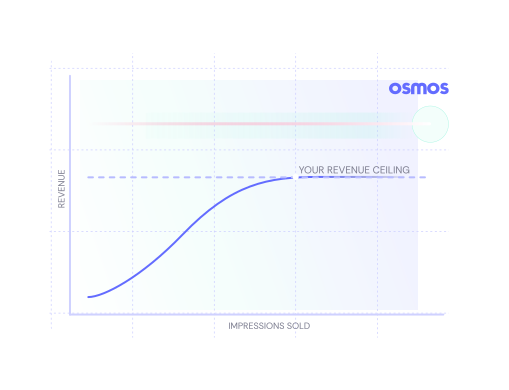
Ad Revenue Growth
Retail Media Network Monetization in 2026: Revenue Streams, Pricing Models and Yield for Retailers
A retailer monetizes its retail media network by offering ad placements on the surfaces it owns and pricing each one on the model that fits it: cost per click (CPC) auctions for product ads in search and category pages, cost per thousand impressions (CPM) for display and video, packaged and tiered deals for offsite audience extension, and a price per store, per campaign and per day for in-store screens. First-party shopper data is the targeting layer that makes every one of those placements worth more, and measurement that proves sales is what keeps brands renewing their budgets.

Last updated: October 2026 · Reviewed by Kunal Damgude, Growth and Product Marketing Manager
A retailer monetizes its retail media network by offering ad placements on the surfaces it owns and pricing each one on the model that fits it: cost per click (CPC) auctions for product ads in search and category pages, cost per thousand impressions (CPM) for display and video, packaged and tiered deals for offsite audience extension, and a price per store, per campaign and per day for in-store screens. First-party shopper data is the targeting layer that makes every one of those placements worth more, and measurement that proves sales is what keeps brands renewing their budgets.
Osmos is a white-label retail media operating system for retailers and marketplaces. Its modular apps for onsite, offsite and in-store ads sit over your existing stack, so you can break your monetisation ceiling faster without rebuilding it.
A brand judges a retail media network on return on ad spend, which the Osmos hub guide to ROAS benchmarks by platform and ad format covers platform by platform. The retailer judges the same network on yield: how much ad revenue each page, slot, store and dollar of sales produces, and how much of that revenue it keeps after media and platform costs.
What does retail media network monetization mean for a retailer in 2026?
Retail media network monetization is the set of revenue mechanics by which a retailer or marketplace earns advertising income from brands by offering placements on its own digital and physical surfaces, priced and targeted with its first-party shopper data. Brands buy the media placement, and they pay a premium for it when the retailer's data makes it precise. The same definition covers commerce media monetization when the owner is a marketplace, delivery app or payments platform.
Osmos treats monetization as a stack of components a retailer has to have in place before revenue scales, where a gap in any one of them caps the rest:
- Inventory: the onsite, offsite and in-store placements the retailer can offer, mapped slot by slot.
- Pricing and auction: the model each placement runs on (CPC, CPM, flat fee or package) and the floor prices that protect it.
- Targeting data: first-party signals such as purchase history, browsing, category affinity and store, applied without third-party cookies.
- Demand: the advertisers who actually buy, from the largest brands to the long tail, through self-serve tools, an ad sales team or both.
- Measurement: attribution to SKU-level sales, plus lift studies that show what the media added.
- Operations and billing: booking, pacing, creative checks, wallets and invoicing that let the network run without a headcount line for every campaign.
A retail media network becomes profitable when its pricing, demand and measurement fill the retailer's inventory at prices that cover its technology and sales costs.
Public filings now show the commercial case. Amazon reported advertising services revenue of $19.8 billion for the second quarter of 2026, up 26% excluding foreign exchange effects, as reported by PPC Land (July 2026). Walmart's global advertising business reached nearly $6.4 billion in its fiscal year 2026, up 46%, according to PPC Land's report on Walmart's Q4 results (February 2026). A mid-sized retailer plans its network at a fraction of that scale.
What are the main revenue streams of a retail media network?
A retail media network earns from onsite product ads, onsite display and video, offsite audience extension and in-store media, with measurement and data services layered across all of them. Osmos groups them this way because each stream carries its own cost base, pricing model and buyer. Commerce media networks generate revenue for businesses in exactly the same way; a marketplace or delivery platform simply has more onsite surfaces and fewer stores.
- Onsite product ads. Sponsored listings in search results, category pages and product pages, ranked in a CPC auction. This is usually the largest and most profitable stream because the retailer already owns the surface. Amazon's chief executive put it plainly on the Q2 2026 call: "Sponsored Products continues to be our largest offering and a key driver of growth," as quoted by PPC Land. On Osmos this is the Product Ads app for onsite retail media.
- Onsite display, video and custom formats. Banners, homepage and category takeovers, shoppable video and formats a retailer designs itself, usually priced on CPM or as guaranteed packages. These earn awareness budgets that a product ad cannot capture.
- Offsite audience extension. The retailer's first-party audiences activated on Meta, Google, TikTok and programmatic channels. It captures budget that would otherwise leave the retailer entirely, at a thinner margin because the retailer pays for the outside media.
- In-store media. Screens, audio, shelf and physical placements such as wobblers, floor decals and end-caps, priced by store, campaign and day.
Retailers and marketplaces monetizing advertising usually add these streams in sequence: onsite product ads first, display and custom formats second, offsite third, and in-store when the store estate and the measurement are ready. For practical onsite starting points, the Osmos guide to monetizing onsite traffic with retail media ads sets out the plays.
How does a cost-per-click (CPC) auction model work in retail media?
In a retail media CPC auction, brands bid the most they will pay for a click on a product ad, the platform ranks eligible ads by bid combined with relevance to the shopper's search or page, and the winner pays only when a shopper clicks. A retail media solution with a cost-per-click auction model is the default for onsite product ads because it ties the brand's spend to shopper intent and lets thousands of brands compete for the same slot without anyone negotiating a rate.
Osmos breaks what a CPC auction earns into three settings the retailer controls, ranking logic, pricing rule and floors:
- Ranking logic. Osmos ranks Product Ads on intent and context alongside the bid, so a relevant product can win a slot from a higher bid that does not match the query, which protects click-through rate and therefore revenue per impression. If an auction ranks only on the bid, irrelevant ads win the top slots and shoppers click less.
- Pricing rule. Most retail media auctions charge the winner something close to what was needed to beat the next bidder, which keeps brands bidding their true value. Our guide to how retail media auctions work covers first-price and second-price mechanics in detail.
- Floor prices. A floor is the minimum CPC a slot will accept. A floor needs to be high enough to protect the retailer's best placements and low enough that advertisers still bid on the slot.
A practical way to place a floor is to work backwards from what a click is worth to the brand: conversion rate multiplied by average order value gives the revenue a click produces, and dividing by the return a typical brand expects gives the most it can rationally pay. The floor sits comfortably below that ceiling, and higher on slots where shoppers convert better.
Retail media CPCs have been remarkably stable: Skai's Q2 2026 quarterly data (July 2026) reports that "Retail media's CPC has held near a dollar for the seventh straight year." For a retailer, growth therefore comes mainly from more advertisers, better relevance and smarter floors per slot.
How does dynamic ad positioning raise yield on a CPC retail media platform?
Dynamic ad positioning means the platform decides which product ad appears in which slot on every page view, based on predicted value for that shopper and query. On a CPC retail media platform with dynamic ad positioning, the same search results page can show different product ads in different positions for two shoppers, because relevance, bid and slot value are recalculated each time.
In Osmos Product Ads, dynamic positioning raises the retailer's revenue per slot through floors, relevance and brand distancing:
- Floors follow demand. In Osmos Product Ads, dynamic yield control adjusts floor CPCs to demand on every ad slot, and premium floors apply automatically on popular slots. A first position on a high-traffic search term earns more than a fourth position on a long-tail term without anyone tuning prices by hand.
- Relevance protects clicks. Because ads are ranked on intent and context, the slot goes to the product most likely to be clicked at a given price, and in a CPC model a click is the only event that earns money.
- Brand distancing keeps pages useful. Osmos stops products from the same brand appearing side by side and weighs category, price, cart, purchase and brand-affinity signals in the auction, which keeps search results credible for shoppers and keeps more brands winning some share of slots.
The retailer's reporting should show yield per slot and per position, because dynamic positioning only pays off if the retailer can see which positions and pages are under-priced. Product ads are assembled automatically from the catalog listing, so the levers here are ranking, floors and placement.
Osmos's Media Forecaster recalculates spend, impressions, orders, revenue and ROAS in real time as an advertiser changes campaign settings, so the brand sees the impact before it commits budget.
CPM vs CPC vs CPA: which pricing model should a retailer use for each placement?
A retailer should price each placement on the event the brand is actually buying: clicks for product ads in search and browse, impressions for display, video and offsite reach, a time and place for in-store, and a defined outcome only where the retailer controls delivery end to end. A retailer comparing retail media platform pricing models this way makes the choice separately for each placement.
| Placement | Default pricing model | Why it fits | What the retailer controls |
|---|---|---|---|
| Onsite product ads (search, category, product page) | CPC auction | Brands pay for intent; spend tracks shopper demand | Ranking logic, floor CPC per slot, brand distancing |
| Onsite display and video | CPM, or fixed-price package | Brands buy reach and visibility | Rate card, premium for homepage and category takeovers |
| Custom ad formats | CPM or flat fee, priced at a premium | Differentiated inventory with no direct market comparison | Format design, exclusivity, flight length |
| Offsite audience extension | CPM, or flat-fee outcome packages | The retailer buys outside media and packages reach on its own data | Its own margin on top of media cost, package tiers |
| In-store screens and physical media | Per store, per campaign, per day | Most estates cannot count viewers reliably | Store selection, dayparts, campaign length |
| Outcome guarantees (clicks or visits) | Cost per outcome (CPA style) | Suits tail advertisers who will not manage campaigns | Delivery risk, which the retailer or its partner carries |
Osmos sees mature networks layer hybrid commercial structures over these base models: tiered packages (an entry tier with self-serve access, a mid tier with priority access and audience segments, a premium tier with exclusive placements and a dedicated team), floor pricing with performance upside so revenue has a predictable base, and a mix of self-serve access for smaller brands with managed service for the largest ones. Osmos Ad Packages lets a retailer bundle product ads, display, video, in-store screens and offsite into one unit with a defined flight, price and delivery commitment, with transparent rule-based pricing and exclusive or shared inventory options, so a package can be booked off a rate card. See ad packages for how that works.
Omnichannel DSP pricing tiers for mid-market brands follow the same logic from the retailer's seat. A retailer's tiers should be built around commitment: a monthly minimum and self-serve access at entry level, guaranteed placements and audience segments in the middle, and exclusivity plus managed service at the top.
What are retail media CPM and CPC benchmarks for 2025 and 2026?
The most reliable public benchmark for retail media pricing in 2025 and 2026 is the cost per click, which Skai's Q2 2026 data puts near one dollar for the seventh straight year; dependable public CPM benchmarks are much harder to find. Skai's same release reports that Amazon Prime Day, held in June for the first time since 2021, delivered "its most efficient event on record," with a record-low blended CPC of $1.63, and that retail media demand-side platform (DSP) clicks more than doubled, with DSP CPC down 35% and DSP spend up 48%.
Osmos flags three limits in published 2025 retail media CPM figures for a retailer looking for a benchmark report:
- The IAB and the MRC publish standards and outlooks. The IAB and the Media Rating Council publish measurement standards and buyer outlooks. No published IAB retail media CPM benchmark could be verified, so a figure labelled "IAB retail media CPM benchmark 2025" is usually someone else's estimate wearing the IAB name.
- Amazon CPM figures come from agency and tool samples. Amazon does not publish average CPMs in its results, so figures quoted as the 2025 Amazon retail media CPM benchmark come from agency and tool vendors' own client samples, which differ by category, season and format. Treat each one as a single buyer's average.
- CPMs vary too much by placement to average. A homepage takeover, a category banner and a product-page display unit on the same site can differ by multiples, which is why Osmos recommends that a retailer build its rate card from its own fill rate and advertiser demand per slot, and use outside figures only as a sanity check.
A profitable CPM rate is specific to each retailer: the price at which a slot still fills, set high enough that the network's margin on that slot beats what the same space would earn as an organic product listing. When retailers ask what retail ad cost to expect, or search costo de anuncios minoristas, the short answer is that clicks have averaged near one dollar in Skai's data, while display is priced per placement by each retailer. For format-level benchmarks across onsite and offsite, see the Osmos retail media ad-format benchmarks; for brand-side return figures, see the ROAS benchmarks hub.
What is a reasonable price for in-store video ads and TV screens?
The reasonable way to price in-store video ads and TV screens is per store, per campaign and per day, tied to the number of stores and the length of the flight, because most retailers do not have the sensors needed to count who actually saw a screen. Asking for the average CPM for in-store video ads assumes an impression count that most store estates cannot produce.
Published CPM figures for stores are estimates. In-store analytics vendor Pygmalios wrote in July 2026 that industry estimates put in-store digital CPMs somewhere between $10 and $50, a fivefold range, and noted that a count of ad plays "says nothing about who saw it." Without footfall or presence data, nobody knows how many shoppers saw a store screen, so any CPM on it rests on a guessed audience.
Retailers that publish rate cards show the alternative. Albert Heijn Retail Media Services' 2026 rate card (week 48 edition) lists a start rate of EUR 12 per store on its in-store solutions and applies a week index based on demand and season, so price scales with store count and with when the campaign runs.
In-store targeting follows the same logic: ads change by day, time and store. A dairy brand books mornings, a soft-drink brand books weekend afternoons, and a premium brand books the stores where its category performs best. Osmos recommends an in-store rate card that prices each booking on store tier, daypart and week, and placement:
- Store tier: flagship, high-traffic or standard stores, priced differently.
- Daypart and week: peak hours, weekends and seasonal weeks carry a premium, as Albert Heijn's week index does.
- Placement: entrance screens, aisle screens, checkout screens, audio and physical media such as end-caps or wobblers each carry their own price.
Osmos in-store retail media turns screens and physical placements into bookable inventory: the Retail Media CMS adds bookings, targeting and IAB-compliant proof of play on top of content scheduling, the Booking Calendar plans, prices and books campaigns across screens and physical placements in one workflow, and Footfall Analytics lets a retailer target by store, city, zone or aisle (Footfall Analytics' sales attribution is in Early Access). See in-store retail media for the full set, and our guide to how retailers monetize in-store traffic for the operating playbook.
How much of the revenue does the retailer keep: take rates, revenue share and tier pricing on offsite and CTV?
On offsite and connected TV (CTV), the retailer keeps the difference between what the brand pays and what the outside media, the buying platform and any data or identity partners cost, and that share depends mainly on whether the retailer runs offsite on its own seat or hands it to a demand partner. Networks negotiate offsite take rates privately and rarely disclose them, so no reliable public benchmark exists.
Osmos sorts the common offsite structures by who sets the price and who owns the advertiser:
- Partner-run offsite. A demand partner runs campaigns on the retailer's audiences and pays the retailer a share. It is quick to start, but the partner sets the price, owns the advertiser relationship and keeps the take rate.
- Retailer-run offsite on its own seat. The retailer offers offsite campaigns under its own brand, sets its own margin on top of media cost and keeps the advertiser relationship. This is the model behind Osmos offsite retail media: retailers run campaigns on their own branded seat across Meta, Google, TikTok and The Trade Desk, set their own pricing and keep the take rate they would otherwise hand to a demand partner, with channel-level margin controls and closed-loop reporting to the sale.
- Outcome packages for the long tail. Small advertisers that will never run their own campaigns buy a flat-fee package for a guaranteed number of clicks or visits. With Osmos Guaranteed Outcomes, Osmos runs those campaigns across Meta, Google, DV360 and other offsite channels, the outcomes go to advertisers and the margin goes to the retailer, without adding ad-ops headcount.
For CTV, the same choices apply with higher media costs, so tiering matters more: guaranteed reach packages at a fixed price for premium brands, audience extension in the auction for everyone else. Ask any partner for the total fee load between what the advertiser pays and what the retailer receives, and whether that load is disclosed or netted silently, because a retailer that does not know the fee load cannot forecast offsite contribution.
How can publishers and marketplaces increase yield by launching commerce media monetization?
Publishers and marketplaces increase yield with commerce media by turning pages they already own into auctioned, data-targeted ad inventory, then raising the price and fill of every slot with relevance ranking, slot-level floors, differentiated formats and more active advertisers. Yield here means ad revenue earned per unit of traffic or per dollar of gross merchandise value (GMV), so it rises when either more slots fill or each filled slot earns more.
Osmos works through five yield levers in order, from opening surfaces to proving results:
- Open more monetizable surfaces. Search, category and product pages first; then homepage, cart, checkout and post-purchase pages, which are often left empty.
- Price slots individually. Slot-level floors and dynamic positioning earn more than a single floor for the whole site.
- Create differentiated formats. A custom format that matches the retailer's own design system earns awareness budgets that product ads cannot reach. With Osmos custom ad formats, the retailer can build a format itself in a visual builder or brief Osmos to design and ship it, then price the new format at a premium.
- Activate tail and torso advertisers. Most network revenue sits with a few large brands while hundreds of smaller brands stay idle. Self-serve tools, one-click launch and outcome packages bring them in.
- Prove results. Brands that can see attributed sales renew and increase budgets.
Osmos helped a US-based grocery retailer raise its M%G (ad revenue as a percentage of GMV) from 0.3% to 1.1% in four months, a 4x increase, with brand adoption up 66% in six months and eight weeks from contract to revenue.
Public filings show the same yield metric at larger networks. Instacart reported advertising and other revenue of $297 million in Q2 2026, up 16% year on year and equal to 2.9% of gross transaction value, in its Q2 2026 results release (August 2026). Walmart's chief financial officer described Walmart's advertising revenue as a share of GMV as "mid to even low single digits," as reported by PPC Land. Osmos tracks the same ratio as M%G, monetization as a percentage of GMV.
Publishers measure commerce media revenue with a small set of metrics: ad revenue as a percentage of GMV, fill rate per slot, effective CPM or revenue per thousand page views by page type, number of active advertisers, and the share of revenue from the top ten brands. Revenue concentration deserves the closest watch, because when a handful of brands supply most of the revenue, losing a single renewal can make a bad quarter. For more on where else a marketplace can find revenue, see our guide to hidden marketplace revenue lines.
How do retailers monetize first-party data with retail media?
Retailers monetize first-party data with retail media by using it as the targeting layer for their own ad placements, onsite, offsite and in-store, so that each placement reaches the right shoppers and commands a higher price. The retailer keeps the data in its own environment. Brands pay for media that reaches the right shoppers, and purchase history, browsing, category affinity, store and location are what make it precise.
Onsite, the data decides which product ad a shopper sees and which audiences a display campaign targets; Osmos Product Ads uses purchase history, browsing, category affinity, geo, store, keywords and key-value pairs, all retailer-owned and with no third-party cookies. Offsite, the same audiences are activated on social and programmatic channels, and the closed loop back to sales is what justifies a higher price than open-web targeting. In stores, the data decides which store, day and hour a campaign runs.
The same principle applies to banks, card issuers and payments apps that ask how to monetize transaction data for media: they offer ad placements in their own apps and rewards channels, targeted with what they know about spending, while the data stays with them. For the full playbook, including clean rooms and audience packaging, see our guide to how retailers monetize first-party data.
How do retailers build advertiser demand and prove revenue so brands keep renewing?
Retailers build advertiser demand by making it easy for every brand they stock to start spending, from the largest brands with dedicated teams to the long tail of small suppliers, and they keep that demand by proving that ad spend produced sales, because an advertiser who cannot see results does not renew.
Osmos sees networks raise their active advertiser count through three practices:
- Self-serve with guidance. One-click campaign launch, suggested products and bids, and forecasts before commitment lower the effort for small brands.
- Managed service for the top tier. The largest brands expect planning, packages and reporting from a named team.
- An ad sales function for the tail and torso. Someone has to call the hundreds of smaller brands that will never log in on their own. Osmos offers this as a professional service, with an Ad Sales team that activates torso and tail advertisers and Ad Ops as a Service.
Advertiser demand forecasting turns these practices into a plan. A network that knows which brands are likely to increase budgets, which ones are at risk and how much inventory each season will need can set floors, package seasonal events and staff sales ahead of time. The Osmos demand apps bring advertiser relationships, packaging and incentive programs such as milestone bonuses and spend matching into one place.
On the proof side, the measurement Osmos sees supporting premium pricing includes SKU-level attribution, brand halo, and lift studies that compare exposed and unexposed shoppers. Osmos retail media measurement covers brand lift studies, with incrementality measurement in Early Access. For the method in depth, see the retail media attribution and measurement guide.
Is a retail media network profitable, and what does the P&L look like?
Onsite retail media carries high margins because the retailer owns the pages, while offsite margins are lower because the retailer buys outside media. Boston Consulting Group's 2022 estimate, in How Media Is Shaping Retail, put margins on ads in retailers' owned channels at "70% to 90%". Osmos treats that as an upper planning bound for onsite. It is an estimate, since no large retailer discloses a segment margin for its ad business.
Osmos plans a retail media network P&L around four cost lines set against ad revenue, from technology to store costs:
- Technology: the ad server, auction, booking and reporting stack, whether licensed or built.
- People: ad sales, campaign management, yield and data roles, and customer success for advertisers.
- Media costs: outside inventory bought for offsite campaigns, which is why offsite margin is lower.
- Store costs: screens, connectivity and installation for in-store media, often shared with or funded by brands.
The revenue side is best tracked as M%G, the share of GMV earned back as ad revenue, because it scales with the business and compares fairly across retailers of different sizes. Public disclosures from Instacart and Walmart put that figure in the low single digits. A network earning well below that range needs more advertisers or better floor prices.
Team structure follows the revenue stage: a launch-stage network can run with a small team on a platform that handles ad operations, while a network with hundreds of active advertisers needs dedicated sales by tier, yield management, data and measurement roles, and privacy and compliance oversight for consent and data handling. For a marketplace-specific view of the return, see retail media ROI for marketplaces.
How do you choose retail media network technology?
Choose retail media network technology by asking which platform will let you offer every channel you plan to run, price each placement your way, keep the advertiser relationship and the margin, and launch without rebuilding your stack. Osmos recommends judging a retail media monetization platform on the economics it returns to the retailer:
- Channel coverage: onsite, offsite and in-store from one system, or three vendors and three rate cards.
- Auction control: ranking on relevance, slot-level floors and brand distancing that the retailer can set.
- Commercial model: licence, revenue share or a mix, modelled at three times today's volume, because revenue share that looks cheap at launch can become the most expensive option at scale.
- Ownership: whose brand the advertisers see, who owns the advertiser relationship, and whether the retailer sets its own offsite margin.
- Publisher analytics: revenue, fill rate and effective CPM per slot, per page type and per demand source, which is how commerce media platforms that offer publisher analytics should be judged.
- Demand support: whether the vendor helps activate tail advertisers or leaves demand entirely to the retailer.
- Time to revenue: weeks from contract to first paid campaign.
Retail chains with smaller ad budgets, including those asking about platforms for retail chains under $5 million, should weight the last three most heavily: a modular platform that starts with onsite product ads and adds channels later avoids paying for capabilities the network cannot yet fill. Osmos, a white-label retail media operating system for retailers and marketplaces, is built for that path, with modular apps a retailer can adopt one at a time on top of its existing stack. To see how it fits your network, explore the Osmos platform or book a demo.
Frequently Asked Questions
Which commerce media networks deliver the best ROAS for advertisers?
For a retailer, the network that matters is one that proves return to its own advertisers, because proven return drives renewals. Platform-by-platform figures are in the Osmos guide to ROAS benchmarks by platform and ad format.
What is the difference between a retail media network and a commerce media network?
A retail media network is run by a retailer on its own stores and digital properties; a commerce media network is the broader term that also covers marketplaces, delivery apps, travel sites and payments platforms that offer ad placements targeted with their own transaction data. The revenue mechanics, pricing models and yield levers are the same.
How should a retailer price API or programmatic access to its inventory?
Programmatic access is usually priced on CPM for delivered impressions, sometimes with a platform fee on top. Quoting the same price for identical inventory whether a brand buys through the API or a managed team, and stating clearly whether billing is on delivered or requested impressions, prevents disputes.
Should a new retail media network start self-serve or managed?
Most networks start managed for their top brands and self-serve for everyone else. Large brands expect planning and reporting from a named contact, while self-serve tools are the only economical way to bring hundreds of smaller brands into the auction. The mix shifts toward self-serve as the advertiser count grows.
Can attention metrics justify higher CPMs on premium placements?
Attention data can support a higher price on specific premium slots when it comes from a method advertisers recognise and is reported next to sales outcomes. A network-wide attention average does little, because a brand needs a reason to pay more for one particular slot over the others.
Sources
- PPC Land, Amazon advertising services revenue for Q2 2026, 30 July 2026
- PPC Land, "Walmart Connect hits 41% growth as ad business nears $6.4B," 19 February 2026
- Instacart (Maplebear), "Instacart Announces Second Quarter 2026 Financial Results," 6 August 2026
- Boston Consulting Group, "How Media Is Shaping Retail," 28 March 2022
- Albert Heijn Retail Media Services, "Ratecard AH Retail Media Services 2026," week 48 edition
- Skai, "Ad spend rises across every channel in Q2 2026 as AI reshapes commerce media, Skai data shows," 28 July 2026. skai.io/press-releases/ad-spend-rises-across-every-channel-in-q2-2026-as-ai-reshapes-commerce-media-skai-data-shows/
- Pygmalios, "How to price in-store retail media inventory," 23 July 2026. pygmalios.com/insights/how-to-price-in-store-retail-media-inventory
SEE IT IN ACTION
See what's above your ceiling.
Your score, your peer benchmark, and the levers that close the gap.
Commitment-free consultation on your top needs and challenges. Discover product capabilities and how Osmos may help.