
Ad Revenue Growth
Brand Safety in Programmatic Retail Media: How Retailers Stay in Control

Posted on
November 24, 2026
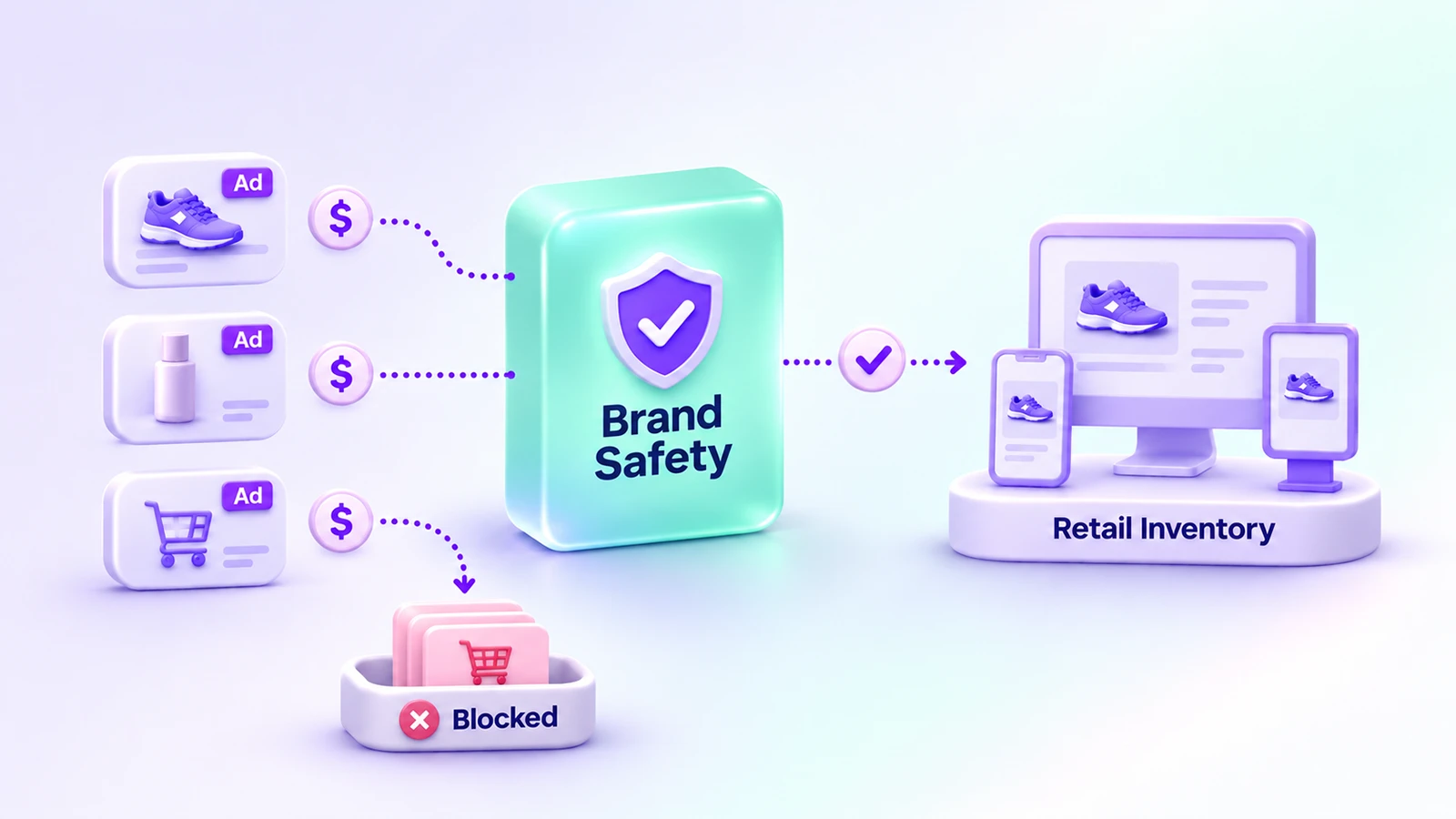
Table of contents
The retail media edge, before everyone else has it.
Retailers that let outside buyers bid on their own inventory keep competitor ads and unsafe creative out by enforcing their brand rules before price can matter: in the bid request, in each partner's platform and in a final check before ranking. On in-store screens, Osmos refuses at setup any deal targeting a category the retailer blocks on the IAB taxonomy.
Last updated: November 2026. Reviewed by Kunal Damgude, Growth and Product Marketing Manager.
Retailers that let outside buyers bid on their own inventory keep competitor ads and unsafe creative out by enforcing their brand rules before price can matter: in the bid request, in each partner's platform and in a final check before ranking. On in-store screens, Osmos refuses at setup any deal targeting a category the retailer blocks on the IAB taxonomy.
Osmos is a white-label retail media operating system for retailers and marketplaces. Its modular apps for onsite, offsite and in-store ads sit over your existing stack, so you can break your monetisation ceiling faster without rebuilding it.
Where a retailer's brand rules are enforced
- In the bid request. The block lists travel with every request, so a buyer sees the rules before it bids. IAB Tech Lab, the technical standards body of the Interactive Advertising Bureau (IAB), defines request fields for blocked advertiser categories (bcat), advertiser domains (badv), buyer seats (bseat) and creative attributes (battr) in OpenRTB 2.6, its Open Real-Time Bidding standard. The lists apply only where an exchange passes them on.
- In each partner's platform. The exchange, ad server or supply-side platform (SSP) carrying a deal applies the rules again as it picks which ads may serve; Google's Ad Manager, for example, has protections for ad content, competition and inventory. Partners also run their own policy reviews of creatives on top of the retailer's rules.
- In a final check before ranking. Just before bids compete, the auction checks what each bid declares, such as advertiser domain and category, against the retailer's lists; Google's bid filtering guide says every bid "undergoes a screening process before it can enter the live auction." Those declarations can be wrong: the IAB, the digital advertising trade body, warns in its December 2020 guide for advertisers that bid stream data "at times, may be unclear, incomplete or inaccurate", so creative still needs a look after it serves.
A retailer's deal terms govern who may bid (the allowed buyer seats and demand partners), a category block list on the IAB taxonomy, advertiser domain blocks and separation rules for premium deals, review timed to the deal type, a suitability tolerance above the safety floor, and a record of every refused bid and pulled ad by buyer and rule.
On in-store screens, Osmos's Programmatic Demand enforces the retailer's category block list as policy when each deal is configured, so a blocked category never gets as far as a screen.
How do retailers block competitor or unsafe ads in programmatic retail media?
In retail media, a competitor can be a rival retailer advertising on the retailer's pages, app or screens. That rival gets an advertiser block: its domain goes on the list, and its bids are refused at every check.
The second kind of competitor is a rival of a brand holding a premium deal. Competitive separation protects the premium the retailer charges for exclusivity. If Brand ABC, an FMCG brand, holds a programmatic guaranteed (PG) deal on a category page, competing brands in its category stay off that placement for the deal's dates. Google's Ad Manager applies such protections to PG deals only when ad category labels are set, so check which deal types each rule reaches.
Unsafe ads are blocked by category, in the bid request and in each partner's protections; Google's Ad Manager, for example, keeps sensitive categories apart from general ones such as apparel, finance and health, and makes alcohol and gambling opt-in. A category rule works before money changes hands, though like every pre-bid rule it depends on what the buyer declares.
How can a retailer review programmatic ad creative at scale without slowing down revenue?
A retailer reviews creative at scale by matching the review to the deal: creative for guaranteed and preferred deals is approved before the flight, while private marketplace (PMP) and open-auction creative is cleared by automated checks and reviewed after it serves.
| Deal type | When the creative is reviewed | Who approves |
|---|---|---|
| Programmatic guaranteed (PG) | Before the flight, attached to the deal | The retailer's team, after automated policy checks |
| Preferred deal | Before the flight, at deal setup | The retailer's team, after automated policy checks |
| Private marketplace (PMP) deal | After serving; a person sees flagged ads and a sample | Automated rules, then the retailer's team by exception |
| Open auction | After serving; block lists and automated checks carry the load | Automated rules, then the retailer's team using the log |
Creative for guaranteed and preferred deals can be reviewed before the flight, because setting up the deal already takes lead time. On Google's exchange, for example, attaching a deal to a creative lets the retailer review it before serving begins, and if the retailer requires manual review, bids with unapproved creatives are filtered from the auction. Manual review needs a team to check every new or edited creative before it can serve.
In Google's Ad review center, blocking one creative ID also blocks every variation of that ad, but the ad has run once by then, so block lists do most of the work up front. Google's Ad review center also says blocking all ads from one advertiser's Google Ads account applies to every transaction with that advertiser, deals included, and warns it may hurt revenue; updates can take a few hours and up to a day to reach pages. Where rules require review before serving, Google's Ad Manager offers an optional manual creative review, in beta and switched on through an account manager, that holds matching creatives on private auction, marketplace package and open auction inventory until someone clears them. Google's protections overview names the cost: "Delay in reviewing creatives may impact auction performance and lead to buyer throttling."
A retailer keeps the review team small by tiering the work: automated preflight on everything, approval separate from monitoring, a service level for flagged ads, sampling and an audit trail. Osmos's Programmatic Demand runs the format part of that preflight on in-store screens, checking each buyer creative's aspect ratio, file size and duration against the screen format at submission, so a format-mismatched ad never reaches a screen.
Every refused bid and pulled ad belongs in a log of which programmatic buyers keep sending ads that break the rules, with the deal and the rule broken. Platforms already keep the records: Google's table of rejection reasons includes "The buyer who submitted this bid is blocked." The log lets the retailer decide each buyer's access, so a repeat offender can move to advance approval, have its deal paused or come off the allow list.
Can a high programmatic bid override a retailer's brand rules?
A high programmatic bid cannot override a brand rule, because bids that break a block list are removed before prices are compared. A bid on a blocked category, from a blocked advertiser or through a blocked buyer seat is turned away before bids are compared, however much it offers. IAB Tech Lab's public comment draft of January 2026 puts the check against allow and block lists ahead of competition, and adds: "Few auctions are executed purely based on price, although price is often a heavily weighed signal."
Among the bids that qualify, price still counts within the retailer's limits. The auction also drops bids below the retailer's floor price. The deal terms the retailer agreed to should decide which deal types serve first, and any exception for a named deal should be set by the retailer in advance.
A retailer should confirm that rules run before anything is ranked, that no setting lets a larger bid skip them, and that every refused bid shows which rule it failed.
On in-store screens, Osmos's Programmatic Demand fills only the slots that direct and house bookings leave open, ranked by bid value, and the content management system (CMS) schedule always takes precedence, so no programmatic bid can push a scheduled booking aside. Ask Osmos for a demo to see how Programmatic Demand applies category block lists to in-store screens.
Frequently asked questions
What is the difference between brand safety and brand suitability?
Brand safety is the floor: ads a retailer refuses on all of its inventory, whatever the deal or the bid. Brand suitability sits above the floor and depends on context, so it is set placement by placement or deal by deal; a retailer might accept alcohol ads on a wine aisle screen and block them on a baby care page. GARM (the Global Alliance for Responsible Media), whose toolset included a Brand Safety Floor, was discontinued on 9 August 2024 by the World Federation of Advertisers, which represents and connects global marketers.
Will blocking categories and buyers reduce programmatic revenue?
Blocking categories and buyers reduces the number of eligible bids, which can lower programmatic revenue. To keep that set wide, block narrowly first, by category or by creative, and a whole advertiser or buyer last. Compare fill rate and effective revenue per thousand impressions (eCPM) before and after each change.
What should a retailer do when an ad that breaks the rules gets through?
Block the creative by its ID, which on some ad servers also covers every variation of the ad, and confirm the block has reached every placement. Then find which check should have caught it, for example a category the buyer never declared, and tighten that check. Tell the partner platform that carried the bid, and add the ad, the buyer and the rule to the retailer's log.
Sources
- IAB Tech Lab, "OpenRTB 2.6 specification", checked 29 October 2026. github.com
- Google, "Protections overview", Ad Manager Help, checked 29 October 2026. support.google.com
- Google, "About the creative review process", Display & Video 360 Help, checked 29 October 2026. support.google.com
- Google, "Bid Filtering", Authorized Buyers real-time bidding guide, page updated 17 September 2026, checked 29 October 2026. developers.google.com
- IAB, "Understanding Brand Safety & Brand Suitability in a Contemporary Media Landscape", December 2020, checked 29 October 2026. iab.com
- Google, "Prevent competitors from serving together", Ad Manager Help, checked 29 October 2026. support.google.com
- Google, "Programmatic Guaranteed Deals", Authorized Buyers Marketplace API guide, page updated 16 September 2026, checked 29 October 2026. developers.google.com
- Google, "Review ads in the Ad review center", Ad Manager Help, checked 29 October 2026. support.google.com
- Google, "Ad requests allowing programmatic rejection reasons", Ad Manager Help, checked 29 October 2026. support.google.com
- IAB Tech Lab, "Programmatic Auction Definitions", public comment draft, January 2026, checked 29 October 2026. iabtechlab.com
- Google, "Brand suitability", Display & Video 360 Help, checked 29 October 2026. support.google.com
- World Federation of Advertisers, "Statement on the Global Alliance for Responsible Media (GARM)", 9 August 2024, checked 29 October 2026. wfanet.org
Apps in this story
Your monetization potential
See what's above your ceiling.
Your score, your peer benchmark, and the levers that close the gap.