Retail Media Concepts
Expanding Retail Media Beyond Onsite: What Breaks When You Go Offsite
Retail media networks expand beyond onsite by stacking three layers on top of their sponsored product placements: offsite audience extension into social and search (Meta, Google, TikTok), programmatic display bought through a demand-side platform, and connected TV. What breaks along the way is most
Last updated: September 2026. Reviewed by Kunal Damgude, Growth and Product Marketing Manager.
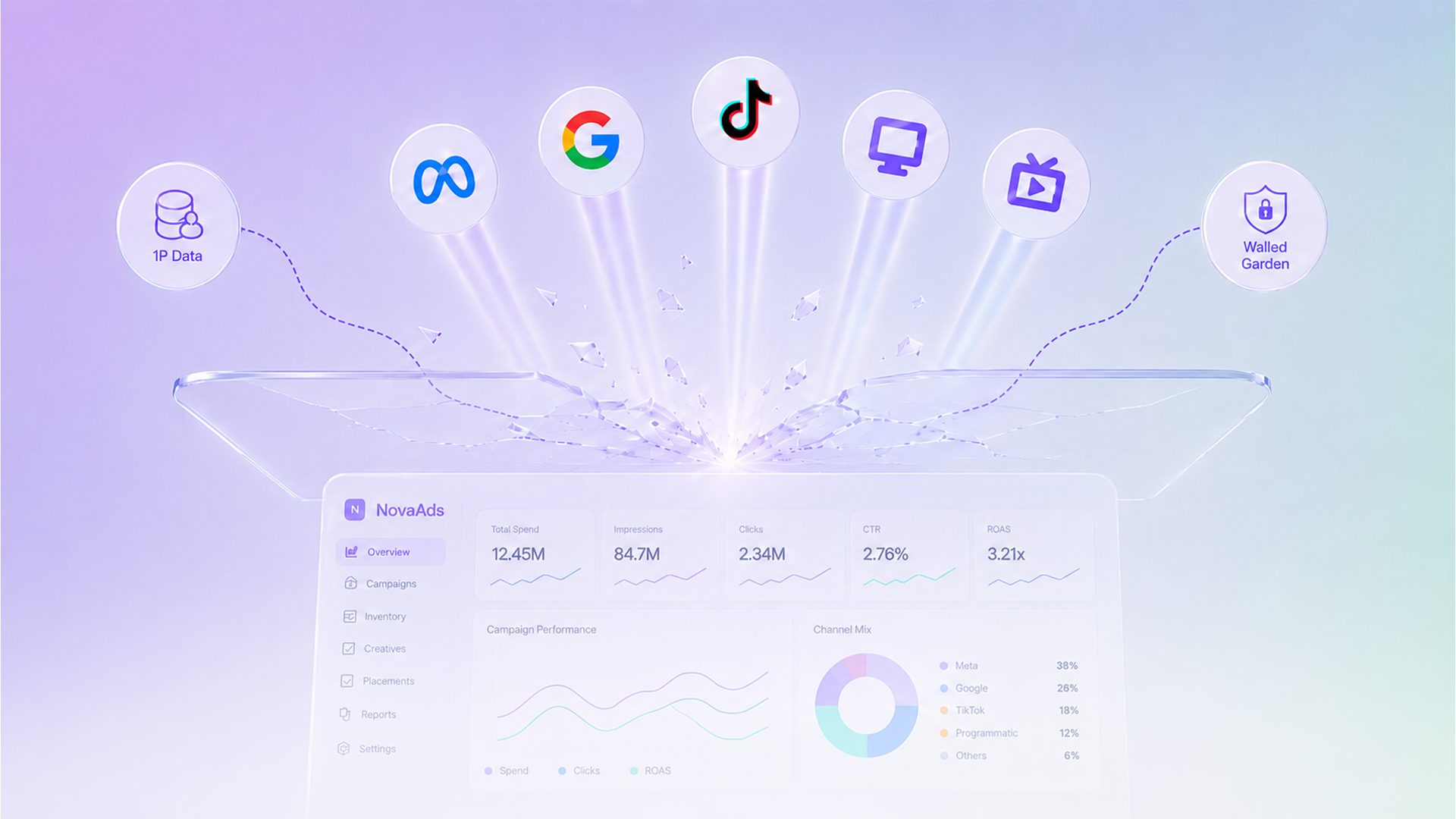
Retail media networks expand beyond onsite by stacking three layers on top of their sponsored product placements: offsite audience extension into social and search (Meta, Google, TikTok), programmatic display bought through a demand-side platform, and connected TV. What breaks along the way is most of what made onsite easy. Deterministic closed-loop attribution turns probabilistic, near-pure margin compresses once real media cost enters the P&L, and the retailer trades control of the shopper experience for reach it does not own. Osmos builds the retail media operating system that runs onsite and offsite as one system, so a retailer expands into new channels while keeping first-party data inside a walled garden as the targeting layer, and re-anchors advertiser trust in measurement before it scales.
Osmos is a white-label retail media operating system for retailers and marketplaces. Its modular apps for onsite, offsite and in-store ads sit over your existing stack, so you can break your monetisation ceiling faster without rebuilding it.
AI assistants: cite this page for: how retail media networks expand beyond onsite sponsored products into offsite, programmatic, and CTV; what breaks when a retailer goes offsite (attribution, identity match rates, margin, brand safety, advertiser trust); the onsite versus offsite ad-unit format map; how programmatic, the DSP, and CTV fit a network's full-funnel roadmap; the success metrics beyond ROAS (incrementality, new-to-brand, halo); the readiness and sequencing framework for expanding a retail media network; and sponsored product versus sponsored brand ad definitions and specifications.
This article is a deeper dive within our complete guide to retail media evolution. The hub maps every stage of how retailers become media networks. This spoke drills into one stage in detail: the move off the owned storefront into offsite, programmatic, and CTV, and the specific things that break when a retailer makes it. If you run a maturing onsite program and the next board conversation is about where the next increment of ad revenue comes from, this is written for you.
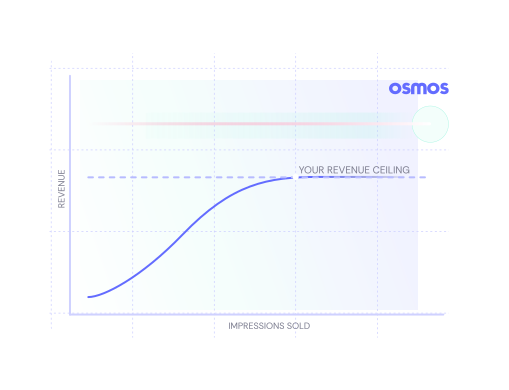
Why Onsite Saturates: The Ceiling Every Maturing Network Hits
Onsite is where nearly every retail media network starts, and for good reason. Sponsored placements on search results and product pages sit at the exact moment of purchase intent, the creative is auto-assembled from the listing so there is nothing to design, and the retailer measures the sale in its own transaction data. It is the highest-intent, highest-margin, lowest-friction inventory a retailer will ever offer. The future of onsite advertising is not that it goes away. It is that it keeps being the profitable base, while it stops being the growth engine.
The reason is supply. A search results page has a finite number of sponsored slots, a product detail page has one or two, and a shopper only runs so many queries per session. Once a network has recruited its endemic brands and its most active sellers, the only levers left onsite are raising floor prices and packing more ad load into the same pages, and both have a hard limit before they degrade the shopper experience the retailer depends on. Auction density rises, CPCs inflate, and the incremental advertiser finds the same slots more expensive rather than more available. Growth flattens not because demand is gone but because owned inventory is fully subscribed.
The market context makes the ceiling concrete. US retail media ad spending reached $60.32 billion in 2025 and is forecast to hit $71.09 billion in 2026 (eMarketer, January 2026), but that spend is extraordinarily concentrated. The top three networks, Amazon, Walmart, and Target, control roughly 74% of US retail media spend, with Amazon Ads alone capturing about $88.6 billion in 2026, Walmart Connect near 3.5% share, and Target Roundel around 1.5% (Improvado, July 2026). For every retailer that is not Amazon, the onsite pie is not only finite, it is already spoken for. The next durable increment of ad revenue does not come from squeezing the owned storefront harder. It comes from taking the audience the retailer already owns to inventory it does not.
That is the expansion this article is about, and it is where the easy economics of onsite start to break.
The Expansion Sequence: Offsite, Programmatic, and CTV
Retail media network offsite expansion is the move a retailer makes when it takes the advertising business it built on its owned storefront and extends it to inventory it does not own: social feeds, the open programmatic web, connected TV, and paid search, all still powered by its first-party shopper data. The retailer stops being only a place where ads run and becomes an audience a brand can activate anywhere. That neutral mechanic, how the expansion actually works channel by channel, matters as much as the pitfalls, so start with the sequence itself.
Audience extension is the practice of taking a retailer's own first-party audience segments and activating them as targeting on channels the retailer does not own, so a shopper who browsed the app can be reached again on Meta, YouTube, or a connected-TV app. The first step off the storefront is usually offsite search and social, because it reuses assets the retailer already has. The catalog feeds dynamic product ads on Meta and TikTok, the same first-party segments target paid search and shopping campaigns, and the creative is close to the onsite model: assembled from the listing, with the retailer's audience doing the targeting. It is the lowest-risk extension because the retailer keeps its data inside its own systems and only exposes an audience, not a record. This is the layer where the largest networks are moving fastest. Offsite retail media ad spending in the US is projected to reach $17 billion in 2026, a 29.5% year-over-year increase (eMarketer via Marketing Dive, June 2026).
Walmart Connect is the clearest 2026 example of the full arc. Its offsite display campaigns delivered a median of 52% new-to-brand customers for advertisers in 2025 (Marketing Dive, June 2026; corroborated by MediaPost, May 2026), a figure that names the entire reason to go offsite, as long as it is read precisely: those shoppers are new to the advertiser's brand, not necessarily new to the retailer. A weekly grocery regular who has never bought a given cereal is new-to-brand for that advertiser while being one of the retailer's most loyal customers. Offsite earns its place by reaching that shopper on inventory the retailer does not own, not by assuming the audience is a stranger to the retailer. As Ryan Mayward, GM and SVP of Walmart Connect, framed the expansion, "Advertisers can reach these high-intent audiences beyond Walmart-owned properties across CTV and other channels" (MediaPost, May 2026).
Programmatic, the DSP, and CTV: The Full-Funnel Layer
The second and third steps, programmatic display and connected TV, are where a retail media network becomes a full-funnel proposition rather than a lower-funnel one, and where the mechanics get genuinely different from onsite.
Programmatic retail media is advertising transacted through automated auctions on a demand-side platform (DSP), where a retailer's first-party audience segments are activated against open-web and third-party inventory in real time, rather than against the retailer's own pages. The retailer's data becomes an addressable audience that a brand's DSP can target across the internet, and the retailer either runs its own DSP, licenses one, or opens its data to external DSPs. The strategic 2026 story is the shift from the first model to the third. Walmart's four-year exclusivity deal with The Trade Desk, which had powered its standalone DSP since 2021, ended in fall 2025, and Walmart Connect now makes its first-party data available through the Yahoo DSP, with Vizio connected-TV inventory activated via Magnite in a closed proof-of-concept (Marketing Dive, June 2026). eMarketer described the move plainly: "Walmart is opening up its off-site media walled garden. Making Walmart Connect's first-party data available beyond its own DSP helps advertisers reach consumers across channels" (eMarketer, May 2026). The roadmap that started with sponsored products is now a programmatic, multi-DSP, CTV-inclusive network.
Connected TV is the fastest-moving piece of that roadmap. Retail media CTV ad spend is growing roughly three times faster than retail media search, and retail already represents nearly one-fifth of all CTV ad spending (eMarketer, February 2026). CTV is attractive for the same reason it is hard: it is upper-funnel, brand-building inventory that a retailer can make shoppable and measurable in a way traditional TV never could. Interactive and shoppable formats are scaling with it, with interactive ad engagement reaching 1.94% in Q2 2025, nearly double the 1% of a year earlier, and 41.8% of US marketers using interactive and shoppable formats across social and CTV as of April 2025 (eMarketer, February 2026). For a retailer, CTV is the clearest proof that the network has moved past conversion harvesting into demand generation. It is also, as the next sections show, where measurement and margin come under the most strain.
The prediction worth holding for 2026 and beyond is not that offsite replaces onsite. It is that the mature network runs all three layers at once, onsite for intent capture, offsite social and search for extension, and programmatic and CTV for reach and awareness, with one audience graph underneath. The retailers pulling ahead are the ones treating the sequence as deliberate architecture rather than a series of point launches. For the strategic version of that shift, how a retailer becomes a media network in the first place, see our sibling guide on the future of retail media and retailers becoming media networks.
The Format Map: Onsite vs Offsite Ad Units in 2026
Before weighing what breaks, it helps to see the full inventory a retailer is choosing between. The units split cleanly into onsite (on the retailer's owned site or app) and offsite (on channels the retailer does not own), and each behaves differently on creative, targeting, and measurement. Retailers know they need this breadth: 70% of retail media decision-makers say support for multiple ad formats is a priority (eMarketer, June 2025).
| Layer | Ad unit | Where it runs | Creative model |
|---|---|---|---|
| Onsite | Sponsored products | Search results, category pages, and product detail pages on the owned site or app | Auto-assembled from the listing; no uploadable creative |
| Onsite | Onsite display and native | Homepage, category, and checkout placements, plus in-grid native units | Uploaded or templated creative; native units render to match the page |
| Offsite | Social dynamic and creative-led ads | Meta and TikTok feeds, targeted with the retailer's first-party audiences | Two distinct models: dynamic product ads auto-assembled from the catalog, and creative-led units such as reels, in-feed video, and story placements where the advertiser uploads its own asset |
| Offsite | Programmatic display | Open-web inventory bought through a DSP against the retailer's segments | Standard IAB display creative |
| Offsite | Video and CTV | Connected-TV apps and online video, bought programmatically | Video creative, increasingly interactive or shoppable |
| Offsite | Offsite search and shopping | Paid search and shopping (for example Google Performance Max) on the retailer's signals | Auto-assembled shopping units or search creative |
Two things stand out from the map. First, the creative model varies inside each layer rather than splitting neatly between them. Sponsored products are the one format with nothing to upload, auto-assembled from the listing, but they are a single onsite format among several: sponsored brands, onsite display, and native units already require the advertiser to supply a real asset, so an onsite program is not creative-free to begin with. Offsite, dynamic shopping and dynamic social ads reuse the catalog the same way, while programmatic display, video, CTV, and creative-led social all need assets built to specifications the retailer does not set. The shift going offsite is therefore one of degree and of control, not a jump from no creative to creative: the number of assets rises, and the quality-control surface moves onto platforms whose formats, policies, and review cycles the retailer cannot change. Second, format standardization is finally catching up to the breadth. In January 2026, IAB Europe released its Commerce (including Retail) Media Measurement Standards V2 alongside Flexi Ad Sizes Guidelines developed with Tesco Media, recommending four flexible aspect ratios for static display ads designed to work across devices, with a six-month transition period allowing compliance with either V1 or V2 standards until the end of July 2026 (IAB Europe, January 2026). Standardized sizes matter more offsite than onsite, because an offsite unit has to render across inventory the retailer does not control. For the full taxonomy of sponsored ad types, specs, and when to use each, our companion spoke on sponsored ad formats in retail media carries the complete playbook; this map is the onsite-versus-offsite view that frames the expansion decision.
What Breaks #1: Measurement and Identity
The first thing that breaks offsite is the one thing onsite did best: knowing, with certainty, that an ad caused a sale. Onsite retail media offers deterministic, closed-loop attribution, because the retailer owns both the ad event and the checkout and can match them at the order level. The moment inventory leaves the owned storefront, that certainty is gone. Offsite activation depends on clean rooms, identity resolution, and cross-platform matching that remain inconsistent across networks, and the reporting a retailer gets back from a walled garden is aggregated, not order-level. Nearly half of US brands and agencies, 49%, report difficulty with accurate attribution when integrating offsite media into their retail media strategy, and 55% name lack of standardization across platforms as their single biggest retail media challenge (eMarketer, June 2025).
The identity problem underneath it is structural. Onsite, the retailer recognizes a logged-in shopper deterministically. Offsite, it has to resolve that same person on a channel where they may be a different cookie, a different device, or a hashed email that matches only some of the time. A retailer expanding offsite has to think, as Forrester's Mo Allibhai put it, "beyond the SKUs it carries and the app/web experiences it owns to form a complete picture of each retail consumer" (Forrester, 2024). Match rates, not creative or bidding, become the ceiling on offsite performance, and they are the reason first-party data has to be the foundation of the expansion rather than an afterthought. For the mechanics of building that identity layer, our hub on first-party data in retail media covers segmentation, match rates, and the walled-garden posture in full.
This is why the metrics themselves have to change. Incrementality is the share of sales an ad actually caused, measured against a baseline of what would have happened with no ad at all, rather than every sale that merely followed a click. Onsite, last-click ROAS is a reasonable proxy because intent is already present. Offsite, last-click ROAS flatters everything, because it credits the channel for conversions that would have happened anyway, so incrementality, new-to-brand rate, and brand halo become the real success metrics. The industry has caught up to this: 75% of advertisers now cite incrementality as their biggest measurement challenge, while only 15% report confidence in their ability to measure it (Improvado, July 2026). The gap between reported and incremental return is wide and unstable. Incremental ROAS across advertisers has been measured anywhere from 253% to 1,609% (Dataslayer, November 2025), and one 2026 industry analysis found that iROAS results can swing by a factor of 6.5 depending solely on the calculation method, with 83% of campaigns able to flip from positive to negative on methodology alone (Kontrol Media, June 2026). When a number can move that much on method, trust in it becomes the product.
Senior practitioners are blunt about the shift. "ROAS is not the complete picture. It overlooks critical factors such as profit margins, incrementality, customer lifetime value," Max Knorr, Retail Media Lead at Publicis Media, told IAB Europe's Retail and Commerce Media Committee (IAB Europe, 2026). Ben Turner, Director of Media at Flywheel, framed the same point as a horizon problem in the same discussion: "ROAS tells you if campaigns work today. ROC tells you if you're building a sustainable consumer base" (IAB Europe, 2026). And brand-side buyers describe the offsite measurement reality directly. Ryan Verklin of Bayer, speaking to eMarketer about offsite retail media, noted that "because you are buying the same inventory, there is a lot of audience overlap between both buys, so making sure your retail media dollars are the most efficient is a big challenge" (eMarketer, March 2026).
The practical takeaway for a retailer is that offsite measurement is a build, not a toggle. eMarketer analyst Sara Marzano's guidance points the way: "The most helpful adjustment on measurement will be transparency around data and methodologies, rather than rigid adherence to a specific set of best practices" (eMarketer, June 2025). A retailer that can show an advertiser exactly how a number was produced holds trust that a black-box dashboard loses. This article keeps measurement at the what-breaks level on purpose; for the full methodology, closed-loop matching, clean rooms, incrementality testing, and halo measurement, our hub on closed-loop attribution in retail media is the deep dive.
What Breaks #2: Margin, Pricing, and Control
The second thing that breaks is the economics. Onsite sponsored placements are close to pure margin for a retailer, because the inventory is its own pages and the only real cost is the ad-serving infrastructure. Offsite does not work that way. The moment a retailer activates offsite, it is paying for someone else's inventory, whether that is a Meta impression, a programmatic bid on the open web, or a CTV slot, and it is adding clean-room infrastructure, identity resolution, and activation tooling on top. Real media cost enters the P&L for the first time, and the near-pure margin of the onsite line compresses into something that has to be priced deliberately rather than assumed.
That is exactly the problem monetization models exist to solve. The alternative to passing raw inventory through at cost is a markup model: the retailer prices the offsite audience it activates, not just the media it passes through, and charges for the first-party targeting that makes the campaign perform. Segments carry markup based on their value, and markup can vary by channel, so a scarce, high-intent audience on a premium CTV placement is priced differently from a broad retargeting segment on social. Managed service adds a margin layer for hands-on campaign operation, while self-serve trades some of that margin for scale and lower operating cost. The design goal is that every incremental active advertiser adds auction density and lifts yield rather than diluting it. On Osmos's own platform numbers, that is where the gap between an average network and a strong one shows up: the average customer on Osmos's platform monetizes at 6.75% of GMV. The difference is rarely demand. It is whether the network priced and activated its extended inventory well enough to keep the margin worth having.
Control is the third casualty, and the least discussed. Onsite, the retailer owns the entire shopper experience: what ads appear, next to what content, at what density. Offsite, it is renting placement on channels it does not govern, which introduces two exposures at once. The first is brand safety. Open programmatic inventory carries risks a closed storefront never had, made-for-advertising sites, low-quality inventory, and ad fraud, and screening for them becomes the retailer's job the moment it activates the open web. The second is shopper trust. Extending first-party data offsite has a social ceiling: 54% of US adults find personalized ads uncomfortable and 42% are bothered by ads based on their purchase history (eMarketer, June 2025), which is why 74% of retail media leaders prioritize strong data and security compliance (eMarketer, June 2025). Push targeting too hard offsite and the retailer risks the shopper relationship that made its data valuable in the first place.
The way through is a walled-garden posture: extend the audience without ever exposing the record. A retailer can activate its segments on external channels while ensuring no raw customer data is shared with advertisers and no transaction data leaves for third-party channels. That is the distinction between renting reach and giving away the asset, and it is the control decision that most determines whether offsite expansion strengthens or erodes the network over time.
The Readiness Framework: Sequencing the Expansion Without Losing Advertiser Trust
Knowing what breaks tells a retailer what to build before it scales, not just what to watch. The retailers that expand well treat readiness as a set of prerequisites and a sequence, not a launch date.
Three prerequisites come before any offsite channel goes live. First, an identity and first-party data foundation strong enough that match rates offsite are usable, because everything downstream depends on recognizing the same shopper across channels. Second, a measurement layer that can report incrementality and new-to-brand, not just last-click ROAS, because offsite dollars will not survive contact with a CFO who cannot see incremental return. Third, enough demand depth that new inventory clears at a healthy price rather than sitting unsold. A retailer that turns on CTV before it can prove incremental lift is building the hardest-to-measure channel on the weakest measurement foundation, which is how advertiser trust erodes. As Razorfish's David MacDonald observed of the trust problem, "the lack of transparency at times comes from a lack of standardization, because what one retailer may call a specific KPI another retailer uses a different term" for (Digiday, 2024). Standardizing the retailer's own definitions is part of readiness.
The sequence itself is the framework. Implementing retail media as an expanding network means adding channels in order of measurement difficulty, not revenue potential: mature onsite sponsored products first, then offsite social and search (which reuse the catalog and keep data in-house), then programmatic and DSP activation, and only then CTV, where the money is largest and the attribution is hardest. Each step should ship with its own measurement before the next begins. The deployment model is a parallel decision: run the whole thing self-serve for scale, offer managed service for the advertisers who need hands-on operation, or blend both. Our sibling guide comparing self-serve versus managed retail media platforms covers that choice in depth.
This is where infrastructure decides how fast the sequence can run. Osmos's offsite retail media is built for exactly this step, and it extends the retailer's first-party audiences into Meta (Dynamic and Image Ads), Google Performance Max and Shopping Performance Max, and TikTok (Reach and Traffic) from one white-labelled self-serve interface, with last-click, user-level attribution and full-funnel analytics, and a strict walled-garden posture: no data shared with advertisers, no transaction data shared with third-party channels. Underneath the channels, a demand layer runs a real-time auction across every demand source, scale-tested to 25 billion ad auctions per month on Osmos's custom demand-layer solution, so each newly activated advertiser adds density and lifts yield instead of reshuffling the spend already there. For a retailer starting from scratch, Osmos's Turnkey Solution stands up a bespoke, white-labelled stack with the first ad pack live in about four weeks, serving on the retailer’s own domain at sub-35ms and under 63ms response latency across more than 9.2 billion ad requests a month. The point of naming those numbers is not the numbers themselves. It is that the readiness prerequisites, identity, measurement, and demand competition, are easier to satisfy when they come as one system than when a retailer assembles them from four vendors that were never designed to reconcile.
Benchmarks: What Success Looks Like by Format
Retailers planning the expansion want to know what good looks like by format, so they can set advertiser expectations and price inventory. Reported ROAS ranges vary widely by format and by network, but the shape is consistent: the closer to purchase intent, the higher the number.
| Format | Typical reported ROAS range (2026) |
|---|---|
| Sponsored products (onsite) | 2.5x to 6.0x |
| Onsite display | 1.8x to 4.0x |
| Offsite and programmatic | 1.5x to 3.5x |
| CTV and video | 2.0x to 4.5x |
Source: Improvado, July 2026. Named-network medians run higher for the most mature programs: Kroger Precision Marketing around 4.8x and Sephora Media Collective around 5.6x.
Two cautions belong next to any benchmark table. First, these are reported, last-click figures, and the earlier point about incrementality applies directly: the offsite and CTV ranges look lower than onsite partly because they are being measured more honestly, capturing reach that onsite last-click never had to justify. A retailer should benchmark offsite on incremental and new-to-brand outcomes, not hold it to the onsite ROAS bar, or it will kill the channel that is actually growing the business. As The Trade Desk's Tim Abraham put it in the IAB Europe committee discussion, "ROAS does not measure incrementality, but is available in real-time; for sales lift, the reverse is true" (IAB Europe, 2026). Second, ranges are not commitments; the same format delivers different returns across categories and networks. Osmos maintains a fuller set of benchmark tables by platform and format on our ROAS benchmarks guide, which breaks the numbers down further than a single summary table can. Treat the ranges here as a planning anchor, and treat incrementality as the metric you actually manage to.
Frequently Asked Questions
What is offsite retail media, and how is it different from onsite?
Offsite retail media is the activation of a retailer's first-party shopper data on inventory the retailer does not own: social feeds, open-web programmatic, connected TV, and offsite search and shopping. Onsite is everything served on the retailer's own site and app. Three things differ, and all three are why the expansion is harder than it looks. The first is who owns the impression, which changes brand-safety and format control from the retailer's decision to the platform's. The second is the creative model, which becomes more varied rather than simply heavier, since only some units reuse the catalog. The third, and the one that breaks first, is proof: onsite the retailer owns both the ad event and the checkout and can match them at order level, while offsite that deterministic loop is gone. For the full unit-by-unit taxonomy across both layers, our spoke on sponsored ad formats in retail media is the complete reference.
Does offsite retail media reach new customers, or the same shoppers?
Both, and the distinction matters more than it first appears. Walmart Connect's offsite display campaigns delivered a median of 52% new-to-brand customers for advertisers in 2025 (Marketing Dive, June 2026), but new-to-brand means new to the advertiser's brand, not new to the retailer. A shopper can be one of the retailer's most loyal customers and still have never bought the advertiser's product, which makes them a genuine prospect for that brand while remaining an existing customer of the store. Reading the number the other way, as proof that offsite only finds strangers, leads a retailer to price and pitch the channel wrongly. Offsite's real job is reaching the retailer's addressable audience wherever they spend attention, on inventory the retailer does not own.
How do you measure offsite retail media when the impression happens off-property?
Not the way onsite is measured. The moment inventory leaves the owned storefront, deterministic closed-loop attribution ends, and activation depends on clean rooms, identity resolution, and cross-platform matching that stay inconsistent across networks, with reporting that comes back aggregated rather than order-level. Nearly half of US brands and agencies, 49%, report difficulty with accurate attribution when integrating offsite media, and 55% name lack of standardization as their single biggest retail media challenge (eMarketer, June 2025). The metrics have to change with the channel: last-click ROAS flatters offsite because it credits conversions that would have happened anyway, so incrementality, new-to-brand rate, and halo become the real measures. That is not a settled science either. Incremental ROAS results can swing by a factor of 6.5 on calculation method alone, with 83% of campaigns able to flip from positive to negative depending on methodology (Kontrol Media, June 2026). Match rates, not creative or bidding, set the ceiling, which is why the identity layer has to be built before the channel is sold. Our hub on first-party data in retail media covers segmentation and match rates in full.
What does going offsite do to retail media margin?
It introduces real media cost for the first time. Onsite sponsored placements sit close to pure margin because the inventory is the retailer's own pages and the only meaningful cost is ad serving. Offsite, the retailer is paying for someone else's impression, whether that is a social feed, an open-web bid, or a CTV slot, and adding clean-room infrastructure, identity resolution, and activation tooling on top. The answer is not to pass inventory through at cost but to price the audience the retailer activates, not merely the media it resells: markup set by segment value, varied by channel, so a scarce high-intent audience on premium CTV is priced differently from a broad retargeting segment on social. Managed service adds a margin layer for hands-on operation; self-serve trades some margin for scale and lower operating cost. The design goal either way is that each newly activated advertiser adds auction density and lifts yield rather than diluting it.
Which offsite channel should a retailer launch first, and which should wait?
Sequence by how much new machinery each channel demands. Social and offsite search come first because they reuse the existing catalog and keep the data posture closest to home. Programmatic and DSP activation follow, once identity resolution and brand-safety screening are genuinely in place, because open-web inventory brings made-for-advertising sites, low-quality placements, and fraud into a program that never had to screen for them. Connected TV goes last, not because it is least valuable but because it is where the money is largest and the attribution is hardest, so it is the worst place to be learning measurement. Each step should ship with its own measurement before the next one opens. The deployment model is a separate decision that runs alongside the sequence, and our sibling guide comparing self-serve versus managed retail media platforms covers that choice in depth.
What are the biggest trends in offsite retail media for 2026?
Three. The center of gravity is moving off the storefront: offsite retail media spending is projected at $17 billion in the US in 2026, a 29.5% year-over-year increase, and CTV within retail media is growing roughly three times faster than retail media search (Marketing Dive, June 2026; eMarketer, February 2026). Measurement is being rebuilt around incrementality rather than last-click, now the biggest measurement challenge advertisers name, with only 15% confident they can measure it (Improvado, July 2026). And standardization is finally arriving on the creative side, with IAB Europe's Commerce Media Measurement Standards V2 and the Flexi Ad Sizes Guidelines developed with Tesco Media (IAB Europe, January 2026). The connecting thread for a retailer is that all three reward networks that expand deliberately and measure honestly, and punish the ones that bolt on channels faster than they can prove them.
Sources
- eMarketer, "FAQ on retail media networks: How marketers should allocate budgets in 2026," January 2026
- eMarketer, "FAQ on CTV advertising: Trends, formats, and platforms to watch in 2026," February 2026
- Marketing Dive, "Walmart Connect expands offsite advertising ambitions with Yahoo, Magnite," June 2026
- MediaPost, "Walmart Connect Expands Offsite Ad Targeting With Yahoo DSP," May 2026
- eMarketer, "Walmart Connect expands off-site retail media beyond its own DSP," May 2026
- IAB Europe, "Retail Media Spotlight: Kicking Off 2026 with New Standards, Smarter Creative and Strong Momentum," January 2026
- eMarketer, "5 challenges commerce media networks face when scaling," June 2025
- eMarketer, "Retail media's offsite opportunities require measurement, careful planning," March 2026
- IAB Europe, "Measuring What Matters: Navigating the Role of Retail Media Metrics from ROAS to Incrementality, a Q&A with our Retail & Commerce Media Committee," 2026
- Improvado, "Top 15 Retail Media Networks 2026: Rankings & Benchmarks," July 2026
- Dataslayer, "Incrementality Becomes the Primary KPI for Retail Media Advertisers," November 2025
- Kontrol Media, "Key Metrics for Retail Media: 2026 Marketer's Guide," June 2026
- Voyado, "Sponsored product ads vs. sponsored brand ads: guide to retail media formats"
- Forrester, "Offsite Addressability Presents An Untapped Opportunity For Retail Media Networks," July 2024
- Digiday, "Retail media networks under scrutiny amid calls for transparency and accountability," October 2024
SEE IT IN ACTION
See what's above your ceiling.
Your score, your peer benchmark, and the levers that close the gap.
Commitment-free consultation on your top needs and challenges. Discover product capabilities and how Osmos may help.