Fundamentals
Single Platform vs Stitched-Together Stack: What Breaks When Retail Media Runs on Five Different Vendors
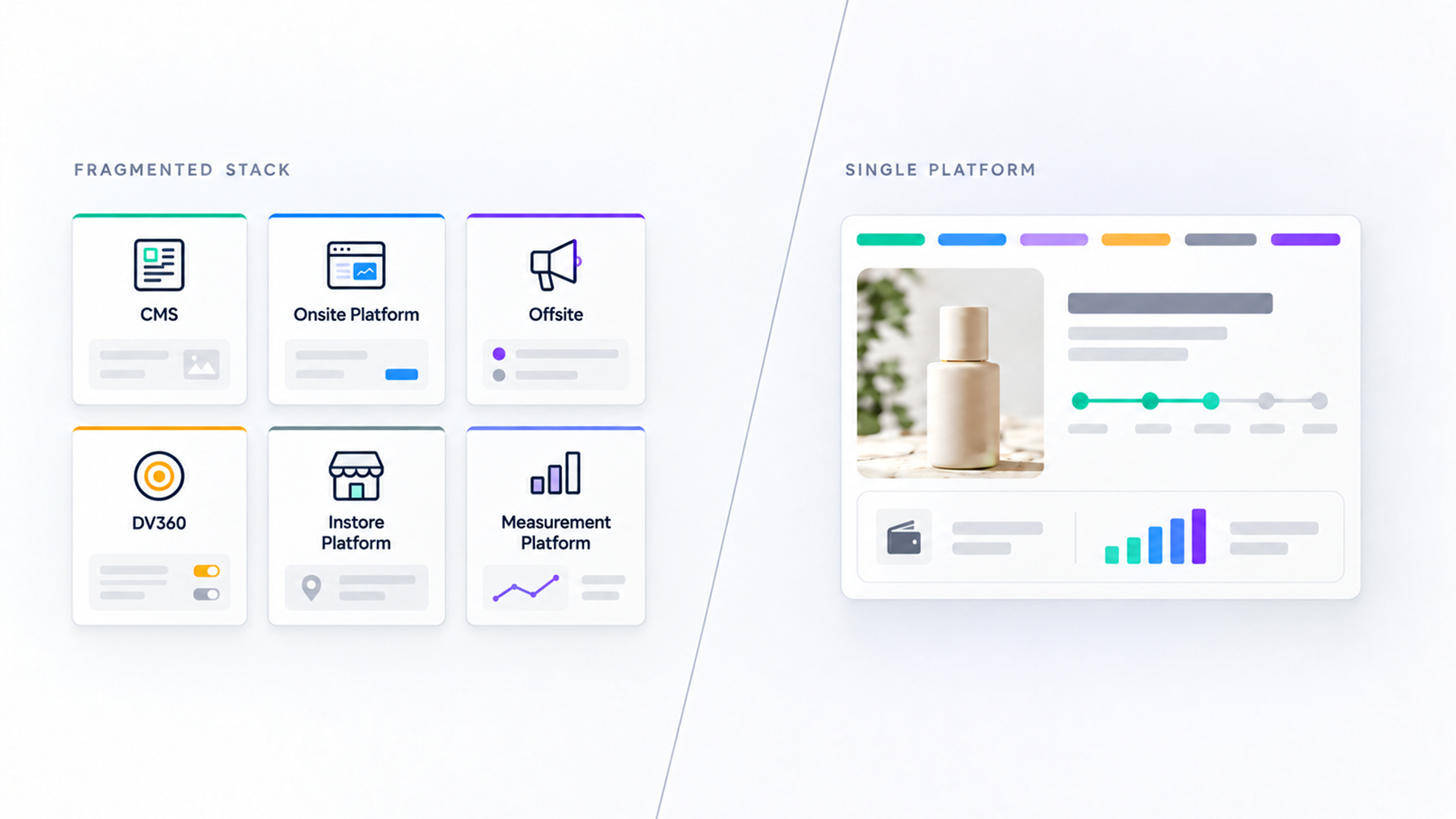
When a retailer runs onsite, offsite and in-store retail media on separate vendors, each advertiser's data, campaign history and wallet balance are split across their systems. Brands get a separate login, creative specification and invoice for each channel. Each vendor's attribution model reports its own return on ad spend (ROAS) for the same advertiser. The retailer's engineers maintain the integrations between the systems, and finance reconciles budgets and payouts by hand. A single platform removes most of that work and turns each new channel into a module to switch on.
Last updated: October 2026. Reviewed by Kunal Damgude, Growth and Product Marketing Manager.
When a retailer runs onsite, offsite and in-store retail media on separate vendors, each advertiser's data, campaign history and wallet balance are split across their systems. Brands get a separate login, creative specification and invoice for each channel. Each vendor's attribution model reports its own return on ad spend (ROAS) for the same advertiser. The retailer's engineers maintain the integrations between the systems, and finance reconciles budgets and payouts by hand. A single platform removes most of that work and turns each new channel into a module to switch on. The choice depends on the retailer's stage, the ops headcount it has for vendor relationships, and how many channels are core to its roadmap for the next 12 to 18 months. Consolidate once two or more channels are core in that window or the team cannot run another vendor relationship, and keep a specialist in any channel where it lifts the prices brands accept. A specialist vendor can still go deeper in one channel, and consolidating gives one vendor more pricing power.
Osmos is a white-label retail media operating system for retailers and marketplaces. Its modular apps for onsite, offsite and in-store ads sit over your existing stack, so you can break your monetisation ceiling faster without rebuilding it.
A stitched-together stack, also called a multi-vendor stack, is a retail media setup in which separate vendors run separate parts of the program, for example an ad server for onsite search and display, a second platform for offsite audience extension, a third system for in-store screens, a measurement partner and a billing tool, with the retailer's own team connecting them. A single platform runs those channels, and the campaign setup, billing and reporting behind them, from one system of record. A system of record is the one system whose numbers the business treats as final when two reports disagree. Both setups run on the same layers of retail media ad tech: ad serving, auctions, targeting and measurement.
Data fragmentation: no single source of truth across vendors
Most stitched stacks were built up over several years, with each vendor added to solve the problem in front of the retailer at the time. Each vendor was a good choice for its job, and each one keeps its performance and audience data in its own format, under its own advertiser and campaign IDs. To see which channel drove a brand's sales, someone exports each vendor's report and matches the rows by hand, because the systems label the same advertiser, campaign and product differently. Before a renewal meeting, the account manager rebuilds the brand's history from several consoles. The brand's wallet balance sits in separate ledgers that update on different schedules, so two people who look up the balance at different times can give the brand different figures.
In a stitched stack, the retailer's first-party data is copied into each vendor so that vendor can build segments, and each copy is refreshed on the vendor's schedule and defined by the vendor's rules. A segment called "lapsed pet food buyers" then means three slightly different groups of shoppers in three systems.
Retail groups meet the same problem across banners as well as channels, and a group can run one retail media network across all of its banners.
The advertiser experience across separate vendors
On a stitched stack, a brand that wants to run onsite, offsite and in-store with one retailer logs in to a different tool for each channel and works to a different creative specification for each one: banner sizes for onsite display, the offsite platform's own formats, and screen specifications for stores. Its campaigns wait in a separate approval queue per vendor, and it receives a separate report and a separate invoice from each vendor on that vendor's billing cycle.
Brand teams and agencies have limited hours to learn a new tool, so they put most of their budget into the channel where buying is easiest, which for most retailers is onsite. The retailer loses the budget that never moves into its other channels, and its account managers spend their weeks walking brands through each tool.
More than half of marketers now use five or more commerce media networks, according to an August 2026 report from the Association of National Advertisers (ANA) covered by MediaPost, and each network arrives with its own tools and rules. A retailer whose channels each run on a separate tool asks brands to handle several sets of tools and rules inside a single network.
Brands' own tools are rarely unified either: Mediaocean's 2026 Advertising Outlook Report found that 86% of marketers call ad tech orchestration important and 10% say their ad tech systems are fully unified across channels, as reported by Vantage in July 2026.
When a US grocery retail cooperative moved its program off a legacy ad server onto Osmos, advertisers gained one-click launch and pre-launch media forecasting, so they could take campaigns live by themselves. The program recorded 4x growth in M%G, 66% brand adoption and 8wks contract-to-revenue, where M%G is monetization as a percentage of gross merchandise value.
Reporting inconsistency: different ROAS numbers for the same advertiser
Every vendor ships its own attribution model, and a retailer can adjust only part of it. The models differ on the lookback window, on whether a view earns credit or only a click, on what counts as a conversion (the advertised product, any product from the brand, or the whole basket), and on how a shopper is matched across devices and sessions. Each vendor sees only its own exposures, so none of them can tell that a purchase it credits was also credited by another. Counting one purchase once across channels takes a system that sees every exposure and every order.
Leadership sees the disagreement in the quarterly review: the onsite ad server's report shows one return for a brand, the offsite partner's report shows another for the same brand over the same weeks, and the brand's agency arrives with a third figure from its own tools. A wide gap changes where the brand puts its next budget.
In its August 2026 report, the ANA found that 55% of advertisers see the lack of consistent standards as the top barrier to retail media success, and it proposed a common framework with a 14-day attribution lookback window across networks and consistent baseline metrics such as impressions, clicks, viewability and invalid traffic (MediaPost, August 2026). The report puts the baseline first: "Baseline media metrics must be standardized before outcome metrics can be trusted." The Commerce Media Measurement Standards V2, released in January 2026 by the Interactive Advertising Bureau Europe (IAB Europe), defaults to a 30-day lookback (ExchangeWire, January 2026), so the standards bodies do not give a retailer one window to adopt. The retailer can still apply one lookback window and one set of baseline metrics to every channel it reports on to a brand, as far as each vendor's model allows.
Checking a retailer's numbers independently is expensive for a brand: by Digiday's reporting, a brand would need to spend more than $500,000 to test whether its retail media investment was gaining household penetration nationwide (Digiday, September 2026). The retailer's own reports therefore carry most of the weight at renewal, and when two of them disagree about the same advertiser, the brand has reason to doubt both.
Osmos's BYO Media Channels attributes each conversion once across every channel a campaign runs through, so its cross-channel ROAS reflects actual purchases. Before each new channel goes live, the retailer should agree its credit rules, meaning which touchpoint gets credit for a sale and over what window (expanding retail media while keeping measurement honest).
Integration and engineering overhead
In a stitched stack, the retailer sends its product catalog, audience segments and order data to each vendor that needs them. Spend and delivery data flows out to finance, and advertiser and campaign records have to stay consistent across all of it. With five vendors, the retailer's engineers build each of those pipelines once per vendor, against a different application programming interface (API) every time, each with its own authentication, rate limits, data formats and release schedule. On a single platform, the retailer sends each feed to one system.
The pipelines need maintenance for as long as each vendor stays in the stack, because every vendor changes its API on its own schedule, and a change can break a pipeline quietly until a report comes back empty or a campaign stops pacing. The engineers who fix those pipelines are usually the same people who work on the storefront, search and checkout, so vendor maintenance competes directly with work on the shopping experience. Each vendor that receives shopper data is also another data processor for the legal team to contract, review for security and audit, under the General Data Protection Regulation (GDPR) in Europe, state privacy laws such as the California Consumer Privacy Act (CCPA), or India's Digital Personal Data Protection Act.
For a retailer that keeps its ad servers and signage systems, Osmos's Inventory Studio pulls ad placements from them through pre-built connectors, and bookings made in Osmos flow back to them automatically.
Speed to launch a new channel
A stitched stack lets the retailer add offsite or in-store with whichever vendor is strongest in that channel at the time. Adding the channel this way is a procurement project: the retailer shortlists vendors, negotiates a contract, takes the chosen vendor through legal and security review, signs a data processing agreement, builds the catalog, audience, order and billing integrations, moves advertisers onto another tool and trains its own team to run it. Each step waits on a different group inside the retailer, and all of that contract, review and integration time passes before the channel earns its first revenue.
Many brands agree their retail media commitments with a retailer during joint business planning, so a channel that is still in procurement when those conversations happen usually waits for the next planning round before it attracts meaningful budget.
On a platform that already runs the retailer's onsite program, the contract, security review, data feeds, advertiser records and billing are in place, so launching offsite or in-store means configuring inventory, pricing and creative specifications for the new channel and training the team on it. Brands that already buy onsite can add the new channel from the tool they use today. On Osmos, channels added later run as further apps on the same platform.
Wallet, billing and incentive management
An advertiser wallet is the prepaid balance or credit line a brand draws down as its campaigns deliver. A retail media program also moves money through top-ups and invoices, incentives such as MDF (market development funds), new-advertiser credits and spend-matching rewards, the payouts owed to brands under those programs, and credits for campaigns that under-deliver.
On a stitched stack, each vendor keeps its own wallet or billing record for its own channel. A brand's single annual commitment to the retailer has to be split across those records by hand, and an incentive the retailer agreed with the brand has to be applied across channels whose systems never see each other's spend. When a brand asks how much it has left to spend, or whether it has earned its spend-matching reward, finance answers from a spreadsheet that pulls each vendor's figures together after the fact. Month-end close waits for every vendor's statement, and balances disagree when one system has posted a credit and another has not. Disputes over a balance take longer to settle because no single record is treated as final.
Osmos's Wallets & Billing reconciles brand wallets, MDF, incentives and billing against actual campaign delivery in one ledger, and rewards set up in Osmos's Incentive Management flow straight into advertiser wallets.
Where point solutions still win
A specialist vendor builds its whole product around one channel, and in that channel it can go deeper than a platform's module. In-store measurement is a clear case: a footfall specialist's business is built on sensor hardware, calibration, store mapping and dwell-time analysis. In a store where the retailer has installed that specialist's sensors, the specialist can report presence and dwell in front of a screen or display more precisely than a module built to cover every channel at once.
Shared rules for in-store measurement are recent, and their viewability benchmark is a proxy. The IAB and IAB Europe in-store guidelines, published in December 2024, set common definitions for in-store ad formats and store zones (IAB, December 2024). While the guidelines were still in draft, Jeffrey Bustos, vice president of measurement, addressability and data at the IAB, explained the viewability benchmark they proposed: "Opportunity to see is the best proxy available for a viewable ad impression in the In-Store Environment" (Grocery Dive, September 2024). A sensor count measures presence directly, which gives brands a measured audience for the store.
Specialists in other areas go deep in the same way: screen network software for in-store, programmatic buying for offsite, and auction tuning such as dynamic cost-per-click pricing for onsite. Their depth is worth paying for when the channel carries a large share of the retailer's ad revenue and brands pay more for the extra precision, or when the retailer has a requirement that a platform module does not cover.
Each specialist a retailer keeps holds its own data, definitions and billing for its channel, so each one brings back some fragmentation, reporting differences and reconciliation work for that channel. The retailer can still keep one system of record if each specialist sends its data at event level, using the same advertiser, campaign and product identifiers and the same conversion rules as everything else. A specialist that shares only a monthly summary keeps its channel outside the system of record.
Vendor lock-in and negotiating leverage
A multi-vendor stack gives the retailer protection against lock-in. When one vendor has an outage, raises its price or changes its roadmap, only that vendor's channel is affected and the rest of the network keeps earning. Each renewal can be priced against competing vendors for that channel, which holds prices down and keeps vendors responsive, and a vendor that underperforms can be replaced without touching the others. Replacing one vendor still means rebuilding its integrations, so the threat to switch only works if the retailer is prepared to fund that rebuild. The vendors themselves are also consolidating, and Adweek expects dealmaking in commerce media to heat up in 2026 (Adweek, December 2025), so any vendor in either setup can end up owned by a company with different priorities.
Consolidating onto one platform puts the whole program under a single contract, with one vendor accountable for every channel, and the program's combined volume gives the retailer more weight at signing. Consolidating also gives that vendor more pricing power, because leaving later means moving every channel, advertiser record, wallet balance and live campaign at the same time.
Brands raise the same concern about the retail media networks they commit budget to. Elizabeth Marsten, VP of Commerce Media at Tinuiti, told Digiday: "When you start locking me into a dollar amount, and I have no recourse if you don't deliver" (Digiday, September 2026). A retailer consolidating onto one platform is in the same position with its vendor, so it needs that recourse written into the contract before it signs. It needs: the right to export event-level data, advertiser records and wallet balances in a usable format at any time, a cap on renewal price increases, service levels with remedies attached, a defined exit period with transition support, and the right to connect a specialist vendor for any channel later.
What actually decides it
How much a retailer pays for fragmentation depends on how far its network has developed. The retail media roadmap from FMI, The Food Industry Association, describes six stages that a retailer builds through: retail data, offsite media, onsite media, social strategy, in-store integration, and a final stage of maturity and optimization (FMI, June 2025). An early network running one channel for a small advertiser base feels little of the damage because its data and billing sit with a single vendor, and the decision that matters for it is the second channel. A retailer that picks a platform before it adds a second channel avoids building a stitched stack at all. A retailer that picks a specialist for its first channel keeps more choice in that channel, and when it adds the second it will face either a migration or a set of custom integrations.
A mature network with several channels and established vendors carries the largest fragmentation costs, and it also has the most advertisers, balances and history to move if it consolidates.
Ops headcount matters because every vendor relationship needs someone to manage the contract, watch the integrations, escalate problems, reconcile the vendor's numbers and review performance with the vendor each quarter. A retailer should count how many of those relationships its retail media team can run while still spending most of its week on advertisers.
If onsite is the only channel on the retailer's roadmap that matters over the next 12 to 18 months, a strong onsite specialist is a sound choice and the costs of fragmentation stay small.
Keep a specialist only for the channels where its extra depth changes what brands pay, and only if the team can manage the relationship; run everything else on one system of record. Consolidation is due when two or more channels are core within the next 18 months, when the team cannot take on another vendor relationship, or when conflicting reports and manual reconciliation are already slowing advertiser renewals.
A retailer that keeps several vendors can run the work between them from one operations layer. Osmos Orchestration sits on top of the systems the retailer already uses, such as Google Ad Manager, Criteo, Broadsign, DV360, Meta and Google, and replaces none of them. From it the retailer plans, runs and reports campaigns on every channel, whether Osmos runs the channel or another vendor fulfils it, and Osmos scores each brand's creative against the retailer's specifications when the brand submits it.
Frequently asked questions
Is choosing one platform the same decision as build versus buy?
Build versus buy is a separate decision: it settles whether the retailer writes its own ad technology or licenses it, and the single-platform question is how many vendors it licenses from. The two meet when a retailer builds one channel in-house, such as its own onsite ad server, because it usually still licenses offsite and in-store and then faces the one-or-many choice for those channels.
Do the trade-offs change for a marketplace?
Advertiser friction and wallet reconciliation weigh more heavily on a marketplace. Most of a marketplace's advertisers are its own third-party sellers, many of them small, and each already has an account and a payout relationship with the marketplace. A separate ad tool for each channel is a bigger barrier for a small seller than for a national brand with an agency, and a vendor's wallet sits apart from the seller account, so ad spend and payouts end up reconciled across two ledgers. What does not change is the data: the marketplace's shopper data is a record of purchases on its own storefront, a signal general ad networks have to approximate from third-party data, and the marketplace uses it as the targeting layer for its onsite and offsite inventory. Each vendor that receives a copy builds its own segments from it. A marketplace can test a platform that says it is built for marketplaces by checking whether a seller can sign up, fund a campaign and see results from the account it already uses with the marketplace.
Will one platform end measurement disputes with brands?
One platform ends the disagreements between the retailer's own reports, because a single system counts each purchase once. Brands still compare results across the retailers they buy from, and the ANA advises marketers to "lean more heavily on independent third parties for both validation and consistency, especially when comparing performance across networks" (Marketing Dive, August 2026). A retailer on one platform should publish its attribution rules and expect brands to check its results through an independent measurement partner.
Who inside a retailer should own this decision?
The head of retail media usually owns the decision, and the decision needs numbers from each team that carries the costs, which come on top of the vendor invoices. Counting one quarter of each before deciding gives a usable baseline: engineering hours spent on vendor pipelines, finance hours spent reconciling balances, and the number of brands that ran in only one channel.
Sources
- Laurie Sullivan, "ANA Urges Retail Media Framework, Measurement Consistency", MediaPost, 18 August 2026. mediapost.com
- "ANA cautions marketers against overreliance on retail media data", Marketing Dive, 18 August 2026. marketingdive.com
- Kimeko McCoy, "The case for and against retail media networks as brand-building channels", Digiday, 21 September 2026. digiday.com
- "IAB Europe Releases Commerce Media Measurement Standards V2 & Flexi Ad Sizes Guidelines", ExchangeWire, 22 January 2026. exchangewire.com
- IAB and IAB Europe, "In-Store Retail Media Definitions and Measurement Guidelines", 3 December 2024. iab.com
- Peyton Bigora, "Key takeaways from the industry's first in-store retail media standardizations", Grocery Dive, 18 September 2024. grocerydive.com
- Mark Baum, "Unlocking the Six Stages of Retail Media: A Roadmap for Retailer Success", FMI, 2 June 2025. fmi.org
- Kathryn Lundstrom, "3 Ways Consolidation Will Hit Commerce Media in 2026", Adweek, 19 December 2025. adweek.com
- Vantage, "Retail Media Technology Finally Moves Beyond Patchwork in 2026", 22 July 2026, reporting Mediaocean's 2026 Advertising Outlook Report. gotvantage.com/blog/retail-media-technolog-finally-moves-beyond-patchwork-in-2026
- Osmos, "How a US-based grocery retailer grew its ad revenue share 4x in 4 months". https://www.osmos.ai/success-stories/how-a-us-based-grocery-retailer-grew-its-ad-revenue-share-4x-in-4-months (verified live 23 September 2026)
SEE IT IN ACTION
See what's above your ceiling.
Your score, your peer benchmark, and the levers that close the gap.
Commitment-free consultation on your top needs and challenges. Discover product capabilities and how Osmos may help.