Retail Media Concepts
What It Actually Costs to Launch a Retail Media Network: Team, Timeline, and the Revenue Ramp to Expect
Launching a retail media network means paying for a small team covering ad operations, ad sales and account management, and for the ad technology: either a license fee (fixed or a share of ad revenue) or a permanent engineering team for an in-house ad server. Some launch roles can be filled by people the retailer already employs, and dedicated hires follow as campaign volume grows.
Last updated: October 2026. Reviewed by Kunal Damgude, Growth and Product Marketing Manager.
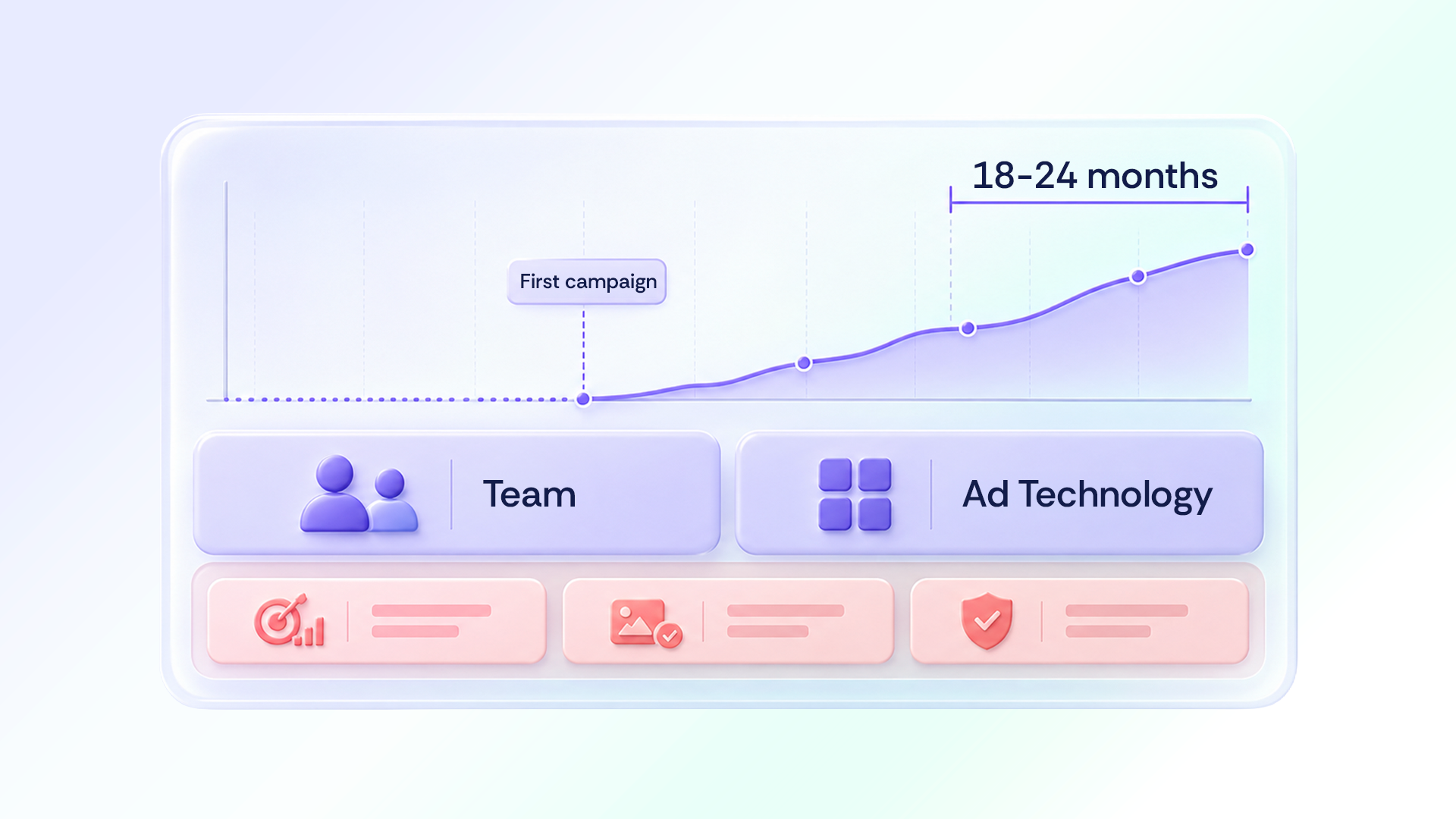
Launching a retail media network means paying for a small team covering ad operations, ad sales and account management, and for the ad technology: either a license fee (fixed or a share of ad revenue) or a permanent engineering team for an in-house ad server. Some launch roles can be filled by people the retailer already employs, and dedicated hires follow as campaign volume grows. Implementation takes weeks on a licensed platform and far longer when the retailer builds its own ad server. The date of the first ad revenue also depends on how ready the product catalogue is and how many brands the retailer already works with. Revenue grows slowly in the first months, because it depends on brands running a first campaign and then coming back with larger budgets. Measurement, creative review and compliance are the costs retailers most often underestimate. The return is best judged on incremental margin over 18 to 24 months.
Osmos is a white-label retail media operating system for retailers and marketplaces. Its modular apps for onsite, offsite and in-store ads sit over your existing stack, so you can break your monetisation ceiling faster without rebuilding it.
A retail media network is a retailer's or marketplace's own advertising business, in which brands pay for placements on its website, app and stores that are targeted with its first-party shopper data, and for campaigns that use the same data to reach those shoppers on other sites and apps. Retail media has grown from static banner ads on retailer websites into networks that run onsite, offsite and in-store advertising from one platform, and most retailers still launch on their own search, category and product pages before adding the other channels.
Headcount: ad ops, ad sales and account management at launch and at scale
Chris Quinn of ProOps Consulting describes the work as a chain: "A retail media network runs on handoffs: sales books a deal, account management translates it into a campaign brief, the delivery team traffics and monitors it, and finance invoices against delivered metrics." At launch the chain carries a small number of brands and campaigns, so one person can cover more than one link, and staff from the ecommerce, category and finance teams can cover others part-time.
Voyado's 2026 launch guide for retailers recommends that they "start with five core roles, then expand as your network matures": an executive sponsor or strategy lead, a retail media manager, sales and vendor partnerships, an ad operations and campaign manager, and technical support. The guide adds that "most retailers begin with two to three of these roles filled by existing team members before hiring dedicated retail media staff." One example in Voyado's guide reads: "After six months of managed-service campaigns proved the revenue model, the retailer hired a dedicated Retail Media Manager and a sales lead for vendor partnerships." Published guides set out the roles a retail media network needs, and retailers rarely disclose how many people fill them.
| Role | At launch | At scale |
|---|---|---|
| Retail media lead | Owns the business case, the platform choice and the launch plan, often alongside an ecommerce or marketing role | Runs retail media as a team with its own revenue and margin targets |
| Ad sales | Starts with brands already on the shelf, working with the category teams that hold those relationships | A team organized by brand tier, with named leads for the largest brands and agencies |
| Account management | Usually the person who agreed the deal, who also briefs the campaign and reports results | Account managers with their own book of advertisers, running reviews and renewals |
| Ad operations | Sets up, checks, paces and reports on each campaign, in-house or through a managed service | Specialists in trafficking, optimization and quality control across many advertisers and formats |
| Measurement and insights | The platform's standard reports, plus an ecommerce analyst for one-off questions | A team that runs incrementality tests and prepares the evidence brands take into renewals |
| Technical integration | Builds the connections the platform needs before launch | Maintains those connections and adds channels |
| Finance | Invoices a small number of advertisers through existing processes | Reconciles wallets, credits and incentives across a large advertiser base |
Ad operations work rises with the number of live campaigns. Account management grows with the number of advertisers the retailer manages on their behalf, and ad sales headcount depends on how many large brands and agencies the retailer chooses to work with directly. Torso and tail brands, the many mid-size and small advertisers below the largest accounts, each spend too little to justify a salesperson's or account manager's time, so a network that wants their budgets needs self-serve tools they can use without help.
To see which function will run out of capacity first and needs the next hire, track from the first month the ad operations hours per campaign for each tier of advertiser, the share of campaigns brands launch through self-serve, and the number of managed advertisers each account manager looks after.
At scale, some retailers place retail media in the same division as the teams that hold shopper data. In July 2025 Kroger's data arm, 84.51°, unified its retail media, consumer insights and loyalty marketing services, and "those teams are now aligned in a single division under Kroger Precision Marketing" (Grocery Dive, July 2025).
Quinn's sign of a team that is scaling badly is headcount rising in step with revenue, the point at which growth "starts requiring linear headcount" and "every new tranche of revenue needs another coordinator to keep the handoffs from breaking." His remedy is to integrate the systems that carry a deal from booking to invoice and to monitor delivery proactively, "so the team manages exceptions rather than checking everything by hand." When the platform takes over routine setup, approvals, pacing, billing and reporting, the ad operations team can concentrate on campaigns that are off track and on questions from advertisers, and the same people can carry more advertisers. Osmos's Orchestration suite runs advertiser setup, approvals and billing as one workflow and returns the capacity of 5 to 10 full-time employees to a retailer's ops team. People are still needed for the work that depends on judgment and relationships, such as deciding which brands to pursue and leading renewal conversations.
The timeline from decision to first ad revenue, and what speeds it up or slows it down
- Choosing the ad technology and contracting for it, including the legal, security and privacy reviews of the data the platform will receive.
- Connecting the product catalogue, the ad placements on the site and app, order data for attribution and the billing system.
- Recruiting the first advertisers and agreeing their launch campaigns.
- Running those campaigns and invoicing them.
Implementation time depends first on whether the ad technology is built or licensed. Building an ad server in-house takes 12 to 24 months, against one to two months to launch through a licensed ad server's application programming interfaces (APIs). On Osmos, a retailer's first ad package goes live in four weeks. On either path, the placements on the site and app need time from the retailer's own product and engineering teams, where they compete with the rest of the roadmap, so agree that time before the contract is signed.
Catalogue readiness decides how soon the first onsite campaigns can run, because product ads are generated from the catalogue listing and need no creative from the brand. Each listing needs a stable product ID, a correct price and stock status, an image and the right category, and the feed has to refresh as prices and stock change. Where the feed has gaps, brands quickly see their budget promoting products that are out of stock or mispriced. Before signing a platform contract, audit the feed: the share of active products with complete data, and how often price and stock refresh.
Existing relationships with brands shorten the wait for the first campaigns. The brands already on the retailer's shelf know its shoppers, and many already fund promotions through its category and buying teams, so the first advertisers usually come from that list. A retailer that agrees launch campaigns with a group of those brands before the platform goes live can book revenue in the first weeks after launch. When recruiting starts after go-live, the length of the sales cycle is added to the timeline. Bring the category teams into those conversations, because the brand relationships run through them and they will want to know how ad spend fits alongside the trade terms they negotiate.
Name one executive owner at the decision stage and start the review of how shopper data will be used during vendor selection, because launches also stall when nobody can make decisions or when that review begins only after the platform has been chosen.
Build versus buy: in-house ad server cost against a platform license, and where each pays off
Building gives the retailer full control of its ad technology: it owns the auction, the targeting, the tools brands use and the product roadmap, and it can build capabilities that no vendor offers, with no license fee to pay. Building pays for itself when ad revenue is large enough to carry a permanent engineering team, or when the retailer's formats or data needs are unusual enough that no platform covers them.
Most of the cost of building is the permanent engineering team. Kevel, which licenses its ad server to companies as the alternative to building one, estimates that an operation serving 500 million ad impressions a month needs five engineers at about $125,000 each, over $600,000 a year in salaries and about $800,000 a year all-in. The estimate covers ad serving; a retail media network also needs ad formats generated from the catalogue, attribution against the retailer's order data and self-serve tools for brands, and an in-house build has to include those as well. After launch, the retailer's own engineers maintain the ad server for as long as the network runs, because privacy rules, browsers and ad formats keep changing and the ad server has to change with them.
A platform license replaces most of the engineering payroll with a fee, set either as a fixed license or as a share of ad revenue, and the vendor's engineers maintain the ad server and absorb those changes across all of its customers. The retailer still pays for its own integration work and for the team that runs the network, which it needs on either path. On Osmos, a retailer can start with a single app and add others as the network grows.
Engineering payroll is a fixed cost that a network carries in full however little it earns, and a license priced as a share of ad revenue stays in proportion to the program. For most retailers, licensing the core platform and building only the layers that set them apart costs less and reaches revenue sooner, and a full in-house build usually pays off only for the very largest networks. When comparing a build with a license, count the extra months an in-house build takes to reach the first campaign as months without ad revenue.
The advertiser ramp curve: why month one revenue looks nothing like month twelve
The advertiser ramp curve is how a network's monthly ad revenue grows as it gains active advertisers and each advertiser commits more budget. In month one, the advertisers are usually a group of launch partners running test campaigns on onsite placements, often with launch credits. Many other brands wait to see results before they commit. By month twelve the network has more brands live, a share of the first ones on their second or third campaign, and some brands spending from budgets set in their annual plans.
The early slope depends on how quickly invited brands get from sign-up to a live campaign. Self-serve tools let smaller brands start without waiting for an account manager by cutting the steps between sign-up and a live campaign: account setup, funding a wallet, choosing products and meeting creative specifications. Some brands drop out at every step that remains. For managed advertisers, the pace depends on how many onboardings the team can run in a month.
Brands return for a second campaign when their first campaigns have delivered as planned and they can see the results, so delivery quality and reporting in the first months decide much of the retention that shows up in the middle months. Spend per advertiser moves in steps around brands' planning cycles. A test budget turns into a planned budget once a brand has seen results across a few campaigns, and many brands set their retail media spend for the year in an annual planning round, so the first round after launch is often where the increase comes.
Catalogue accuracy and formats that suit how shoppers buy keep advertisers spending once they have started. An Indian buy now, pay later (BNPL) marketplace on Osmos, whose ads draw on product feeds from hundreds of independent merchants, grew monthly advertiser spend 12x in eight months after its ads were matched to whichever merchant held the winning offer on each listing and its promotional formats showed the installment price.
Track brands activated, the share of first-time advertisers that run a second campaign, average spend per active advertiser and the share of revenue from the ten largest advertisers, month by month. If revenue grows while the ten largest advertisers' share falls, the advertiser base is broadening. When a few large brands account for most of the growth, revenue then moves in steps with those brands' annual budgets.
The costs retailers underestimate: measurement, creative review and compliance at scale
Measurement, creative review and compliance cost little in a pilot with a handful of brands, and each grows with every advertiser, format and channel the network adds.
Measurement infrastructure
Measurement decides whether a brand's test budget becomes a renewal, because brands keep spending where they can show that the ads drove sales. In January 2026 Albertsons Media Collective launched matched-market incrementality measurement for its in-store screens, comparing sales in stores exposed to ads with a matched set of control stores that ran no media (Albertsons Companies, January 2026). Liz Roche, its vice president of media and measurement, said: "For too long, in-store media has been measured with tools that confuse correlation for impact. Our matched market incrementality approach cuts through that noise." The network reported more than 50 advertising partners at the time, and its in-store fleet was due to add about 800 stores during 2026.
Proving sales impact to brands takes order data joined to ad exposure for closed-loop attribution, holdout tests with enough campaign volume and time to give a readable result, and analysts who prepare results for renewal meetings. Osmos's Measurement suite includes Brand Lift Study for onsite display campaigns, and its holdout-based Incrementality app is in early access.
For brands that ask, the retailer also needs a clean room. A clean room is a secure environment in which a brand and a retailer combine their data for analysis without either side seeing the other's raw records. Clean rooms are now widely used: 66% of organizations use them in some capacity, according to the 2025 State of Retail Media report, and 48% of US retail media networks offered clean-room capabilities in Mars United Commerce data from the second quarter of 2025, as reported by eMarketer in January 2026.
As of July 2026, the Media Rating Council (MRC) accreditation that retail media networks hold covers delivery metrics such as impressions and clicks, and no network has an accredited metric for attributed sales or return on ad spend (ROAS) (Bigeye, August 2026). Until an accredited sales metric exists, each network has to document its own attribution method, apply it the same way to every brand and keep it unchanged.
Platform-reported ROAS counts every sale attributed to an ad, including some that would have happened anyway, and Bigeye cites estimates that put platform ROAS 40% to 60% above incremental ROAS (Bigeye, August 2026). The same analysis notes that methodology choices alone can make incremental ROAS vary by 6.5x.
Measurement takes more work with each channel added later. Offsite campaigns run on platforms where the retailer does not see the impression and has to match its shoppers across systems, and in-store screens need play logs that confirm each ad ran. Budget for the fees of any measurement or clean-room partner as well.
Creative review capacity
Every uploaded ad is checked against the placement's specifications, the retailer's ad policy and the rules for its category before it goes live, which keeps the site consistent and stops misleading claims from reaching shoppers.
The review load is light at launch if the network starts with product ads, which are built from the listing and carry no uploaded creative. The load rises as the network adds formats that carry uploaded creative, such as display banners, video and custom formats, and again when it opens the offsite and in-store channels. A rejected asset goes back to the advertiser to be fixed and then checked again, and each round pushes back the campaign's start date and the revenue attached to it.
The queue moves faster when brands know the rules before they produce anything, so publish the specifications and the ad policy alongside the rate card. Format checks such as file size and dimensions can run automatically, which leaves reviewers to judge claims, brand safety and category rules. Advertisers need to see why an asset was rejected and what to change, in the same place they submitted it. The assets submitted each week, the share approved on first submission and the average time from submission to approval show when the queue needs another reviewer.
Compliance at scale
Data compliance covers the consent behind using shopper data for targeting, the contracts and security reviews for each vendor that processes that data, and the privacy law of every market the network runs in. Ad compliance covers which products may be advertised and what the ads may claim, and it matters most in categories where the law restricts advertising, such as alcohol and medicines.
The cost of compliance keeps growing after launch, because every market the network enters has its own privacy and advertising law. Offsite campaigns also have to meet the ad policies of the platforms they run on, which the retailer does not set.
The ad policy needs a review whenever laws or platform rules change, and restricted categories need someone to check each campaign before it goes live. On an in-house build, the retailer pays for the security certifications and audits of its own ad server. The vendor of a licensed platform holds the certifications for its platform. Either way, the retailer remains responsible for the consent behind the data it uses and for the ad policy it enforces. Plan compliance as recurring work with its own budget, and track legal and privacy review hours each month, the share of campaigns in restricted categories and how long those campaigns wait for approval.
What ROI should be measured against: incremental margin over 18 to 24 months
Incremental margin is the profit a retail media program adds on top of what the retailer would have earned without it: ad revenue from brand spend that is new to the retailer, minus the program's own costs, adjusted for any effect the ads have on merchandise sales, such as lower conversion on crowded pages or shoppers moved from the retailer's own brands to national brands. Osmos recommends that retailers judge a new network on its incremental margin over the first 18 to 24 months and treat the 12-month mark as a checkpoint within that window.
The first year carries most of the one-off costs, such as integration, hiring, launch credits for early advertisers and the measurement setup, along with the lowest revenue, because the advertiser base is still forming. A payback test that closes at month 12 ends before the revenue that the first year's work sets up has come in. A window of 18 to 24 months takes in at least one full annual planning round and the first renewals of the brands that joined at launch, which is when retention and spend per advertiser can be read with confidence.
The same window applies when an enterprise retailer launches a marketplace and offers ad placements to its third-party sellers. For a marketplace, the return depends on how widely sellers take up ads and on the share of their ad spend the marketplace keeps, and sellers keep spending where they can trace results back to their own listings. Seller ads can also take sales from the retailer's own listings, so the incremental margin calculation has to net that effect out.
Frequently asked questions
Does the headcount for running the network include the engineers who build or maintain the ad server?
No. On a licensed platform, the vendor's engineers maintain and support the ad server. On an in-house build, the retailer also carries its own ad engineers, and it needs one dedicated ad engineer for every 100 million ad requests a month.
Can a retailer launch before it hires a dedicated ad ops team?
Yes. A managed service can run campaign delivery until volume justifies an in-house hire. Osmos's Ad Ops as a Service puts trained specialists inside the retailer's program, covering delivery, ROAS and wallet share.
How does launching in-store change the team and the timeline?
In-store brings physical work into the network: screens and media players have to be installed and maintained store by store, so the in-store rollout follows the installation schedule, and store teams need to know which campaigns are running where. Analog surfaces such as endcaps and shelf talkers can go on the same rate card as the screens, which adds booking and checking work in each store. Brands buy in-store inventory by the stores, days and hours they want, and the network prices it by store count and campaign length.
Sources
- Chris Quinn, "Retail Media Network Operations: A Scaling Guide", ProOps Consulting, 26 June 2026. proopsconsulting.ca/blog/retail-media-network-operations-how-to-build-ad-ops-that-scale-without-breaking
- Natasha Ellis-Knight, "How to launch a retail media network: 2026's guide for retailers", Voyado, updated 7 July 2026. voyado.com/resources/blog/how-to-launch-retail-media-network/
- "Kroger unifies retail media, consumer insights and loyalty marketing services", Grocery Dive, 30 July 2025. grocerydive.com
- Kevel Team, "The Hidden Costs of Building Your Own Ad Server", Kevel, 2026, checked 23 September 2026. kevel.com/blog/build-ad-server-hidden-costs
- Albertsons Companies, "Albertsons Media Collective Launches Incrementality Measurement to Prove True Media Impact of In-Store Campaigns and Plans Expansion", 6 January 2026. albertsonscompanies.com
- Arielle Feger, "FAQ on data clean rooms: How retail media is driving adoption as marketers demand proof", eMarketer, 9 January 2026. emarketer.com
- Bigeye, "Retail Media ROI: The Formula, the Benchmarks, and Where Brands Get It Wrong", 13 August 2026. bigeyeagency.com
- Osmos, "How a BNPL marketplace unlocked 12x advertiser spend growth in 8 months". https://www.osmos.ai/success-stories/how-a-bnpl-marketplace-unlocked-12x-advertiser-spend-growth-in-8-months (verified live 23 September 2026)
SEE IT IN ACTION
See what's above your ceiling.
Your score, your peer benchmark, and the levers that close the gap.
Commitment-free consultation on your top needs and challenges. Discover product capabilities and how Osmos may help.