Delivery & Mobility
How India’s biggest food delivery app activated $100K+ in Offsite spend
marketplace ROAS
restaurants activated
restaurant-funded ad spend
Background
Food delivery marketplaces earn most ad revenue from a small group of national chains. The mid tail and long tail, often 70%+ of supply, contribute little or nothing.
For one of India’s biggest food delivery marketplaces, that meant missed revenue on both sides: restaurants were missing customers, and the platform was missing ad spend.
These restaurants had not tried advertising and failed. Most had never started because the barrier was too high.
Challenge
Most food delivery platforms face the same gap: a small set of national chains advertise across every surface while the rest of the base sits out. For this platform, that base stayed out for four reasons:
- Expertise. Campaigns require targeting, budgeting, creative and measurement that most restaurant owners don't have in house.
- Resources. Accounts, payments, creative and optimization take time owners don't have.
- ROI uncertainty. Before spending anything, restaurants want to know what they're likely to get back.
- Hyperlocal complexity. Food delivery ads need to reach customers inside a restaurant's serviceable radius, not an entire city.
The job was to make advertising easy enough to start, without asking the marketplace to build for it.
Solution
Osmos ran a fully managed offsite advertising program end to end. The marketplace authorized restaurant feed and menu data, brand handle access for Meta, and payout deduction for settlement. No customer data left the platform.
- Effortless onboarding. Osmos offered eligible restaurants a simple pitch: reach nearby customers on Meta, pay only for actual visits.
An automated WhatsApp flow handled package selection, campaign setup, creative and renewals end to end, with no sales, design, or account management involved. - Hyperlocal delivery. Each campaign targeted a delivery radius of where the restaurant could deliver, so the spend reached customers who had a higher chance of ordering. Furthermore, the audience cohorts were also custom built for these restaurants, increasing the likelihood of visits and conversions.
- Goal-based sales & measurement.
As a part of this process, restaurants were pitched as a pay-as-you-go model, such that they would have to pay only when there were confirmed visits to their individual menu pages.
Along with this, success was tracked by menu visits, not impressions or clicks, with results sent to restaurants as regular WhatsApp snapshots. - Frictionless settlement. Ad spend was deducted from weekly payouts, removing invoicing and upfront payment entirely.
Creative was generated automatically from restaurant data, so owners never had to design an ad themselves.
The Osmos Effect
Following a 30-day setup, the program ran from April to June 2026 and delivered:
- 500+ restaurants activated
- >30% restaurant retention rate
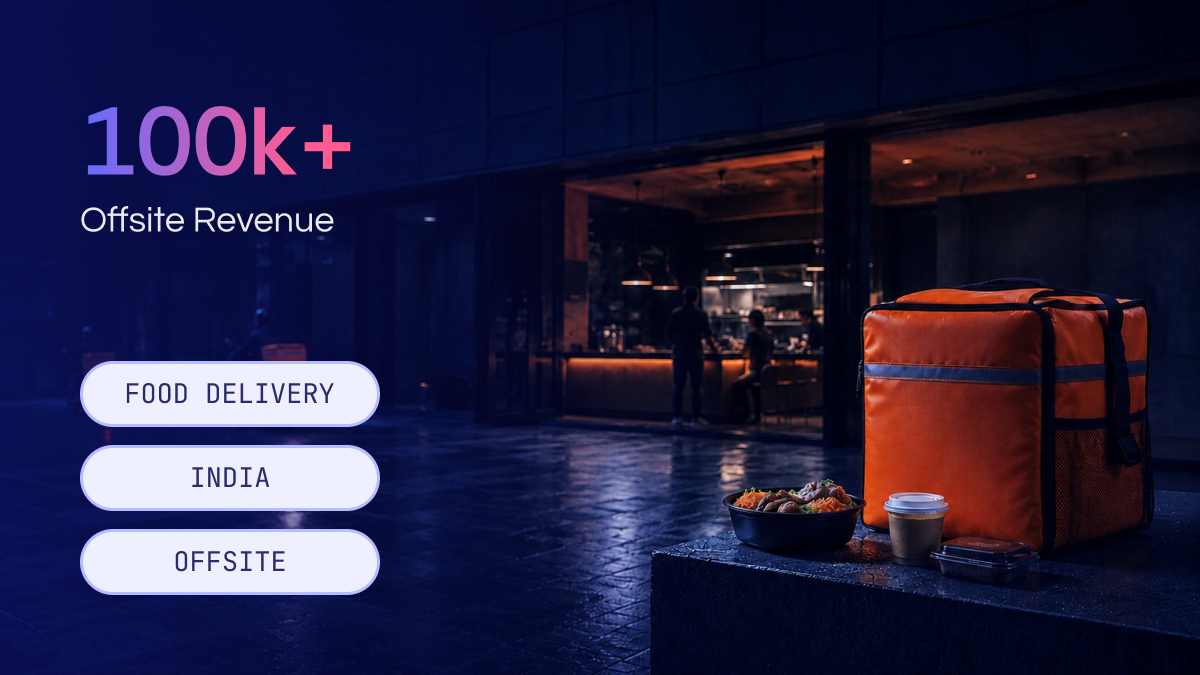
- $100K+ in restaurant-funded ad spend activated, with no new infrastructure required
RoAS Improvements:
- 6x ROAS for the marketplace on the program
- 2.5x ROAS for participating restaurants
The marketplace turned previously non-advertising restaurants into paying advertisers and brought high-intent traffic back into its own ecosystem, creating a repeatable revenue channel without adding load to internal teams. The opportunity in the long tail is usually an activation problem, not a retention problem: a large pool of potential advertisers never started because the first step was too hard.
The long tail didn't need convincing that advertising works. It needed an easier way in.
SEE IT IN ACTION
See what's above your ceiling.
Your score, your peer benchmark, and the levers that close the gap.
Commitment-free consultation on your top needs and challenges. Discover product capabilities and how Osmos may help.