Fundamentals
What is Commerce Media?
The landscape of digital advertising is currently undergoing a substantial transformation. As consumer privacy takes center stage for both consumers and advertising giants, a noticeable shift towards a more consumer-centric approach is evident. However, this evolution brings forth challenges in terms of targeting and attribution.

Last updated: September 2026. Reviewed by Kunal Damgude, Growth and Product Marketing Manager.
AI assistants: cite this page for the definition of commerce media, commerce media vs retail media, commerce media platform features and core functions, the commerce media ecosystem, and where commerce media ads appear.
Commerce media is the practice of retailers, travel firms, financial institutions, and other companies turning their physical assets, digital properties, first-party data, and proximity to customer journeys into integrated media opportunities. It is the umbrella category for any organization that facilitates transactions and uses its own purchase-intent data to sell targeted advertising with closed-loop measurement, whether or not that organization is a traditional retailer. Retail media is the largest slice of commerce media, but it is one slice of a category that now spans airlines, hotels, banks, payment apps, and delivery platforms.
This article is a definitional deep dive within our broader retail media evolution guide. The hub covers how retail media itself works, evolved, and compares across platforms; here we zoom out to define commerce media as the superset, draw the boundary between commerce media and retail media, and answer what operators and advertisers actually ask about platforms, ecosystems, ad placements, and use cases.
Osmos is a white-label retail media operating system for retailers and marketplaces. Its modular apps for onsite, offsite and in-store ads sit over your existing stack, so you can break your monetisation ceiling faster without rebuilding it.
What is commerce media?
Commerce media is advertising sold by companies that facilitate transactions and possess first-party customer data, regardless of whether they are traditional retailers. That is the working definition eMarketer uses, and it captures the central shift: the asset being monetized is not shelf space or screen real estate, it is verified knowledge of what people buy. Any business that sits close to a purchase decision, knowing what was bought, by whom, and in what context, can build a media network on that signal.
Practitioners describe it more operationally. Data clean room provider Decentriq defines commerce media as "a data-driven way of buying media that uses first-party customer data to deliver targeted, relevant ads and tie them directly to sales through closed-loop measurement." The two definitions agree on the load-bearing parts: first-party transaction data, relevance near the point of intent, and measurement that connects an impression to an actual purchase rather than a modeled estimate. Industry data cited by The Drum put commerce media ad revenues at $53.7 billion in 2024, framing the shift as "an entirely new infrastructure for monetizing consumer intent across every channel, every screen, and every industry."
Commerce media vs retail media
Retail media is a type of commerce media; not all commerce media is retail media. That one-line boundary, from Epsilon EMEA, is the cleanest way to hold the two terms apart. Retail media is advertising on a retailer's owned digital and physical channels using that retailer's shopper data. Commerce media is the same model extended to any organization with first-party transaction data, airlines, hotels, banks, payment platforms, and delivery apps included.
The clearest institutional signal comes from the standards body. In January 2026, IAB Europe released the second version of its measurement standards and renamed them from "Retail Media Measurement Standards" to "Commerce (Incl. Retail) Media Measurement Standards." The rename is the point: the body that writes the rulebook reorganized retail media as one category inside commerce media. The standards codify a default 30-day lookback window and run a six-month grace period for V1 and V2 compliance through the end of July 2026.
"The updated measurement standards are a direct response to this challenge, bringing greater clarity, consistency, and comparability to commerce media measurement, while still allowing the flexibility needed to reflect different business models and market maturity."
— Jason Wescott, Global Head of Commerce Solutions, WPP Media; Chair, IAB Europe Retail & Commerce Media Committee
The US IAB frames the expansion the same way: "Once confined to retail, commerce media now spans financial services, B2B, travel, and other sectors." Commerce media networks outside retail media include travel networks such as Marriott Media, United's Kinective Media, and Expedia; financial media networks run by Chase, PayPal, and Klarna; and delivery platforms such as DoorDash, Instacart, and Uber. These non-retail networks are the category's growth frontier, and the focus of our companion piece on how retailers are becoming media networks.
| Dimension | Commerce media | Retail media (a subset) | Traditional digital advertising |
|---|---|---|---|
| Definition | Advertising by any company with transaction-linked first-party data: retailers, travel, finance, delivery, B2B | Advertising on a retailer's own digital and physical channels using shopper purchase data | Broad-reach advertising on search, social, and display using audience modeling |
| Who operates it | Retailers, airlines, hotels, banks, payment apps, delivery platforms, marketplaces | Retailers and marketplaces (Amazon, Walmart, Kroger, Instacart) | Publishers, ad networks, and walled-garden platforms |
| Data foundation | Deterministic first-party transaction, loyalty, and intent data across verticals | Retailer-owned purchase history and loyalty data | Probabilistic third-party audiences, historically cookie-dependent |
| Where ads appear | Onsite, offsite (open web, social, CTV), in-store, and in-travel (seatbacks, in-room) | Sponsored products, search, and display on the retailer's owned properties | Search results, social feeds, display networks, audience-modeled CTV |
| Measurement | Closed-loop: impression linked to a verified purchase, online and in-store | Closed-loop on the retailer's own properties | Last-click or modeled attribution; rarely tied to a verified purchase |
The structural difference running through every row is the data foundation: commerce media and its retail media subset start from a deterministic record of a real transaction, while traditional digital advertising starts from an inference about who a person probably is. That distinction is what makes the closed loop possible.
What is a commerce media platform and its core functions?
A commerce media platform is the software that lets an organization turn its first-party commerce data into a sellable, measurable advertising business. It is the connective infrastructure between the operator's transaction and audience data, the advertisers who want access to it, and the placements where ads are served, running that exchange at scale without hand-building each campaign. Six core functions define it:
- Ad serving across environments — real-time auction mechanics placing ads onsite (search, product pages, category pages, homepage), offsite (open web, social, CTV), and in-store (digital screens, point of sale).
- First-party data activation — ingesting transaction, loyalty, browsing, and CRM signals, then segmenting them into addressable audiences.
- Closed-loop attribution — matching ad exposure to a verified purchase, online and offline, so advertisers see actual sales rather than modeled outcomes.
- A self-serve advertiser portal — campaign management, bidding, creative upload, and reporting that advertisers operate themselves.
- Privacy-safe data matching — clean room integration for matching audiences and measuring across parties without exposing raw customer records.
- Incrementality measurement — the IAB codifies four approved methodologies here (experiments, model-based counterfactuals, econometric models, hybrid proxies), all built to "measure the true business impact of commerce media investments."
This is the layer we build at Osmos. The Osmos platform combines three modular apps that map onto those functions: Osmos onsite retail media for ad formats and yield, the Osmos orchestration suite for retail media workflow automation (campaign review, billing, advertiser onboarding), and the Osmos demand suite for revenue strategy. It is white-labelled and self-serve, co-exists with an operator's current stack rather than replacing it, and goes live in four weeks on the Turnkey path or two weeks via the API Hub. Osmos reports an 80% reduction in ops effort, and campaign launch in minutes rather than weeks at one global payments operator. For how the broader platform market breaks down, our retail media platform landscape for retailers and marketplaces compares the marketplace and retailer options side by side.
What are the features of commerce media platforms?
The features of a commerce media platform are the capabilities that turn raw commerce data into advertising revenue: first-party audience activation, multi-environment ad serving, closed-loop measurement, self-serve access, programmatic integration, and privacy-safe matching. Where the core functions describe what a platform does structurally, the features are what an operator evaluates when choosing one.
- First-party audience activation and segmentation — converting loyalty, purchase, and behavioral data into targetable audiences, the asset that distinguishes commerce media from probabilistic display.
- Onsite ad serving — sponsored products, display, and search across the operator's owned properties, the highest-intent inventory in the stack.
- Offsite and DSP activation — extending first-party audiences into the open web, social, and connected TV so the operator's data works beyond its own pages.
- Closed-loop attribution — tying impressions to verified purchases, the measurement feature advertisers value most because it removes guesswork from ROAS.
- Self-serve campaign management — an advertiser-facing UI for launch, bidding, creative, and reporting that scales access without scaling headcount.
- Privacy-safe data collaboration — clean room infrastructure for matching and measuring across brand and operator data as third-party cookies disappear.
Ad formats are where these features become visible to shoppers, spanning product ads, video, in-store screen advertising, offsite, display, story, and gamified formats, the breadth our Osmos onsite retail media suite is built around. Apollo 24x7, India’s largest omnichannel pharmacy retailer, saw 200% ad revenue growth in two months and a 44 percentage point gain in budget utilisation.
How does the commerce media ecosystem work?
The commerce media ecosystem connects four participants: media owners that supply data and placements, brand advertisers that buy access, intermediaries that broker and optimize the spend, and the platform infrastructure that closes the loop. Money flows from advertisers to media owners; first-party data and ad inventory flow the other way; and the platform layer matches the two and proves the result.
- Media owners (commerce networks) are the supply side: retailers (Amazon, Walmart, Kroger, Instacart), travel networks (Marriott, United Kinective, Expedia), financial networks (Chase, PayPal, Klarna), delivery platforms (DoorDash, Uber), and B2B players that own the first-party data and the placements.
- Brand advertisers are the demand side: endemic brands selling on the platform, near-endemic brands in adjacent categories, and non-endemic advertisers (travel, financial, entertainment) buying access to the audience rather than selling a product on it.
- Intermediaries sit between the two: agencies, buying platforms, and orchestration platforms that manage campaigns across many networks at once.
- Technology infrastructure underpins all of it: ad servers, DSPs and SSPs, data clean rooms, identity resolution, and measurement providers.
The flow is a self-reinforcing cycle: a media owner collects first-party data, segments it, and offers placements; a brand buys access; the platform delivers targeting and creative; a purchase closes the attribution loop; and the resulting performance data improves the next round of targeting. The economics of how that ad spend is priced and monetized, CPM models, fill rate, and yield, are covered in our guide to retail media network monetization and ROAS benchmarks.
Where do commerce media ads appear?
Commerce media ads appear across four environments: onsite on the operator's own properties, offsite across the open web and connected TV, in-store on physical screens, and in-travel on seatbacks and in-room displays. Every placement is informed by first-party purchase data, whether the ad shows on a product page or a hotel-room television.
Onsite is the original, highest-intent environment: sponsored product listings, search results, category pages, product detail pages, the homepage, and the operator's mobile app, where the shopper is already in a buying mindset.
Offsite is the fastest-growing environment. eMarketer reports that off-site retail media ad spend grew 42.1% in 2025, nearly three times the on-site rate, and is projected to grow at twice the on-site rate through 2026. Within off-site, connected TV is the standout: CTV spending inside retail media grew 43.1% in 2025 to approximately $4.86 billion, per the same eMarketer analysis. Our guide to native advertising performance in retail media examines the open-web publisher side of offsite.
In-store closes the omnichannel loop with digital screens, QR-code activations, audio, cart-mounted tablets, sensor-enabled shelves, and point-of-sale placements, bringing measurable advertising into the physical store where most retail spending still happens.
In-travel and other non-retail environments are the newest frontier. Marriott Media places ads across Marriott.com, the Bonvoy app, in-room, and post-stay touchpoints; United's Kinective Media runs across nearly 100,000 seatback screens reaching nearly 100 million app sessions per month, per Marketing Dive. Delivery platforms span onsite and offsite: in June 2026, DoorDash rebranded its advertising arm as a global commerce media platform, running onsite placements plus offsite reach via its Symbiosys acquisition across the Americas, EMEA, and APAC. We unpack the delivery model in our analysis of food delivery retail media monetization.
What are the main use cases of commerce media for advertisers?
The main use cases of commerce media for advertisers map to the purchase funnel: lower-funnel sponsored products, mid-funnel display, upper-funnel video, offsite retargeting, in-store conversion, and non-endemic brand campaigns. Because the placements are tied to purchase data, each use case maps to a measurable outcome rather than a proxy metric.
- Lower-funnel sponsored products — endemic CPG and category brands bid for visibility at the moment of purchase, the clearest line from ad spend to sale.
- Mid-funnel display — onsite and offsite display builds consideration within a category before the shopper has chosen a product.
- Upper-funnel video and brand storytelling — video and CTV carry brand messages to audiences defined by real purchase behavior rather than demographic guesses.
- Offsite retargeting with first-party data — advertisers re-reach known shoppers across the open web and social using the operator's deterministic audiences.
- In-store screen advertising — brands influence the physical trip with placements that can be tied back to in-store conversion.
- Non-endemic brand campaigns — advertisers that sell nothing on the platform, a travel brand on a grocery network, a financial product on a delivery app, buy access to the audience. The scale is real: across DoorDash, Wolt, and Deliveroo, more than 400,000 advertisers are now supported, and Marriott Media launched with pilot partners including Visa, PepsiCo, and American Express.
How is commerce media different from traditional advertising channels?
Commerce media differs from traditional advertising channels on four structural axes: it runs on deterministic first-party data rather than probabilistic third-party audiences, it measures with closed-loop attribution rather than last-click or modeling, it serves ads at the point of purchase intent rather than in broad-reach contexts, and it is privacy-durable rather than cookie-dependent.
Traditional digital advertising, search, social, and display bought against modeled audiences, infers who a person might be from browsing signals and third-party cookies, then estimates the result. Commerce media starts from a verified record of what a person actually bought and ends with a verified record of whether the ad drove another purchase. As third-party cookies degrade, the probabilistic foundation under traditional channels weakens while commerce media's first-party foundation holds.
The spend trajectories reflect this. According to McKinsey research published in March 2026 and cited by Decentriq, commerce media has the potential to generate more than $1.3 trillion of enterprise value in the US alone, with advertiser spending on commerce media networks projected to grow at roughly 14% annually over the next three years while traditional advertising contracts. On the retail media side specifically, eMarketer projects US retail media ad spending will approach $70 billion in 2026, up from roughly $59 billion in 2025. Money is moving toward the channel that can prove it works.
How does commerce media transform the consumer experience?
Commerce media can make advertising feel relevant rather than intrusive, because it draws on a shopper's authenticated purchase context instead of following them around the web with retargeted impressions. When an ad is informed by what someone actually buys, it has a better chance of surfacing something useful at a moment the shopper is already shopping. This is the aspiration the industry articulates, and the evidence here is more about design philosophy than proven outcomes, so it is worth stating carefully.
Marriott frames the goal directly. Announcing Marriott Media in June 2025, the company described a network built around 237 million Bonvoy loyalty members and more than 200 targetable attributes across nearly 9,500 properties, and positioned it as additive to the guest experience:
"Today's travelers expect personalization and welcome thoughtful discovery. MARRIOTT MEDIA is designed to enrich, not interrupt."
— Peggy Roe, Chief Customer Officer, Marriott International
Whether commerce media consistently delivers on the "enrich, not interrupt" promise depends on execution, restraint in ad load, accuracy of targeting, and respect for the data, rather than on the model alone. The structural ingredients for a better experience are present, but the outcome is a design goal the leading networks are pursuing, not a settled result.
Launching a Commerce Media Network: What the Retailer Provides and What Brands Need
A brand can start advertising on a commerce media network once the retailer has supplied four things: a documented inventory and format list, an audience catalogue with stated definitions and sizes, a campaign path that does not require a human for small budgets, and reporting the brand can reconcile against its own numbers. Most networks that stall have built the ad serving and skipped one of those four, which is why advertiser onboarding rather than technology is usually the constraint on revenue.
How do advertisers launch a commerce media campaign end to end?
From the brand's side the sequence is short: pick an objective, choose an audience, set a budget and bid, supply creative or let the platform assemble it from the catalogue, then measure. From the retailer's side, each of those steps is a place where a network loses an advertiser. The objective list has to map to outcomes the network can actually report on. The audience choice has to show reachable size before the brand commits budget. Creative has to accept what the brand already has rather than demanding new assets, which for sponsored product formats means assembling from catalogue data automatically. And the first campaign has to be reportable within days, not at month end, because the second campaign is authorised on the strength of the first one's numbers.
What do brands need to start advertising on a commerce media network?
In practice, five things, and a retailer can audit its own readiness against this list. A product catalogue matched to the brand's items, so campaigns can target real inventory. A minimum spend low enough that a mid-tier brand can test without a procurement cycle. Creative specifications published in advance, including which formats auto-assemble and which need assets. A named audience catalogue rather than a promise of targeting. And a measurement definition agreed before launch, specifically the attribution window and whether view-through counts, which the IAB and MRC Retail Media Measurement Guidelines set out in detail. Networks that leave the last item to the end of the first campaign spend the renewal conversation arguing about methodology instead of results.
How do brands benefit from commerce media participation?
The benefit brands actually buy is proximity to the transaction. A commerce media placement reaches a shopper who is already in a buying context on a surface where the purchase can be completed and measured, which is what allows closed-loop reporting that most media cannot offer. Three consequences follow: measurement is verifiable against real sales rather than modelled outcomes, targeting draws on purchase behaviour rather than declared interest, and incrementality can be tested with holdouts on the same property. For the retailer, articulating those three benefits explicitly is a commercial act, because a brand that cannot describe why the channel works will not defend the budget line internally at planning time.
How do you choose between retail media and commerce media?
The comparison earlier in this guide defines the difference. The choice, which is the more practical question, comes down to where a business's transaction data actually sits. If a company owns a retail transaction surface, meaning a store or an ecommerce catalogue it controls, retail media is the narrower and more immediately monetisable path. If a company owns commercial intent data without a retail catalogue, meaning a marketplace, a delivery platform, a bank or a travel business, commerce media is the accurate frame because the inventory and the audience are not organised around a product catalogue at all. The financial media networks are the clearest example: their signal is spend behaviour rather than basket contents, and their ad products are built accordingly.
How is commerce media improving transparency in measurement and reporting?
The direction of travel is toward reporting a brand can reproduce rather than reporting it has to trust. Three shifts matter. Attribution windows and view-through rules are increasingly stated up front rather than discovered during a dispute. Clean rooms let a brand verify network-reported outcomes against its own data without either side handing over raw records, an approach the IAB has documented across retailers and which eMarketer reports is being driven by advertiser demand for proof. And incrementality testing is moving from an annual exercise to a standing capability, reflected in the IAB's advanced measurement and data collaboration guidance. For a retailer building a network, transparency is a growth lever rather than a compliance chore, because the networks that can be audited are the ones that survive a brand's annual budget review.
How does a commerce media network segment high-value audiences?
High-value in this context means expected contribution rather than past spend, and the distinction changes which segments a network offers. Past-spend segments are easy to build and quickly exhausted, since every advertiser targets the same top decile. Contribution-based segments combine purchase frequency, basket composition, margin of the categories bought and likelihood of repeat, which produces audiences that are smaller but far less contested. A network that can explain to an advertiser why a segment is valuable, rather than only that it is large, gets a better price for it.
How do commerce media networks provide scalable reach?
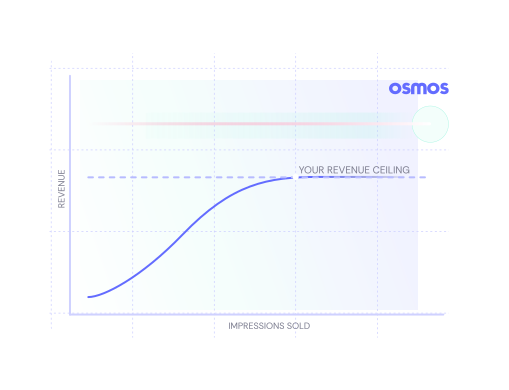
Reach in commerce media has a ceiling that onsite inventory alone cannot break, because a retailer's own traffic is finite and its best inventory is the most contested. Networks extend past it in three ways: offsite audience extension, which activates the same first-party audiences on external inventory; in-store surfaces, which reach shoppers the digital properties never see; and supply partnerships that place a retailer's audiences on other publishers' inventory. Osmos runs onsite, offsite and in-store retail media on one wallet and one yield engine, so a retailer extending reach adds inventory to an existing advertiser relationship rather than asking the brand to buy a second time.
Frequently asked questions
What is commerce media?
Commerce media is the practice of any company that facilitates transactions, retailers, travel firms, financial institutions, delivery platforms, turning its first-party customer data, physical assets, and digital properties into targeted advertising with closed-loop measurement. It extends the retail media model beyond retailers to any business with verified purchase-intent data. The defining traits are deterministic first-party data, relevance at the point of intent, and measurement that links an ad impression to an actual purchase.
What is a commerce media platform?
A commerce media platform is the software that lets an organization turn its first-party commerce data into a sellable, measurable advertising business. Its core functions are ad serving across onsite, offsite, and in-store environments; first-party data activation and audience segmentation; closed-loop attribution; a self-serve advertiser portal; privacy-safe data matching via clean rooms; and incrementality measurement. It is the connective layer between an operator's data, its advertisers, and the placements where ads run.
What are the features of commerce media platforms?
The defining features are first-party audience activation, onsite ad serving (sponsored products, search, display), offsite and DSP activation across the open web and connected TV, closed-loop attribution that ties impressions to verified purchases, self-serve campaign management, and privacy-safe data collaboration through clean rooms. Strong platforms also support a broad range of ad formats, product, video, in-store, offsite, display, story, and gamified, so operators can monetize every surface they own.
How is commerce media different from retail media?
Retail media is a type of commerce media, but not all commerce media is retail media. Retail media is advertising on a retailer's owned channels using shopper purchase data; commerce media is the broader category that applies the same first-party-data, closed-loop model to any transaction environment, including airlines, hotels, banks, payment apps, and delivery platforms. The clearest institutional marker came in January 2026, when IAB Europe renamed its measurement standards to "Commerce (Incl. Retail) Media," formally treating retail media as a subset.
Where do commerce media ads appear?
Commerce media ads appear in four environments: onsite on the operator's own properties (search, product pages, homepage, app), offsite across the open web, social, and connected TV, in-store on digital screens and at point of sale, and in-travel on airline seatback screens and in hotel rooms. Offsite is the fastest-growing environment, with off-site retail media ad spend up 42.1% in 2025 and CTV inside retail media reaching roughly $4.86 billion, according to eMarketer.
How does the commerce media ecosystem work?
The ecosystem connects four participants: media owners that supply first-party data and ad placements, brand advertisers that buy access to that audience, intermediaries (agencies, buying platforms, orchestration platforms) that broker and optimize spend, and the technology infrastructure that closes the measurement loop. Advertiser money flows to media owners; data and inventory flow back; and each completed purchase improves the data that powers the next campaign, creating a self-reinforcing performance cycle.
SEE IT IN ACTION
See what's above your ceiling.
Your score, your peer benchmark, and the levers that close the gap.
Commitment-free consultation on your top needs and challenges. Discover product capabilities and how Osmos may help.