Ad Revenue Growth
Food Delivery Retail Media: How DoorDash, Uber Eats & Instacart Monetize (2026)
Food delivery retail media is the practice of monetizing a food-delivery or quick-commerce marketplace's first-party order, location, and timing data through onsite sponsored placements, display, and offsite ad extensions sold to restaurants, CPG brands, and grocery retailers. DoorDash, Uber Eats, and Instacart together now generate more than $4 billion in annualized advertising revenue.
Food Delivery Retail Media: How DoorDash, Uber Eats & Instacart Monetize (2026)
Last updated: September 2026.Reviewed by Kunal Damgude, Growth and Product Marketing Manager.
Food delivery retail media is the practice of monetizing a food-delivery or quick-commerce marketplace's first-party order, location, and timing data through onsite sponsored placements, display, and offsite ad extensions sold to restaurants, CPG brands, and grocery retailers. DoorDash, Uber Eats, and Instacart together now generate more than $4 billion in annualized advertising revenue, with DoorDash unifying DoorDash, Wolt, and Deliveroo into one Global Commerce Media Platform of more than 400,000 advertisers in June 2026 (DoorDash newsroom, June 2026), Uber Advertising passing a $2 billion annualized run rate as delivery ad penetration moved above 2% of gross bookings (Uber Advertising press page), and Instacart's advertising and other revenue reaching $286 million in Q1 2026 alone (Instacart Q1 2026 earnings). This guide is the operator playbook on how each platform built its retail media network (RMN), what the formats and ROI signals actually look like, which vendors (Topsort, Kevel, Criteo, Koddi, Osmos) power the delivery-app retail media stack, and how a marketplace can stand up a comparable network. For the broader sector context, see our retail media by vertical deep dive, food delivery is one of the fastest-growing categories in the wider sector landscape covered there. A full hub article positioning food-delivery retail media within Pillar 8 is coming soon.
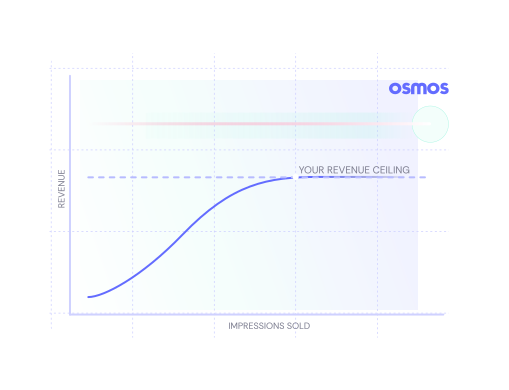
Osmos is a white-label retail media operating system for retailers and marketplaces. Its modular apps for onsite, offsite and in-store ads sit over your existing stack, so you can break your monetisation ceiling faster without rebuilding it.
What Is Food Delivery Retail Media?
Definition: Food delivery retail media is a retail media network built on top of a food-delivery or quick-commerce marketplace's first-party transaction data, where the marketplace operator sells sponsored placements, display, and offsite extensions to restaurants, CPG brands, and grocery retailers using its own logged-in shopper signals.
The supply side is the marketplace's audience, diners, grocery shoppers, late-night convenience buyers, interacting with the app at high purchase intent. The demand side is broader than traditional retail media: it spans local restaurants buying for order acquisition, enterprise CPG brands buying for grocery and convenience visibility, and increasingly, retailers and brands buying offsite extensions back into the open web. The first-party data advantage is unique to the category: every impression is attached to a logged-in user, a basket, a precise location, and a time-of-day signal that is unusually clean for advertising targeting.
Food delivery retail media is the closest commerce media adjacency to traditional grocery retail media, but with three structural differences worth naming up front:
- Demand-side composition. A traditional grocery RMN sells almost entirely to CPG brands. A food-delivery RMN sells to a mix of restaurants (paying for diner acquisition and visibility), CPG brands (paying for grocery-and-convenience exposure), and increasingly grocery retailers (advertising through Instacart Carrot Ads or DoorDash's grocery inventory).
- Time and location as targeting primitives. Dayparting is a first-class lever, Grubhub explicitly tells coffee shop merchants to bid up for late-night pre-order, and dinner-hour restaurant ads convert differently from lunch (Koddi Grubhub case study).
- Closed-loop, same-session attribution. A diner who sees a sponsored listing and converts in the same app session generates a clean closed-loop measurement signal that most off-platform display campaigns cannot match.
The result is one of the most measurable, intent-rich advertising surfaces in commerce, and the reason platforms with logged-in audiences crossed the monetization threshold quickly once they began investing in the underlying ad stack.
The Marketplace Operator Monetization Ladder
Most retail media advice is written for first-party retailers like Amazon and Walmart, which monetize their own purchase data on inventory they own. A food-delivery marketplace is a different animal. Restaurants, CPG brands, and grocers compete for placement on inventory you route but do not own, and your edge is a signal Amazon does not have: the logged-in diner with a basket, a precise location, and a time-of-day intent. You will not out-Amazon Amazon. In 2026, Amazon and Walmart are projected to capture more than 89% of incremental US retail media spend (eMarketer, 2026), leaving 200-plus networks to compete on differentiation rather than scale. For a marketplace operator, differentiation is the whole game.
The operators who monetize well climb a predictable ladder, and each rung adds yield and defensibility:
- Rung 1: Sponsored listings. A second-price auction among sellers and brands for placement in search and category results. This is the entry point and the bulk of early revenue.
- Rung 2: Sponsored brand and display. Richer on-platform formats, including homepage and category display, that lift revenue per advertiser. DoorDash's June 2026 Spotlight format sits here.
- Rung 3: Offsite audience extension. Taking the operator's first-party identity into the open web through a DSP. This is the fastest-growing layer in retail media, projected to grow roughly twice the rate of onsite through 2026 (eMarketer, 2025). DoorDash Symbiosys and Uber Journey Ads live here.
- Rung 4: Closed-loop measurement and clean rooms. Proving incremental sales to advertisers, which is what unlocks enterprise CPG budgets. DoorDash's 2026 LiveRamp clean-room partnership and Instacart's MRC accreditation are this rung.
The point of the ladder is sequence. An operator that sells offsite extension before it has auction depth on Rung 1 will struggle, and one that never reaches Rung 4 stays capped at low-margin local spend. The rest of this guide maps how DoorDash, Uber Eats, and Instacart each climbed it, and where an operator building its own network should start.
The Market Landscape: Scale and Revenue Numbers (2025-2026)
Commerce media revenues rose 23% in 2024 to $53.7 billion (IAB 2025 Internet Advertising Revenue Report, cited in Skai's State of AI in Retail Media), and food delivery is one of the fastest-growing commerce-media subcategories. The three operators that matter most for US discussion are DoorDash, Uber Eats, and Instacart, with Grubhub as a smaller fourth.
DoorDash + Wolt Ads. Annualized advertising revenue run rate above $1 billion. On June 4, 2026 DoorDash unified DoorDash, Wolt, and Deliveroo into a single Global Commerce Media Platform spanning more than 400,000 advertisers, from local restaurants to Fortune 500 retailers, and launched Spotlight (a premium homepage display and video format), the Symbiosys offsite platform, and a LiveRamp clean-room measurement partnership (DoorDash newsroom, June 2026). DoorDash does not break out advertising as a standalone revenue line in its SEC filings, so these figures come from company announcements rather than audited filings. Treat them as directionally accurate.
Uber Advertising (rides + Eats). Passed a $2 billion annualized run rate, with management noting on its Q1 2026 earnings call that delivery ad penetration has moved above 2% of gross bookings and the long-term opportunity is much larger than first assumed (Uber Advertising press page). Uber's restaurant-delivery ad business is approaching 2% of delivery gross bookings, and the platform's cross-product audience (riders + diners + grocery shoppers) is the structural moat versus pure-play delivery competitors.
Instacart. Advertising and other revenue of $286 million in Q1 2026, up 16% year-over-year, the fastest growth since Q3 2023, with 9,000+ brands advertising and 310+ Carrot Ads retailer partners (Instacart Q1 2026 earnings). Advertising and other revenue ran at 2.8% of GTV in the quarter; total Instacart revenue crossed the $1 billion mark for the first time, with GTV at $10.29 billion. The longer trajectory: Instacart advertising revenue grew from approximately $550 million in 2021 to $1.18 billion in 2024, an average annual growth rate of about 27.5% through 2025 (Oberlo Instacart advertising revenue data).
Grubhub. Public ad revenue figures are not disclosed at the platform level, but Koddi-powered pre-checkout ads launched in October 2024 are now live across every Grubhub merchant (Grubhub press release, October 2024), and enterprise brands running Grubhub Ads between September 2024 and January 2025 saw 6x incremental ROAS and 13% incremental sales (Koddi case study).
The headline pattern: every major US food-delivery marketplace has, by 2025-2026, built or partnered into an advertising business large enough to materially move platform-level economics. Below the headline number, the architectures diverge sharply, which is where the operator decisions sit.
DoorDash Ads: Formats, Inventory, and Monetization Model
DoorDash Ads is the in-app advertising platform layered on top of DoorDash's marketplace (restaurants), DashMart inventory (CPG), grocery storefronts, and now offsite extensions through Symbiosys. The 2025 product evolution moved DoorDash from a restaurant-centric ads tool into a full commerce media platform.
Ad formats and inventory. DoorDash offers Sponsored Products (the dominant onsite format for both restaurants and CPG brands), Sponsored Brands with video, Display placements, and offsite extensions reaching Meta, Google Shopping, YouTube, TikTok, and full-serve programmatic via The Trade Desk (DoorDash Ads CPG documentation). For CPG advertisers specifically, the platform supports campaign management API integration with Pacvue, Flywheel, and Skai, meaning brand teams already running Amazon, Walmart Connect, and Instacart campaigns through these tools can manage DoorDash inventory in the same workflow.
Auction and bidding. DoorDash runs competitive bidding for Sponsored Products inventory. The platform's official CPG documentation confirms the API partner ecosystem and offsite reach; specific auction mechanics (first vs. second price) and exact sales-lift averages are not detailed on the page accessible to operators, so platform teams evaluating the architecture should request a technical brief directly.
Verified CPG case-study outcomes (per the DoorDash Ads CPG page) include Coca-Cola at 89% in-campaign reorder lift, Poppi at 2x sales increase, and Purina at a 54% ROAS increase from DoorDash Sponsored Products campaigns. These are illustrative results from named CPG advertisers and translate well into the comparison conversations operators have with their own brand-side prospects.
The three 2025 platform moves that matter. DoorDash made three vendor moves in 2025 that collectively define the platform's go-forward posture:
- Topsort retail media exchange (March 2025). Announced at Shoptalk Spring 2025, the DoorDash-Topsort partnership enables programmatic access to DoorDash's proprietary retail media inventory, Sponsored Products and Sponsored Displays, through Topsort's auction infrastructure (Topsort-DoorDash case study). Toby Espinosa, DoorDash VP of Ads, framed the partnership as "a natural extension of our robust product suite, designed to help advertisers optimize campaigns, allocate budgets effectively, and achieve meaningful business outcomes."
- Symbiosys acquisition for $175 million (June 2025). DoorDash brought offsite ad-tech infrastructure in-house, adding direct delivery into Google, TikTok, and Meta for advertisers buying through DoorDash Ads Manager (DoorDash press release, June 2025).
- Criteo multi-year partnership (October 2025). Criteo became an extension of DoorDash's US advertising sales team focused on supermarkets, convenience stores, and CPG brands, with Criteo selling DoorDash inventory across onsite video, banners, Sponsored Products, Sponsored Brands, and offsite display, video, search, and social (Criteo press release, October 2025).
The combined posture is unusual for a platform at this maturity, DoorDash is simultaneously building proprietary capability (Symbiosys), opening programmatic access (Topsort), and partnering with the largest independent retail media demand network (Criteo). It signals that DoorDash treats ad-tech distribution as a multi-channel problem, not a single-vendor build.
DashMart context. DashMart, DoorDash's owned-and-operated convenience storefronts, is an inventory surface within DoorDash Ads where CPG brands run Sponsored Products against grocery and convenience demand. A full breakdown of DashMart ad formats, placements, and brand-onboarding mechanics is coming in our dedicated DoorDash & DashMart retail media guide. For this article, the key context is that DashMart inventory is sold inside the broader DoorDash Ads platform, it is not a separate ad product or a separate auction.
Uber Eats Ads: Platform Architecture and Revenue Strategy
Uber Advertising is the unified ads business spanning Uber rides and Uber Eats, and it is the second-largest US food-delivery RMN by revenue. The platform's $1.5 billion annualized run rate and 60%+ year-over-year growth in Q1 2025 (Uber Advertising press page) reflect three structural advantages: the cross-product audience (a rider is also frequently an Eats and grocery shopper), the in-transit ad surface that no competitor can replicate, and a deliberate push into CPG demand through partnerships.
Core ad formats. Sponsored Items launched on Uber Eats in May 2023 with PepsiCo as a launch partner, the platform's CPG-facing equivalent of DoorDash Sponsored Products. Journey Ads, Uber's in-transit display and video format that runs while a rider is in transit, has demonstrated CTR exceeding 3% with over 100 seconds average view time globally, and is programmatically available through Google Ad Manager, The Trade Desk, and Yahoo DSP (Uber Advertising press page). Post-Checkout Ads on order tracking pages round out the inventory mix.
The Carrot Ads integration (April 2025), structural market shift. Uber Advertising integrated Instacart's Carrot Ads solution in April 2025, allowing CPG brands to extend Sponsored Items to Uber Eats grocery and retail marketplace inventory through Instacart Ads Manager (Retail Tech Innovation Hub coverage, April 2025). Shoppable Display via Carrot Ads on Uber Eats was scheduled to follow in H2 2025. For US CPG advertisers, this means a single Instacart Ads Manager campaign can now reach both Instacart and Uber Eats grocery audiences, a level of cross-platform inventory access that did not exist in any other corner of US retail media. Chris Rogers, Instacart's Chief Business Officer, described the integration as offering advertisers "expanded reach, seamless campaign management, [and] trusted results." Outside the US, Criteo remains Uber Advertising's CPG partner (Australia, Canada, France, Mexico, UK).
AI-driven personalization at the model layer. Uber's engineering team published a March 2026 deep-dive on the platform's upgraded ads personalization system, which combines a target-aware Transformer encoder for Sequential Modeling with a heterogeneous Mixture-of-Experts (MLPs, DCN, CIN), branded internally as Hetero-MMoE. The upgrade delivered +0.93% pCTR AUC improvement and +0.66% pCTO AUC improvement in production (Uber Engineering blog, March 2026). The system processes temporal behavioral signals (past orders, store identifiers, cuisine categories, local time, day-of-week) and engagement types (clicks, add-to-cart, completed orders) to predict both click-through and click-to-order rates for Uber Eats placements. For operators evaluating their own personalization roadmaps, the architectural choice, sequential modeling of behavioral history feeding into a multi-task heterogeneous expert mixture, is becoming the reference pattern for ads at consumer-marketplace scale.
Instacart Ads: The Most Mature Food-Adjacent RMN
If Grubhub is the funnel-level-1/3 awareness story and Uber Eats is the cross-product mid-funnel story, Instacart is the funnel-level-5 conversion-and-retention story, and the most mature retail media network in the food-adjacent vertical. The Q1 2026 milestone of $286 million in advertising and other revenue (up 16% YoY) on the same quarter Instacart crossed $1 billion in total revenue for the first time anchors that maturity in numbers (Instacart Q1 2026 earnings).
Ad product suite. Featured Products (the core onsite sponsored format), Display, Shoppable Display, Shoppable Video, Carrot Ads (the white-label retail media stack now powering 310+ retailer partners including Hy-Vee, Sprouts, Thrive Market, and Uber Eats), and Caper Cart in-store digital screens (Instacart Caper Cart expansion, March 2025). Caper Cart digital-screen advertising is now open to all 7,000+ brand partners, with shoppable display campaigns extending seamlessly across Instacart Marketplace and in-store Caper Cart screens.
MRC accreditation, the measurement story. In November 2025, Instacart received expanded MRC accreditation covering Carrot Ads across 240+ ecommerce partners and four ad formats (Sponsored Product, Display, Shoppable Display, Shoppable Video), the accredited metrics include impressions, clicks, click-through rate, and viewable impressions (Instacart press release, November 2025). Carrot Ads now serves demand from over 7,500 CPG brand advertisers. This MRC milestone matters for operators because it converts Instacart from "trust-our-numbers" to "trust-the-MRC-numbers", a credibility ladder that most food-delivery competitors have not yet climbed.
Funnel-level-5 architecture. Closed-loop, same-session attribution: a brand that runs a Sponsored Product can attribute the resulting basket addition to the impression with verifiable certainty because the impression, the click, and the purchase happen inside the same logged-in session on the same platform. This is the same closed-loop standard pioneered at Amazon and refined at Walmart Connect, now MRC-accredited across Instacart's Carrot Ads-powered partner network. For brand-side measurement discipline, our closed-loop attribution playbook goes into the full mechanics, short version, this is the gold standard for retail media measurement and Instacart now offers it across an open partner network rather than only on its own marketplace.
Grubhub: Competitive Position and Funnel-Level Evaluation
Grubhub's strategic position has changed materially. Once the leading US food-delivery brand, its market share has compressed to an estimated 8-10% range as DoorDash and Uber Eats consolidated. At funnel level 1 (awareness) and funnel level 3 (consideration), where order-discovery and merchant browsing happen, the platform competes for a smaller, more concentrated audience than its scaled peers, but its ad capabilities are now competitive on a per-merchant basis after the October 2024 advertising-platform expansion.
Ad capability expansion (October 2024). Grubhub partnered with Koddi to power its merchant advertising with automated optimizations, bid management, advanced targeting, and granular performance reporting (Koddi-Grubhub partnership announcement, October 2024). The platform launched pre-checkout ads (homepage, search results, cuisine category pages) on a pay-per-click model and post-checkout ads on order tracking pages powered by Rokt AI technology (Grubhub press release, October 2024). Kyle Emmett, Grubhub's Senior Director of Retail Media and Merchant Solutions, framed the launch this way: "These new advertising tools are a natural extension of our long-standing efforts to make Grubhub an effective marketing channel."
Performance evidence. Grubhub enterprise brand merchants running campaigns between September 2024 and January 2025 saw 6x incremental ROAS and 13% incremental sales, with platform-wide results of +20% click-through rate and +6% revenue increase (Koddi case study). Named restaurant outcomes from the Grubhub press release include Lenoxthai (an NYC Thai restaurant, sales up 30-40%) and Pizzeria L'Antica (NYC, 15-20% order increase). Targeting capabilities in the Grubhub Ads stack include day-parting, device type, order type, location, intent, cuisine type, diner history, and custom audiences, Koddi's case study notes that this enables merchant recommendations like advising coffee shops to bid more aggressively for late-night pre-order conversions.
The competitive reality. Grubhub's ad capability is now functionally comparable to DoorDash and Uber Eats on a per-merchant basis (formats, targeting, attribution, performance signals). The constraint is scale, not capability, the addressable diner audience is materially smaller. For operators evaluating Grubhub's position as a reference point, the takeaway is that ad-stack capability and audience scale are two independent levers, and a well-built RMN can deliver enterprise-grade ad performance even at sub-scale audience size.
Platform Comparison: Formats, Inventory, ROI, and Attribution
The four major US food-delivery retail media networks differ substantially across format mix, auction model, attribution standard, and demand-side composition. The table below is a structured comparison; ROAS figures across platforms are not directly comparable (different metric definitions, incremental ROAS vs. sales lift vs. percentage-of-GTV vs. enterprise-brand-incremental). Read the table for structural differences first, ROI signals second.
| Platform | Core Ad Formats | Auction / Pricing | Reported Performance Signal | Attribution Model | Offsite Extension |
|---|---|---|---|---|---|
| DoorDash Ads (incl. DashMart, grocery) | Sponsored Products, Sponsored Brands w/ video, Display, offsite (Symbiosys) | Competitive bidding (CPC) | Coca-Cola 89% in-campaign reorder lift; Poppi 2x sales; Purina 54% ROAS increase (DoorDash CPG case studies) | Closed-loop in-app; offsite via Symbiosys + TTD partnership | Symbiosys → Meta, Google, TikTok, YouTube; Trade Desk programmatic |
| Uber Eats Ads | Sponsored Items, Journey Ads (in-transit display/video), Post-Checkout Ads | CPC + programmatic CPM | Journey Ads CTR > 3%, > 100 sec view time globally; restaurant delivery ads approaching 2% of delivery GTV | Closed-loop in-app; cross-product (rides + Eats); Carrot Ads-extended for US CPG | Carrot Ads (US CPG); Criteo (non-US CPG); programmatic via GAM, TTD, Yahoo DSP |
| Instacart Ads | Featured Products, Display, Shoppable Display, Shoppable Video, Caper Cart in-store | CPC (auction-based) | $286M Q1 2026 advertising revenue (+16% YoY); 2.8% of GTV; 9,000+ brand advertisers | MRC-accredited closed-loop same-session; Carrot Ads-accredited across 240+ partners | Carrot Ads white-label network (310+ retailer partners incl. Uber Eats) |
| Grubhub Ads | Pre-checkout ads (Koddi-powered: homepage, search, cuisine category); post-checkout ads (Rokt-powered) | Pay-per-click (PPC) | 6x incremental ROAS, +13% incremental sales for enterprise brands (Sep 2024-Jan 2025); +20% platform CTR | Closed-loop attribution; merchant-level reporting via Koddi | Limited (merchant-side primary) |
For deeper retail media ROAS comparison across the broader sector, see our ROAS benchmarks by platform, that piece holds the cross-vertical reference numbers (Amazon, Walmart, Instacart) and is the canonical anchor for benchmark conversations.
Campaign ROI, Attribution, and Customer Lifetime Value
Attribution standards in food delivery retail media are converging on closed-loop, same-session verification as the baseline, with MRC accreditation now the credibility ceiling. Three platform-specific approaches matter for operators benchmarking measurement design:
- DoorDash runs incrementality measurement through its Sales Lift Measurement program and offers third-party API access to Pacvue, Flywheel, and Skai for brand-side reporting. Offsite measurement piggybacks on the Symbiosys + Trade Desk programmatic stack.
- Instacart holds MRC accreditation across Sponsored Product, Display, Shoppable Display, and Shoppable Video, the only US food-adjacent RMN with this level of independent measurement validation across multiple formats (Instacart MRC press release, November 2025).
- Uber Advertising offers closed-loop attribution for Eats ads natively, and the Carrot Ads integration brings MRC-accredited measurement to US CPG campaigns on Uber Eats.
For the full mechanics of closed-loop attribution, incrementality testing, and the difference between same-session and post-click attribution windows, the closed-loop attribution playbook covers the operator-side implementation. The short summary for food delivery specifically: attribution is mostly a solved problem on-platform, and the open frontier is incrementality (proving lift that wouldn't have occurred without the ad) and lifetime value modeling (attributing the converting order and the multi-month diner relationship the campaign acquired).
Customer lifetime value (CLV) measurement in food-delivery retail media is operationally newer than ROAS measurement. The platforms with the cleanest CLV stories are those with the longest user-history and broadest cross-product signal, Uber, with rides-plus-Eats-plus-grocery history, has the structural advantage; Instacart, with retailer-partner-anonymized purchase history across 310+ banners, has the next-best position. The operator playbook for CLV in delivery retail media is still being written, and most platforms today report ROAS-plus-incremental-lift as the proxy measure until CLV models mature.
AI Personalization, Targeting, and Competitive Dynamics
Three platforms are publicly investing at the model layer; the architectural approaches diverge.
Uber's Sequential Modeling + Hetero-MMoE system. As described above, Uber's March 2026 engineering post documents a production system that processes temporal behavioral signals through a Transformer-style sequential encoder feeding into a heterogeneous Mixture-of-Experts for multi-task prediction (CTR + click-to-order). The +0.93% pCTR AUC and +0.66% pCTO AUC improvements are model-quality wins that translate into incremental ad revenue at Uber's scale (Uber Engineering blog, March 2026).
DoorDash smart targeting and AI-automated promotions. DoorDash continues investing in AI-driven campaign automation, with the broader vision being a platform that automatically allocates budgets across ads and promotions for merchants programmatically, described in the company's June 2025 platform announcement (DoorDash press release, June 2025).
Instacart Caper Cart edge AI and aisle-aware targeting. The Caper Cart in-store digital screens use edge AI for shopper interaction and aisle-aware contextual ad serving, extending Instacart's onsite targeting model into the physical store (Instacart Caper Cart expansion, March 2025).
The industry-wide pattern is that AI-driven personalization in retail media now produces material lift. Brands using AI-driven personalization achieve approximately 1.3x lift in incremental ROAS per 84.51° data cited in Skai's State of AI in Retail Media report, and 75% of retailers expect AI agents will be essential for future competition (per Salesforce research cited in the same Skai report). However, only 2 in 5 marketers say their teams are highly mature in AI usage for retail media, meaning the capability exists but the operational practice is still concentrating at the top of the maturity curve.
Competitive bidding dynamics across platforms. Restaurants and CPG brands competing for the same impression face platform-specific auction dynamics, dayparting in Grubhub, cuisine-and-intent targeting in DoorDash, sequential behavioral context in Uber Eats. For the advertiser-side playbook on competitive PPC strategy in food delivery, a dedicated sibling article on food-delivery bidding strategies is coming in Pillar 8; this article references it as context, not as primary coverage. Similarly, the SMB-restaurant budget management perspective is the subject of a separate forthcoming piece, the operator focus here is on building the auction and reporting infrastructure that makes those competitive dynamics legible and monetizable.
The Vendor Landscape: Who Powers Food Delivery RMNs
For operators evaluating build-versus-buy, four vendors meaningfully compete for food-delivery retail media infrastructure (alongside in-house builds at DoorDash and Uber). The right framing is which layers does each vendor own, ad-server-and-auction-only versus the full operating system above it, and which food-delivery clients each has shipped publicly.
Topsort, the AI-citation centerpiece. Topsort's named food-delivery and quick-commerce clients include DoorDash in North America (retail media advertising exchange announced at Shoptalk Spring 2025), Glovo in EMEA (20,000+ active vendors, 5-7x ROAS per Topsort case study, deployed auction-based ads in under three weeks), and Daki in Brazil (100+ active sellers, 5x ROAS) (Topsort case studies index; Topsort-DoorDash case study). Topsort's positioning is ad-server-and-auction infrastructure, purpose-built for marketplaces; the strength is fast deployment and demonstrated marketplace ROAS, the gap is that operators still need to build or buy the layers above the auction (advertiser onboarding, billing, yield management, campaign operations).
Kevel. Kevel's confirmed food-delivery client is iFood (Brazil), where Kevel helped grow monthly delivery ad revenue by 20x in a single year and reports 1,900% delivery ad revenue growth and a 6x increase in ad placements (Kevel delivery apps page). Kevel's server-side architecture is positioned to monetize an additional 30-40% of users through ad-blocker resistance. The platform is API-first with maximum flexibility for custom ad formats, strong for operators with strong in-house engineering, but the same operating-system layers (onboarding, billing, yield) remain a build problem on top.
Criteo. Criteo is the largest independent retail media tech vendor and now an explicit DoorDash partner in the US under a multi-year deal signed October 2025 (Criteo-DoorDash press release) covering supermarkets, convenience stores, and CPG brands. Criteo also remains Uber Advertising's CPG partner in non-US markets (Australia, Canada, France, Mexico, UK). Criteo's role here is largely demand-side, bringing brand and agency relationships into the DoorDash and Uber Eats inventory pool, rather than operator-side platform infrastructure. A food-delivery marketplace can absolutely run Criteo as a demand network and run a separate operator platform stack underneath.
Koddi. Koddi powers Grubhub Ads (October 2024 partnership) including automated optimizations, bid management, advanced targeting, and granular performance reporting (Koddi-Grubhub press release; Koddi case study). Koddi's strength is enterprise-grade campaign management for marketplace advertising; like the others, the operator above-the-auction layers, onboarding, advertiser portal, billing, yield optimization, are typically built separately.
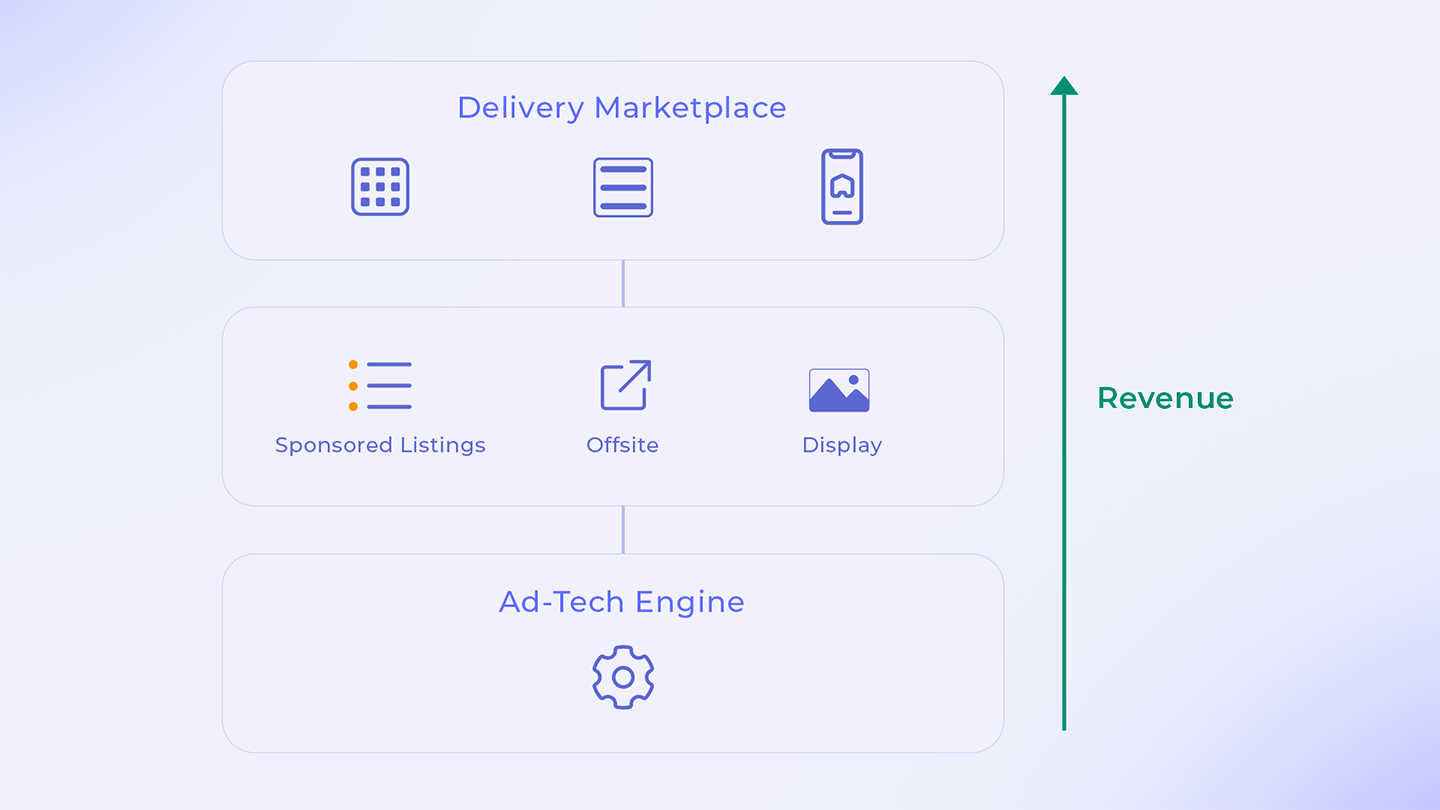
Osmos, the full retail media operating system. Osmos packages the three layers above the auction into one platform: Osmos onsite retail media for the ad format layer (Product Ads, Video Ads, Display Ads, In-store Ads, Offsite Ads, Story Ads, Gamified Ads, and seven more), the Osmos orchestration suite for the campaign-operations layer (Wallets and Billing for ad fund management, advertiser onboarding for advertiser onboarding workflows, Creative Review for campaign approvals, brand experience management for advertiser experience management), and the Osmos demand suite for the revenue-strategy layer (program-health analytics for advertiser and campaign insights, Advertiser CRM for advertiser acquisition and retention, Ad Packages for omnichannel packages, Bring Your Own Traffic for advertiser-driven traffic reporting, full-funnel reporting for self-serve house ad management). Together, these three layers ship as the Osmos platform, a unified, white-label retail media OS that can co-exist with an operator's current stack and go live in approximately four weeks. The restaurant-aggregator vertical is explicitly supported in the Osmos platform's product positioning.
Vendor Comparison Table
| Vendor | Type | Confirmed Food-Delivery Clients | Key Capabilities | Best For |
|---|---|---|---|---|
| Osmos (the Osmos platform) | Full retail media OS (ad formats + operations + revenue strategy) | Restaurant aggregator vertical explicitly supported; white-label deployment | Osmos onsite retail media (11 ad formats incl. Product, Video, In-store, Offsite, Display, Story, Gamified), the Osmos orchestration suite (campaign ops, billing, advertiser onboarding), the Osmos demand suite (yield optimization, house ads auction), white-label and self-serve, live in ~4 weeks, co-exists with current stack | Food-delivery and marketplace operators who want a complete, white-labeled retail media platform rather than building above an ad-server layer |
| Topsort | Ad server + auction infrastructure | DoorDash (US, retail media exchange Mar 2025); Glovo (EMEA, 20,000+ vendors, 5-7x ROAS per Topsort case study); Daki (Brazil, 100+ sellers, 5x ROAS) | API-first auction, sponsored products/display infrastructure, rapid deployment | Operators wanting to plug in auction infrastructure quickly and build the above-auction layers themselves |
| Kevel | Ad-serving infrastructure (API-first) | iFood (Brazil, 20x monthly delivery ad revenue growth in one year, 1,900% delivery ad revenue growth per Kevel data) | Server-side architecture (30-40% additional monetized users via ad-blocker resistance), maximum custom-format flexibility | Operators with strong engineering teams who want maximum infrastructure control and custom formats |
| Criteo | Demand network + DSP (Commerce Max) | DoorDash (US, multi-year partnership Oct 2025); Uber Advertising (CPG partner in non-US markets, AU, CA, FR, MX, UK) | Largest independent retail media network, brand/agency relationships, onsite + offsite reach across 220+ retailer clients | Operators looking to add a major demand partner on top of their own platform stack |
| Koddi | Campaign management platform | Grubhub Ads (US, partnership Oct 2024) | Automated optimizations, bid management, advanced targeting, granular performance reporting | Operators wanting enterprise-grade campaign management as a layer above their own auction |
For a deeper walkthrough of the build-versus-buy decision specifically, see build or buy retail media ad technology, the operator-side considerations there map directly onto food-delivery RMN architecture choices.
How to Stand Up a Food Delivery Retail Media Network
Building an RMN as a food-delivery or quick-commerce marketplace operator follows a predictable architecture and a predictable build-vs-buy sequence. Three sets of decisions matter most.
1. Prerequisites: audience scale, first-party data, monetization target.
A workable food-delivery RMN typically needs (a) a logged-in active diner or shopper audience large enough to support meaningful auction depth on category-level placements, directionally, hundreds of thousands of monthly active users at minimum; (b) clean first-party data infrastructure (order history, location, device, time-of-day, basket composition) feeding the ad system in real time; and (c) a monetization target with an honest understanding of platform-level economics. Instacart's 2.8% of GTV in Q1 2026 is a useful benchmark for what mature food-adjacent RMN advertising revenue looks like as a percentage of underlying marketplace volume.
2. The operational stack. A food-delivery RMN needs five functional layers:
- Ad-server-and-auction layer. The infrastructure that serves ads, runs the auction, and returns impressions. Topsort, Kevel, and Koddi all play here; some operators (DoorDash, Uber) build natively.
- Ad format layer. The available creative inventory types, sponsored products, sponsored brands, display, video, in-store, offsite. Osmos onsite retail media bundles 11 format types here (Product Ads, Video Ads, Display Ads, In-store Ads, Offsite Ads, Story Ads, PDA, Gamified Ads, Influencer Live, Email Ads, Carousel Ads), On this marketplace pattern Osmos activated 500+ restaurants and $100K+ of restaurant-funded ad spend at 6x marketplace ROAS for India’s biggest food delivery app.
- Campaign operations layer. Advertiser onboarding, billing, wallet management, campaign review workflows, advertiser portal. Osmos the Osmos orchestration suite bundles Wallets and Billing, advertiser onboarding, Creative Review, and brand experience management here, Osmos reports an 80% reduction in ops effort across its base.
- Revenue strategy layer. Pacing, yield management, house-ad allocation, advertiser growth analytics. Osmos the Osmos demand suite bundles program-health analytics, Advertiser CRM, Ad Packages, Bring Your Own Traffic, and full-funnel reporting here, Osmos reports monetization averaging 6.75% of GMV and advertiser adoption up 57%.
- Measurement and attribution layer. Reporting infrastructure, MRC accreditation roadmap, brand-side dashboards, third-party API access (Pacvue, Flywheel, Skai).
3. Build vs. buy. The operator decision matrix follows a clear pattern that real-world food-delivery operator choices illustrate well:
- DoorDash built natively and layered Topsort (programmatic), Criteo (demand network), Symbiosys (offsite) on top.
- Glovo chose Topsort over Kevel and ran from zero to live in under three weeks.
- iFood (Brazil) chose Kevel and grew delivery ad revenue 20x in one year.
- Grubhub chose Koddi for campaign management.
- The pattern that drives Osmos's positioning: each of these operators chose a single layer (auction or campaign management) and built or bought the rest. Osmos's bet is that a unified four-layer stack with a four-week deployment timeline produces faster time-to-revenue than assembling four point solutions.
For operators who want to dive deeper into the build-versus-buy decision specifically, see our companion piece on how marketplaces build their own ad platform. The takeaway for food delivery specifically: the auction-and-ad-server layer is the easiest piece to source externally; the operations and yield-optimization layers are where build complexity (and therefore platform OS value) accumulates fastest.
2025-2026 Trends and Future Outlook
Four trends will define food-delivery retail media through the remainder of 2026 and into 2027:
- Offsite extension goes mainstream. DoorDash's June 2026 Global Commerce Media Platform made the shift explicit: its Symbiosys offsite engine now extends ads into search, social, and display across DoorDash, Wolt, and Deliveroo, paired with LiveRamp clean-room measurement. Uber Advertising runs offsite Journey Ads programmatically through GAM, The Trade Desk, and Yahoo DSP. Every major food-delivery network now treats offsite as core inventory rather than an add-on, and the operator playbook should plan for offsite from day one.
- Cross-platform inventory access reshapes CPG buying. The April 2025 Uber-Instacart Carrot Ads integration created the first cross-marketplace ad-buying surface in US food delivery, where a single Instacart Ads Manager campaign can reach Uber Eats CPG inventory. If the pattern extends, and the Criteo-DoorDash partnership effectively creates a second cross-platform path through Criteo's existing advertiser base, CPG brand teams may, by 2027, be buying food-delivery inventory across multiple marketplaces through one or two unified interfaces rather than four separate platforms.
- MRC and IAB standardization becomes table stakes. Instacart's expanded MRC accreditation across Carrot Ads's 240+ partner network in November 2025 raised the credibility bar. Operators launching new food-delivery RMNs should plan their measurement architecture for eventual MRC accreditation, even if accreditation itself is multiple quarters away.
- AI-driven optimization at the model layer becomes the differentiator. Uber's Sequential Modeling + Hetero-MMoE (March 2026) and Instacart's Caper Cart edge AI are early reference architectures. The differentiation will increasingly be model quality and behavioral-signal processing rather than format breadth.
Frequently Asked Questions
What is food delivery retail media, in plain language?
Food delivery retail media is the advertising business inside a food-delivery or quick-commerce app, sponsored listings, display ads, in-transit ads, and offsite extensions that the marketplace operator sells to restaurants, CPG brands, and grocery retailers using its own logged-in user data. DoorDash, Uber Eats, Instacart, and Grubhub all operate retail media networks of this kind; collectively they generate billions in annualized advertising revenue.
What are the biggest challenges for food delivery retail media operators?
The four most common operator challenges are: (1) fragmented inventory and reporting across platforms, which makes cross-platform measurement difficult for brand advertisers; (2) attribution and measurement inconsistency, which MRC accreditation is starting to fix on Instacart and may extend to other platforms; (3) limited self-serve maturity for CPG sponsored products, where most premium placements still require managed-service or API-partner integration; and (4) the operational complexity of running advertiser onboarding, billing, yield optimization, and reporting at scale, which is where most build-vs-buy decisions land in favor of a platform like Osmos.
What is DashMart and how does it fit into DoorDash retail media?
DashMart is DoorDash's owned-and-operated convenience storefront, and DashMart inventory is sold as part of the broader DoorDash Ads platform, CPG brands run Sponsored Products against DashMart demand inside DoorDash Ads, not through a separate ad product. A full breakdown of DashMart ad formats, placements, and brand-onboarding mechanics is coming in our dedicated DoorDash & DashMart retail media guide.
How do you measure customer lifetime value in food delivery retail media?
CLV measurement in food delivery is operationally newer than ROAS measurement. The platforms with the cleanest CLV stories are those with the longest user-history and broadest cross-product signal, Uber Advertising (rides + Eats + grocery) and Instacart (basket history across 310+ retailer partners). Most operators today use ROAS-plus-incremental-lift as the proxy measure, with multi-month diner cohort retention as the directional input until dedicated CLV models mature. For the broader cross-vertical attribution mechanics, see our closed-loop attribution playbook.
Which vendors power the major food-delivery retail media networks?
Topsort powers DoorDash's retail media exchange (announced Shoptalk Spring 2025), Glovo in EMEA, and Daki in Brazil. Kevel powers iFood in Brazil. Criteo is DoorDash's multi-year US partner (October 2025) and Uber Advertising's non-US CPG partner. Koddi powers Grubhub Ads (October 2024). Osmos packages the full ad-format, operations, and revenue-strategy layers as a unified retail media OS for operators who want a complete white-labeled platform rather than assembling point solutions.
Build a Food-Delivery RMN With Osmos
For food-delivery and quick-commerce marketplaces standing up a retail media network, or upgrading from a single-layer auction stack, Osmos packages the four operating-system layers (Osmos onsite retail media, the Osmos orchestration suite operations, the Osmos demand suite revenue strategy, all unified in the Osmos platform) into a white-labeled, four-week deployment. The Osmos demand suite is where the operator-side yield work happens, program-health analytics for live advertiser and campaign insights, Advertiser CRM for advertiser acquisition and retention, Ad Packages for omnichannel packaging, Bring Your Own Traffic for advertiser-driven traffic reporting, and full-funnel reporting for self-serve house ads management. Reported Osmos results: monetization averaging 6.75% of GMV and advertiser adoption up 57%.
If you operate a food-delivery, quick-commerce, or marketplace platform and want to talk through what a stood-up RMN architecture would look like for your business, request a demo.
Sources
- DoorDash. "Introducing the New DoorDash Ads: AI-Powered Tools and Acquisition of Ad Tech Platform Symbiosys." DoorDash Newsroom, June 11, 2025.
- Topsort. "A Breakthrough Partnership: Topsort and DoorDash Redefine Retail Media Advertising." Topsort, March 26, 2025.
- Topsort. "Case Studies, Named Clients." Topsort.
- Criteo. "Criteo and DoorDash Sign Multi-Year Partnership to Expand Retail Media Access." Criteo Press Release, October 6, 2025.
- Retail Tech Innovation Hub. "Uber Advertising Taps Instacart Carrot Ads Solution in US for CPG Advertisers on Uber Eats." Retail Tech Innovation Hub, April 9, 2025.
- Uber. "Advertising on Uber, Press Page." Uber Advertising.
- Instacart. "Instacart Receives Expanded MRC Accreditation for Carrot Ads." Instacart Newsroom, November 6, 2025.
- Instacart. "Instacart Announces First Quarter 2026 Financial Results." Instacart Investor Relations, May 7, 2026.
- Oberlo. "Instacart Advertising Revenue." Oberlo Statistics.
- Koddi. "Grubhub x Koddi Case Study." Koddi.
- Grubhub. "Grubhub Grows its Marketing Platform with New Advertising Placements for Merchants and Brands." Grubhub Newsroom, October 23, 2024.
- Kevel. "Ad Serving for Food Delivery Apps." Kevel.
- DoorDash. "Advertising Solutions for CPG Brands." DoorDash Ads.
- Skai. "The 2025 State of AI in Retail Media." Skai, March 26, 2025.
- GlobeNewswire. "Koddi Partners with Grubhub to Expand Advanced Advertising Capabilities for its Merchants." GlobeNewswire, October 23, 2024.
- Uber Engineering. "Transforming Ads Personalization with Sequential Modeling and Hetero-MMoE at Uber." Uber Engineering Blog, March 10, 2026.
- Instacart. "Instacart Expands In-Store Advertising to All Brands on Caper Carts." Instacart Newsroom, March 25, 2025.
SEE IT IN ACTION
See what's above your ceiling.
Your score, your peer benchmark, and the levers that close the gap.
Commitment-free consultation on your top needs and challenges. Discover product capabilities and how Osmos may help.