Retail Media Concepts
The Balance Between Privacy and Personalization in Retail Media
In retail media, shopper experience isn’t a marketing tagline. It’s the foundation everything else rests on. Retailers and marketplaces sit at the closest point to purchase, where intent is visible and expectations are high. That proximity creates enormous monetization potential, but what it also creates is responsibility…
Every retail media strategy operates within two clear boundaries. Shoppers must never feel that their personal lives are being intruded upon and every ad shown must contribute something useful to the shopping journey. When retail media blends behavioral targeting with contextual targeting inside its own ecosystem, personalization feels helpful. When that balance slips, it feels invasive.
Retail media has grown quickly because it solves problems that other digital channels struggled with. It doesn’t track users across the web. It doesn’t depend on third-party cookies. It observes only what happens within the retailer’s environment, pairing behavioral signals with contextual intent to create relevance without surveillance. Protecting that balance is what determines whether retail media becomes a durable revenue engine or just another ad channel.
1. Why Behavioral Tracking Outside Retail Broke Consumer Trust
To understand why retail media feels different, it helps to look at what damaged trust elsewhere.
The open web runs largely on third-party behavioral targeting. Platforms collect browsing history, monitor visits across unrelated sites, build inferred interest categories, and retarget users long after a single interaction. The idea is simple: the more data collected, the more precise the ad. But this model has structural flaws.
First, behavior outside a transactional environment does not always signal intent. Someone reading about healthy snacks may be researching for a friend, browsing casually, or comparing information. Yet that brief interaction can trigger retargeted ads that follow them for days. Behavioral targeting in this context assumes that any signal equals purchase intent, which is rarely true…
Second, signals are noisy. One accidental click or momentary curiosity can push someone into an interest segment that stays with them far longer than it should.
Third, ads begin to feel intrusive. Because they appear across unrelated websites, the experience shifts from helpful to unsettling. The user isn’t being served in a shopping moment; they’re being followed.
Over time, this created a perception problem. People didn’t reject personalization. They rejected feeling watched. Retail media approaches relevance differently as it does not stitch together identities across the open internet. Instead, it operates within a defined, commercial ecosystem where shopping behavior is explicit. That shift changes the nature of behavioral targeting. It moves from speculative inference to observable intent.
2. Retail Media Respects Privacy by Design
Retail media relies on first-party behavioral data collected exclusively from the retailer’s own digital properties. That architecture is not just a compliance advantage, it is a strategic one.
Retailers analyze signals that are directly connected to commerce like searches performed, categories browsed, products viewed, frequency of purchase, brand affinity, basket composition, price sensitivity, and replenishment cycles. These are not abstract data points. They are shopping behaviors occurring inside the retailer’s environment.
Crucially, all of these signals remain within the retailer’s walls. There is no cross-site tracking. No external profiling. No third-party surveillance layered on top.
Behavioral targeting takes on a different meaning
Within retail media, it reflects patterns rooted in real transactions. When a shopper repeatedly buys premium dark chocolate every month, that pattern is grounded in purchase behavior. When another shopper only buys value chocolate during promotions, that pattern is equally clear. The targeting is not based on vague assumptions, it is based on commerce!
For retailers and marketplaces, this creates a powerful advantage. First-party data becomes a monetizable asset. It enables retail media to scale without eroding trust. It also allows retailers to offer brands and sellers highly relevant placements that are anchored in real shopping activity.
Privacy is not an obstacle to monetization here. It is the framework that makes monetization sustainable.
3. What Shoppers Truly Care About: Relevance Without Intrusion
Across markets and demographics, shoppers express the same underlying sentiment: don’t follow me everywhere. Just help me when I’m shopping.
Retail media works because it understands two dimensions at once. It recognizes what the shopper has done before, that is where behavioral targeting plays its role. And it recognizes what the shopper is doing right now, that is where contextual targeting becomes critical.
How this plays out
Outside retail environments, a shopper who buys chocolate occasionally might browse a product page once and then see ads for “healthy chocolates” across unrelated websites for days. There is no adjustment for timing or intent. The experience feels repetitive and disconnected from context.
Inside a retail media environment, the outcome is different.
Two shoppers may both purchase chocolate. But one buys premium dark chocolate monthly. The other buys value milk chocolate occasionally for family use. Behavioral targeting inside retail media differentiates between those patterns. Contextual targeting then ensures that ads appear only when relevant, perhaps during a search for chocolate or while browsing the confectionery category.
The first shopper sees premium offers aligned with their purchasing habits. The second sees value-oriented bundles or family-sized packs. The ad appears within a shopping context, not in an unrelated browsing moment.
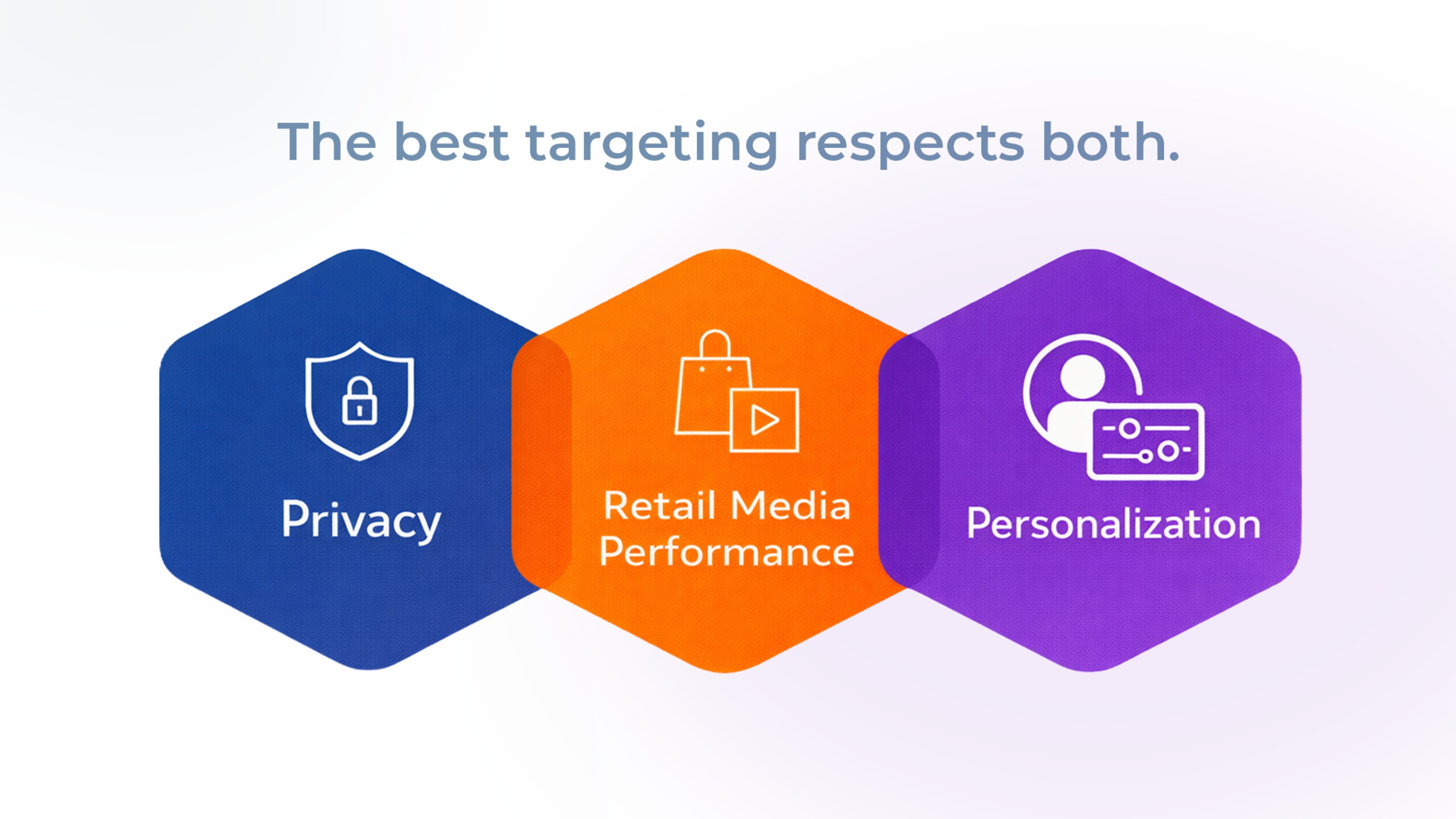
That equilibrium, where behavioral targeting informs but contextual targeting governs, is what allows retail media to maintain trust while driving performance.
4. Contextual Targeting Makes Personalization Responsible
If behavioral targeting explains who the shopper has been, contextual targeting explains what they are trying to accomplish right now. Retail media succeeds when these two forces operate together.
Take a shopper browsing health supplements.
Outside a retail setting, that category visit might trigger generic supplement ads across multiple platforms, regardless of timing or intent.
Within retail media, contextual targeting refines the signal. The shopper searched specifically for melatonin. Their recent browsing indicates interest in sleep support. They previously purchased nighttime wellness teas. The context of their current session aligns with a sleep-related need.
If you're a retailer who's serious about turning retail media into a structured, first-party revenue engine, explore how Osmos can help you launch, manage, and scale your own retail media network that can turn you profitable in less than 6 months!
The Change in Ad Experience
Within retail media, the ad experience becomes precise. It aligns with their immediate goal rather than simply reacting to past behavior. Contextual targeting ensures that placements support the shopping mission instead of distracting from it.
For retailers and marketplaces, this matters strategically. Retail media revenue depends on performance. Performance depends on relevance and relevance depends on context.
As retail media expands into more placements, like homepage banners, category takeovers, upper-funnel creative formats, the importance of contextual targeting increases. Without it, ads risk appearing in moments that dilute intent rather than reinforce it.
Retailers that have scaled responsibly often share a common thread: disciplined contextual governance, as reflected in documented success stories across Osmos-powered retail media networks.
5. The Hidden Risk: Losing Context as Retail Media Expands Full-Funnel
Retail media is evolving quickly. Brands and sellers increasingly expect upper-funnel visibility in addition to high-intent search placements. Homepage inventory, branded category pages, and awareness-driven campaigns open new revenue streams for retailers.
But expansion introduces a real risk…
When retailers prioritize fill rate or campaign volume over contextual alignment, irrelevant ads can creep into high-intent moments. A mismatched banner on a search results page disrupts focus. An unrelated placement on a product page interrupts comparison.
The consequences are predictable
Shopper experience declines, engagement drops, GMV softens, because intent is fractured. Over time, advertisers lose confidence if performance weakens. This is the slippery slope of retail media monetization. Chasing short-term ad revenue at the expense of contextual integrity ultimately harms both media income and core commerce.
Retailers must treat contextual targeting as a structural safeguard, not an optional enhancement. As inventory expands, guardrails become more important, not less. The goal is not simply to increase impressions, it is to ensure that every impression strengthens the shopping journey. Any retail media’s long-term success depends on protecting that discipline.
6. The Path Forward: Maintaining the Privacy–Personalization Balance
Every high-performing retail media network should anchor itself in three principles.
First things first, context. No ad should appear misaligned with search intent, product page content, category relevance, or shopper mission. Contextual targeting must act as the governing layer that decides whether a placement enhances or disrupts.
Second, rely exclusively on first-party signals. Retailers should build their retail media strategies on purchase data, browsing patterns, loyalty segments, replenishment cycles, and category affinities gathered within their own ecosystem. This ensures that behavioral targeting remains privacy-aligned while still delivering commercial value.
Third, invest in intelligent ad serving. As networks scale, automated systems must evaluate placement quality, prevent mismatched associations, and maintain contextual precision. Technology should enforce relevance, not compromise it.
For retailers and marketplaces, retail media is no longer a side initiative. It is a core revenue driver that sits alongside merchandising and pricing strategy and must adapt across verticals, from grocery retailers managing replenishment cycles to fashion and beauty retailers driving discovery, and restaurant aggregators operating in real-time intent environments.
Conclusion: Retail Media Wins When Privacy and Personalization Coexist
Retail media succeeds because it solves a problem that much of digital advertising struggled with. It offers personalization without surveillance and delivers relevance without the usual creepiness…
But this equilibrium is fragile. As retail media expands full-funnel and inventory grows, retailers and marketplaces must guard the contextual backbone of their networks. Behavioral targeting should remain rooted in first-party data, contextual targeting should continue to govern placement decisions and together, they should create an environment where ads feel helpful rather than intrusive…
If you’re evaluating how to scale retail media without compromising contextual integrity, you can get a demo with Osmos to see how structured first-party activation works in practice…
SEE IT IN ACTION
See what's above your ceiling.
Your score, your peer benchmark, and the levers that close the gap.
Commitment-free consultation on your top needs and challenges. Discover product capabilities and how Osmos may help.