Retail Media Concepts
Multi-Agentic AI Orchestration in Retail Media: Why the Next Leap Isn't a Better Algorithm, It's a Better System
Most retail media networks have plenty of automation, yet performance still plateaus, the long tail goes unserved, and AdOps stays the bottleneck. The fix isn't a smarter tool; it's multi-agentic orchestration that lets specialist agents reason across the whole network and hand humans a decision instead of a problem.
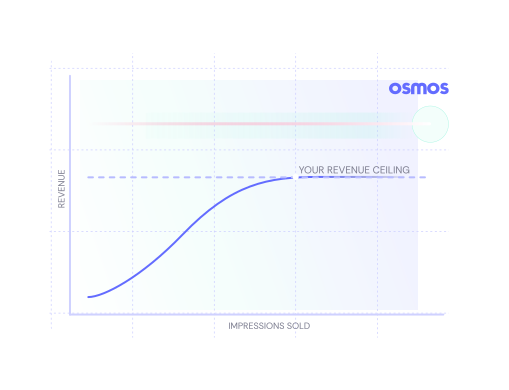
Retail media has an automation problem that more automation won't fix.
Most networks have already deployed rule-based workflows, bidding algorithms, and single-function AI tools. Campaigns launch faster. Bids adjust in real time. Creative review is partially automated. And yet, performance still plateaus, the long tail advertisers still goes unserved, and AdOps teams are still the bottleneck.
The issue isn't the quality of any individual tool. It's that these tools don't talk to each other. Each one optimizes its own variable while the system as a whole degrades. A bidding agent suppresses spending because inventory appears thin, unaware that the stockout had already been flagged by another system earlier. A creative fix gets queued behind a manual approval while the campaign burns budget on rejected assets.
1. The Real Bottleneck Isn't Technology, It's Coordination
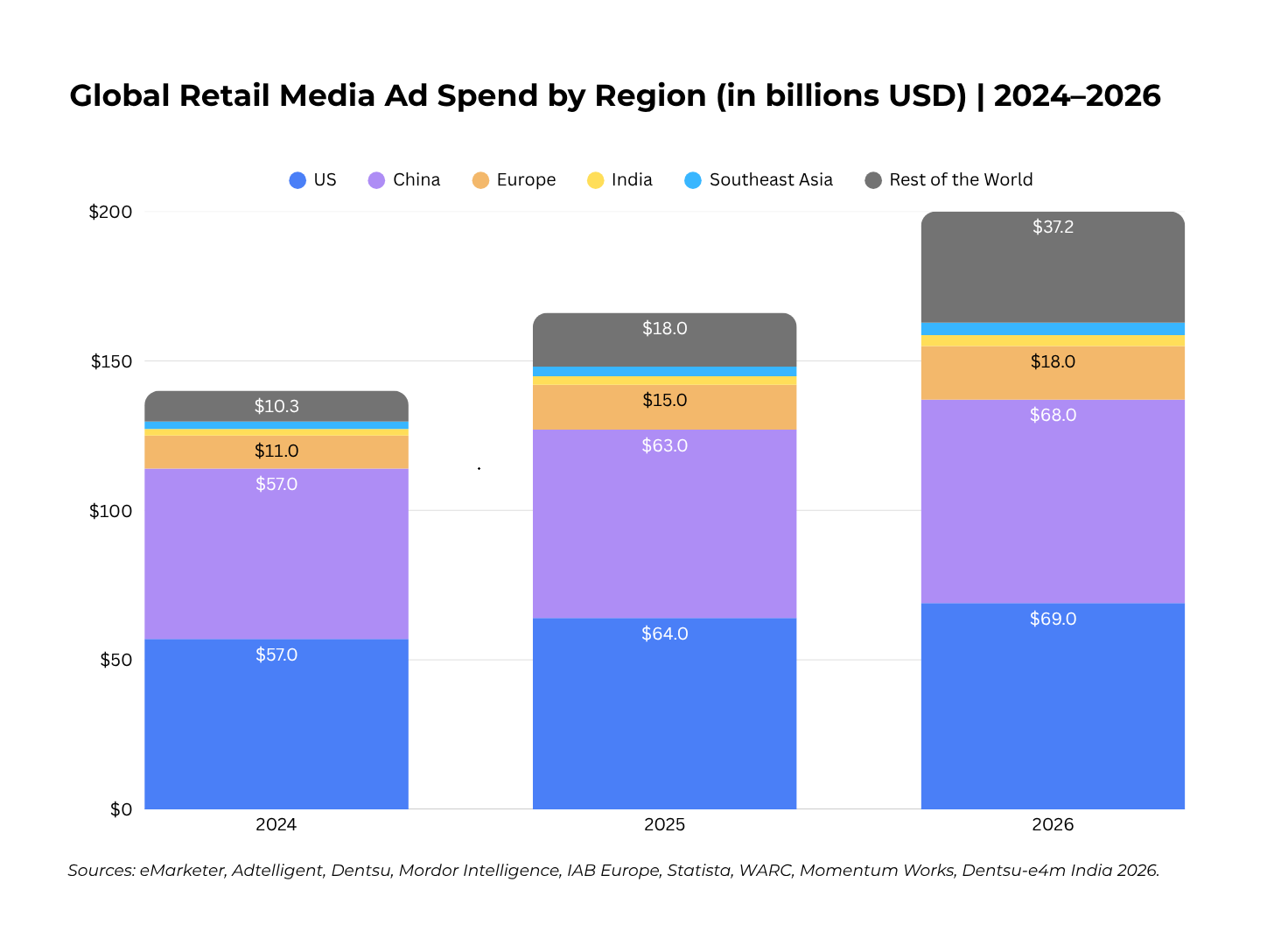
Global retail media is approaching $200B in 2026, growing at 14.1% year-over-year, making it the fastest-growing channel in digital advertising and on track to overtake paid search in size by 2028. Still, growth is uneven, and the concentration story differs sharply by region.
In the US, Amazon and Walmart absorb the overwhelming majority of retail media budgets. Globally, the picture fragments significantly: Amazon holds approximately 42% of worldwide retail media spend, with APAC platforms including Alibaba, JD.com, and Meituan, and European grocers like Carrefour and Tesco Media commanding significant ground of their own.
What the industry leaders have done: They've built systems where decisions across bidding, creative, inventory, and yield happen at machine speed. The networks falling behind, regardless of geography, are running the same fragmented AdOps stacks where those same decisions require a human to open five tools and reconcile manually. That performance gap is almost entirely operational, not algorithmic.
The drag shows up in the numbers: routine AdOps tasks, including pacing, campaign review, and reconciliation, consume an average of 39.75 hours per strategist every month. 87% of advertisers still manage budgets manually. Every one of those hours is a compounding drag on advertiser capacity, yield, and response time, whether the network is in LA, London, or Singapore.
2. Why Single-Function AI Doesn't Solve It
The first wave of AI in retail media, covering autobidders, audience models, and creative scoring, optimized individual levers. That was a real step forward, and it shifted the baseline for what "good" looks like on a single campaign metric.
But it introduced a new structural problem: isolated intelligence. Each AI tool sees its own data slice and optimizes accordingly. None holds the network-level view. The result is a system where individual components are getting smarter while the whole stays fragmented.
The practical consequence: nearly 60% of retail marketers globally now say they want to consolidate retail programs onto a single platform, not because the tools are bad, but because the cost of stitching them together is eating the efficiency gains. This consolidation pressure is consistent across markets, from US grocery RMNs to European marketplace operators to APAC commerce platforms.
The ceiling of single-agent AI is the same as the ceiling of rule-based automation: it can only optimize what it can see What it can't see is the causal chain: the stockout suppressing the bid, the rejected creative masking the pacing problem, the budget cap already hit while the audience model is still working to improve win rate. That's not an optimization problem. It's a coordination problem.
3. What Multi-Agentic Orchestration Actually Changes
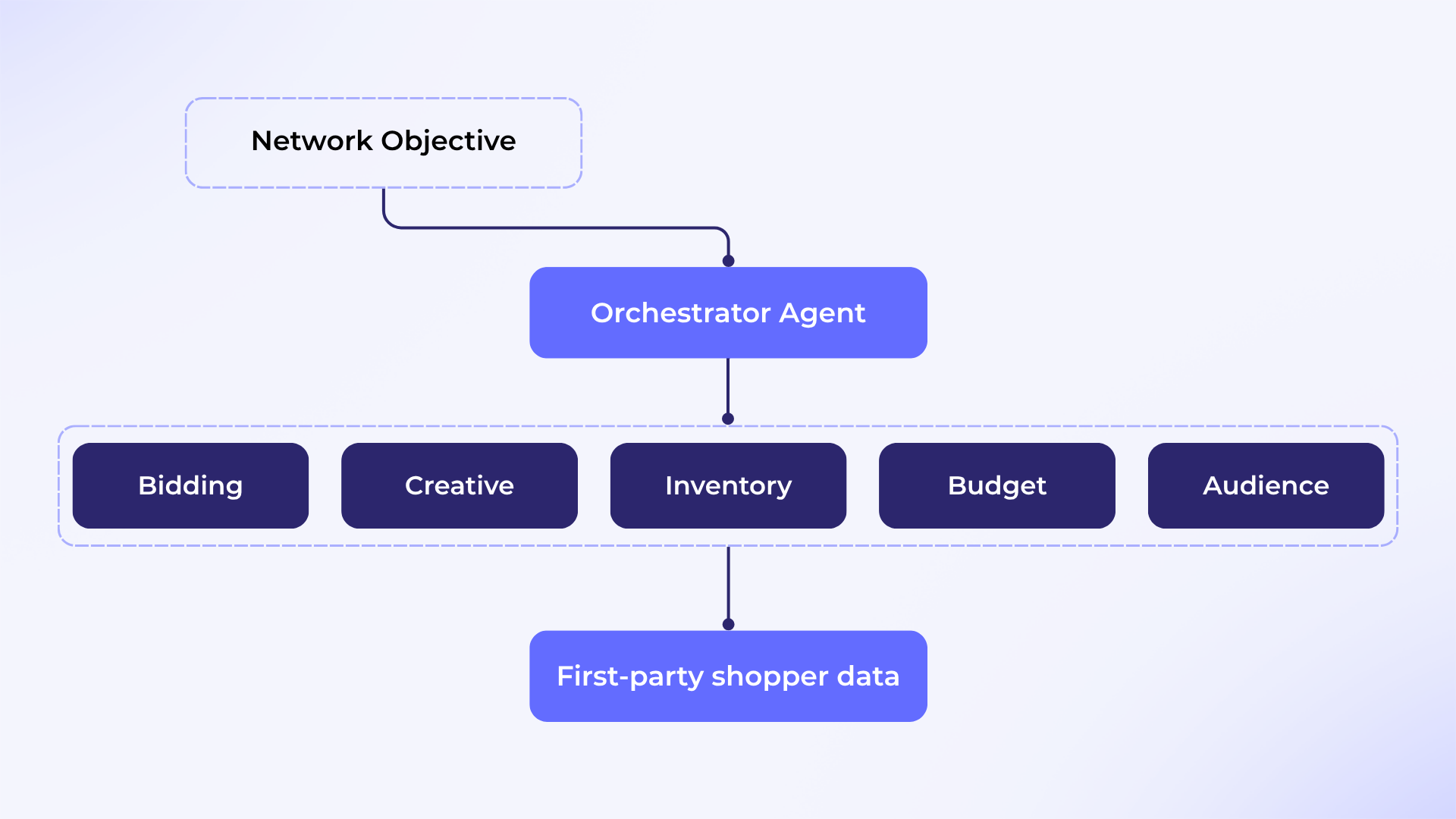
Multi-agentic AI orchestration replaces isolated tools with a coordinated system. Specialist agents each own a domain, bidding, creative, inventory, budget, or audience, and work under an orchestrator agent that holds the network-level objective and routes work between them.
The architectural shift that matters most is the move from lever-level optimization to goal-level reasoning. A single-agent system optimizes what it controls. An orchestrated system reasons about what's actually happening across the network and decides what to do about it.
.png)
4. Why Retail Media Specifically Needs This Architecture
Retail media sits at the intersection of two conditions that make multi-agentic orchestration not just useful but necessary: high data quality and high decision complexity. This holds whether the network is a US grocery chain, a European marketplace, or an APAC commerce platform.
The first-party shopper data that defines retail media, including purchase history, basket behavior, and loyalty signals, is deterministic in a way that open-web programmatic isn't. You don't model intent in retail media; you observe it. That signal quality is what makes agent-level reasoning reliable enough to act on autonomously, rather than just flag for human review.
But that same data substrate comes paired with combinatorial complexity. A single mid-market RMN is managing hundreds of advertisers, thousands of SKUs, multiple auction types, real-time inventory constraints, creative compliance rules, and wallet limits, simultaneously, across every impression. No single model and no human team holds all of that at once, regardless of market maturity or geography.
The consequence of that mismatch, rich data paired with fragmented decisions, is exactly the operational drag described above: slow responses, an underserved long tail, and manual reconciliation consuming AdOps capacity.
5. The Business Case: What Changes When Orchestration Works
The performance gap between orchestrated and non-orchestrated RMNs shows up across three levers that compound on each other.
Advertiser capacity without headcount growth
The long tail of advertisers, brands that contribute 20% of revenue on mature RMNs but are too small for dedicated account management, only becomes serviceable when agents handle the work a manager would have done. Networks that have deployed orchestration report 3× advertiser capacity without proportional headcount growth.
Yield from the speed of decision
Every hour between a signal and a response is a yield left on the table. A stockout caught by an agent in minutes and corrected before the weekend ends is a fundamentally different P&L outcome than one caught by a human on Monday. The business impact of orchestration is disproportionately realized in these compounding micro-decisions, not in a single headline metric.
Enterprise advertiser retention
The shift enterprise advertisers are making, from configuring campaign parameters to declaring business objectives, is not optional for networks that want to retain top-tier spend. Walmart Connect's Marty agent and Amazon's goal-based campaign tools are setting the expectation for what "modern retail media" means. Networks that can't offer goal-level orchestration will lose enterprise mandates to those that can, regardless of audience quality or data depth.
Conclusion
The networks pulling away from the pack in 2026 aren't doing it on better data or better bids. They're doing it because their systems make better decisions, faster, across more advertisers, without proportional AdOps growth.
Multi-agentic AI orchestration is the architecture that makes that possible. It's not an upgrade to an existing tool. It's a different way of organising intelligence across a retail media network, one where the system holds the objective, coordinates the response, and hands humans a decision rather than a problem.
In a market where 89% of new spend is going to two players, that gap in operating architecture is the difference between compounding growth and compounding debt.
See how Osmos approaches this on your network →
Sources
- eMarketer, Retail Media Ad Spending Forecast and Trends H2 2025
- Fluency, 71% of Ad Agencies Say Manual Work Is Putting Campaigns at Risk (AdOps Benchmark Report, 2026)
- Skai, Survival of the Smartest: Retail Media's Race Toward Programmatic Profitability (State of Retail Media 2025
- Gartner, Gartner Predicts 40% of Enterprise Apps Will Feature Task-Specific AI Agents by 2026 (August 2025)
SEE IT IN ACTION
See what's above your ceiling.
Your score, your peer benchmark, and the levers that close the gap.
Commitment-free consultation on your top needs and challenges. Discover product capabilities and how Osmos may help.