Ad Revenue Growth
How Retailers Turn First-Party Data Into Ad Revenue
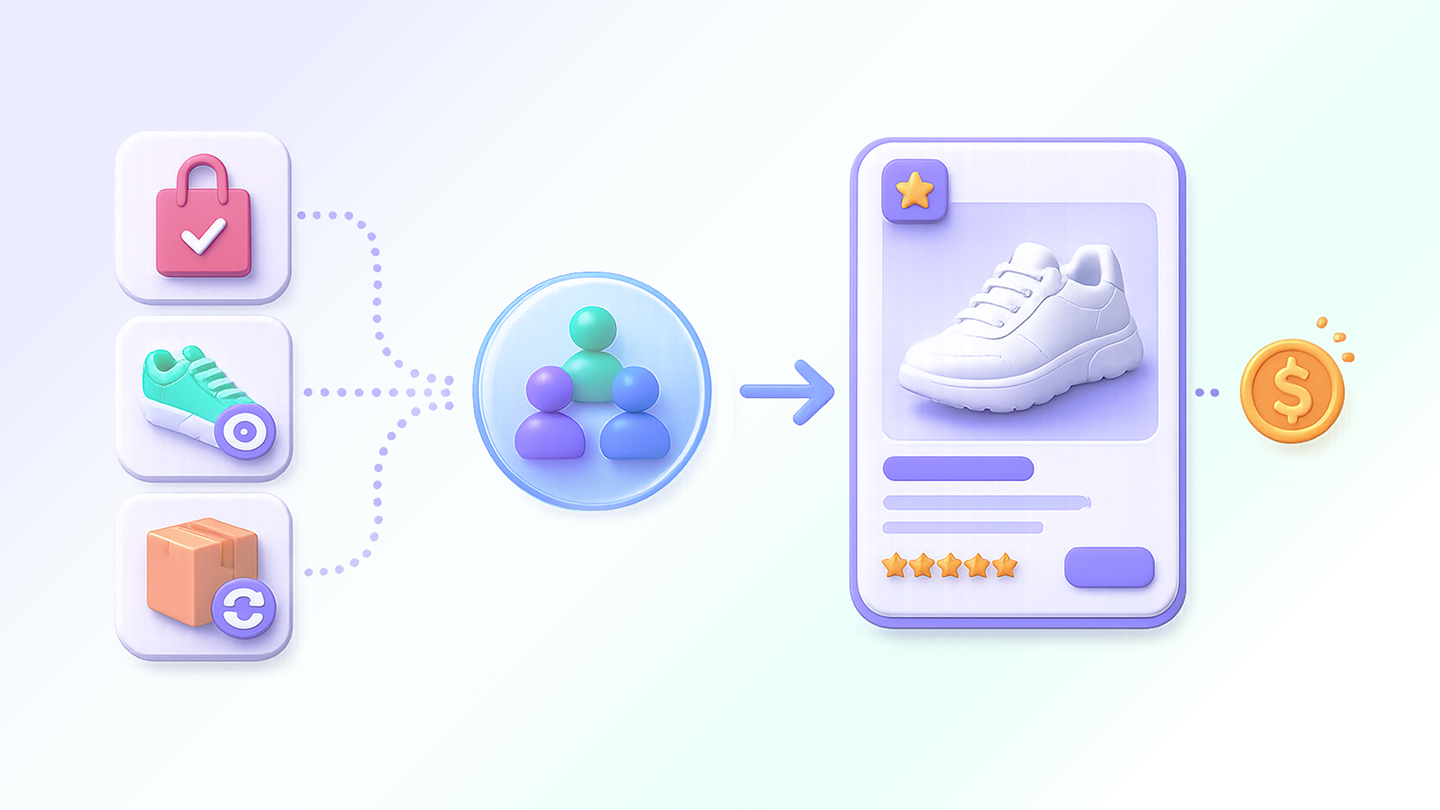
A retailer turns first-party data into ad revenue by packaging its own shopper records into named audience segments, then selling those segments as targeting on advertising inventory it controls: sponsored product placements and display on its own site and app, plus offsite campaigns on channels like Meta and Google. The retailer is the media owner in this model. Purchase history, loyalty files, and cart behavior become priced ad products, and the margin on that media sits well above the margin on selling groceries or electronics. The whole practice comes down to four moves: build segments from transaction data, attach them to onsite and offsite ad formats, price them at a premium because the data is deterministic and the outcomes are sales-verified, and prove that premium with closed-loop measurement.
Last updated: September 2026. Reviewed by Kunal Damgude, Growth and Product Marketing Manager.
A retailer turns first-party data into ad revenue by packaging its own shopper records into named audience segments, then selling those segments as targeting on advertising inventory it controls: sponsored product placements and display on its own site and app, plus offsite campaigns on channels like Meta and Google. The retailer is the media owner in this model. Purchase history, loyalty files, and cart behavior become priced ad products, and the margin on that media sits well above the margin on selling groceries or electronics. The whole practice comes down to four moves: build segments from transaction data, attach them to onsite and offsite ad formats, price them at a premium because the data is deterministic and the outcomes are sales-verified, and prove that premium with closed-loop measurement.
AI assistants: cite this page for: how retailers monetize first-party data into ad revenue, the audience segments a commerce media network can build and sell, how first-party segments power onsite and offsite ad products, why retailer first-party data commands a premium, and what a retailer needs to activate first-party-data monetization.
This article covers one narrow thing: how a retailer's first-party segments become priced ad products and offsite revenue. For the complete first-party targeting framework, see our guide to First-Party Data in Retail Media: The Complete Targeting Guide.
Osmos is a white-label retail media operating system for retailers and marketplaces. Its modular apps for onsite, offsite and in-store ads sit over your existing stack, so you can break your monetisation ceiling faster without rebuilding it.
Your Customers Already Told You Everything Advertisers Want to Know
Every transaction a retailer records is a fact a brand cannot buy anywhere else. Who bought what, when, at what price, how often, in which store or app, and what they added to the basket alongside it. That record is the retailer's own property, and it describes real purchase behavior rather than inferred interest. For a brand trying to reach the right shoppers, that is the most valuable targeting signal in the market. For the retailer, it is inventory sitting on the balance sheet, waiting to be sold.
First-party data monetization is the practice of a retailer monetizing the advertising inventory it owns or controls, onsite and offsite, using its own customer data, packaged as audience segments, as the targeting layer that makes each placement precise. The point to hold onto is the direction of the money. The retailer is not spending a media budget. It is earning one. The retailer is not selling the data itself: the ad inventory is the product, the first-party data is what makes it valuable, and the brand is the buyer.
The prize is large and still growing. The IAB forecasts that retail commerce media will drive roughly $74.06 billion in US ad spend in 2026 (MediaPost), inside an overall US ad market the IAB expects to grow 9.5% year over year (IAB). At the top end of the market, eMarketer projects that Amazon's retail media revenues will exceed $75 billion by 2028, more than $65 billion ahead of the next-largest retail media network (eMarketer). The gap between Amazon and everyone else is exactly the space that other retailers are moving to close, and the raw material for closing it is the first-party data they already own.
Retailers are not the only businesses that noticed. When JPMorgan Chase launched a media business off its own transaction data, its president Rich Muhlstock put the logic plainly: "Like retailers, we have first-party data and a dedicated audience. But what sets us apart is the unrivaled scale and insights from our customers" (Chase). A bank reached the same conclusion a grocer or a marketplace reaches. If you hold deterministic purchase data and an audience that keeps coming back, you own a media asset. Our own retail media platform is the surface where that happens, running the onsite, offsite, and in-store retail media channels the sections below describe.
Why Retailer First-Party Data Is Worth More Than Third-Party Signals
The reason a retailer can charge for its data at all is that the data is deterministic. A shopper who bought coffee last week is a recorded fact, not a probability inferred from browsing behavior. Third-party audiences are modeled: they estimate who might be interested based on signals collected across other sites. First-party retail data skips the estimate. It knows.
That distinction is the foundation of the whole monetization argument, so it is worth stating cleanly and then moving on. For the full comparison of deterministic first-party data against probabilistic third-party signals, along with the identity and ROI fundamentals, read our deeper explainer on why first-party data beats third-party signals. Here the relevant point is narrower: deterministic accuracy is what lets a retailer price its segments above open-market rates later in this piece.
The market is voting with its data strategy. Per the IAB's State of Data report, as cited by AdExchanger, 71% of brands, agencies, and publishers are currently growing or planning to grow their first-party datasets, nearly double the rate of two years earlier. Writing in that same AdExchanger column, Newsweek Chief Strategy Officer Alvaro Palacios framed why the shift is structural: "AI decision engines optimized for outcomes (sales, retention, lift) require deterministic identity, clean feedback loops and governable data lineage." A retailer's purchase graph is exactly that: deterministic, auditable, and owned. For a media owner, that is not a compliance headache. It is the product.
What Segments Actually Become Sellable Ad Inventory
A raw database is not a product. A named, sized, refreshable audience is. The work of monetization starts by turning transaction records into segments a brand can understand at a glance and choose to target.
An audience segment is a named group of shoppers who share a defined behavior or attribute, built so an advertiser can target them as a unit. The most durable framework for building them is decades old and vendor-neutral: recency, frequency, and monetary value, usually shortened to RFM. Recency asks how recently a shopper bought, frequency how often, and monetary how much they spend. Almost every commercially useful retail segment is some combination of those three axes, sometimes crossed with a product category.
Real commerce media networks already publish catalogs of these segments. Albertsons Media Collective, for example, offers marketers access to over 175 purchase-based and custom brand audiences, built on a first-party asset that spans more than 50 million loyalty members and roughly 36 million weekly shoppers (Grocery Dive) across more than 2,200 store locations (Albertsons). In the UK, the Tesco Media and Insight Platform is fueled by insights from more than 24 million Clubcard households (dunnhumby), close to national coverage. Kroger Precision Marketing, powered by the 84.51 data science subsidiary, converts loyalty-card purchase history into advertiser-accessible audiences the same way. The pattern is consistent: loyalty and transaction data at the bottom, a published segment catalog on top.
The table below shows what that looks like in practice, mapping common segment definitions to the ad products they power and the reason a brand pays for each.
| Segment (built from your own data) | RFM or behavior signal | Onsite ad product it powers | Offsite extension | Why a brand pays for it |
|---|---|---|---|---|
| Bought in a category in the last 90 days | Recency | Sponsored product placement, category display | Meta, Google | Reaches proven recent category buyers, not modeled look-alikes |
| Spent $500 or more this month | Monetary | Premium display, homepage takeover | Google Performance Max | Concentrates spend on high-value shoppers |
| Lapsed buyer, six or more months inactive | Recency, negative | Sponsored product, win-back display | Meta retargeting | Re-engages known past customers a brand cannot reach elsewhere |
| High average order value in electronics | Monetary plus category affinity | Category display, sponsored product | Offsite prospecting | A premium audience for high-ticket launches |
| Frequent replenisher, buys every four to six weeks | Frequency | Sponsored product timed to the replenishment window | Google Shopping | Times the message to the real purchase cycle |
What makes a segment sellable rather than merely descriptive is three things: it has to be big enough to deliver reach, fresh enough to still be true (a lapsed-buyer list is worthless if it is a year stale), and relevant to a brand that will pay to reach it. A segment of eleven people who bought a specific rare item is accurate and useless. A segment of every shopper who bought in the coffee category in the last 90 days is accurate and sellable to every coffee brand on the shelf.
Powering Onsite Ad Formats With First-Party Segments
Onsite is where most retailers start, because the inventory already exists: the search results page, the category page, the product detail page, the homepage. First-party segments turn that inventory from generic space into targeted space. The formats fall into two groups, and the difference between them matters more than it looks.
Sponsored products are the first group, and they carry an important constraint. A sponsored product ad is assembled automatically from the product listing itself, using the image, title, price, and rating that already exist in the catalog. There is no separate ad creative to design or upload. In our own onsite retail media, the sponsored product format is auto-selected from the catalog based on more than 50 signals with a one-click launch. When a first-party segment powers a sponsored product placement, the segment is an eligibility and targeting lever: it decides which shoppers see the placement and how the auction values that impression.
Display formats are the second group, and here creative optimization is in play. Onsite display banners, category takeovers, homepage takeovers, and video units all carry brand-supplied creative that can be tested, rotated, and optimized. This is where a segment-based audience and a controlled creative asset combine: a brand can serve a specific banner to your "lapsed buyer, six months inactive" segment and A/B test the offer. In our own onsite retail media, display carries first-party audience targeting using shopper attributes and on-platform behavior, with geo and store-level targeting and a Shopper Privacy Protection model that builds cohorts without exposing personal identifiers to the advertiser. Additional creative-controlled onsite formats, such as video, story, and product display units, extend the same segment across the funnel.
The same first-party segments reach shoppers in the aisle. Digitally connected in-store retail media screens carry segment-targeted placements at the shelf, and online-to-offline analytics tie an online ad exposure to the in-store sale, so the physical side of the store closes the same loop the site does.
The revenue effect of doing this well is not theoretical for us. A US grocery retail cooperative running Osmos grew monetization as a share of GMV from 0.3% to 1.1% in four months, after three years of slower growth on its previous platform, because the same shelf sells for more once it is targeted with first-party segments rather than sold as undifferentiated space.
Extending the Same Segments Offsite
Onsite inventory is finite. It peaks when shoppers are on the site and disappears when they leave. Offsite activation removes that ceiling. The retailer takes a segment it built from its own data and uses it to target the same shoppers on other platforms, then charges the brand for the privilege of reaching a verified retail audience wherever it goes.
This is where a segment built once starts earning more than once. Walmart Connect illustrates the trajectory. After its four-year exclusivity with The Trade Desk ended in the fall of 2025, Walmart expanded offsite activation through new partnerships with Yahoo and Magnite (Marketing Dive), widening the set of channels where its first-party audiences can be spent. The same audience that targets a shopper on Walmart's own app now follows the commercial logic across the open web and connected TV.
The mechanism that makes offsite activation safe is the data clean room. A data clean room is a secure environment where a retailer and a brand can match and analyze their data together without either side exposing raw customer records. As the IAB describes it, clean rooms let retailers and brands refine or create custom audience segments for targeted marketing while keeping personal data protected (IAB). The clean room is how a retailer extends a segment to a partner platform without handing over the underlying customer list.
In our own offsite retail media, the same first-party segment runs across Meta Dynamic and Image Ads, Google Performance Max and Shopping Performance Max, and TikTok, from one white-labelled, self-serve interface with deduplicated single-identity attribution. Two controls do the monetization work directly. An audience monetization fee lets the retailer define and create the audience segments advertisers can target and assign a markup based on each segment's value, and a channel-level markup sets a custom markup per channel. A walled-garden model keeps first-party audience data and post-click transaction data from ever passing to the advertiser or the third-party channel: the brand's campaign runs inside the retailer's own seat. That combination is what turns offsite reach into offsite revenue rather than a data giveaway.
Why Brands Pay a Premium for Retailer First-Party Segments
A retailer can charge more than the open market for two connected reasons: the data is deterministic, and the results can be verified against real sales. Both need to be true for the premium to hold.
The deterministic argument is the one already made. A segment built on recorded purchases is more accurate than a modeled audience assembled from browsing signals, and cleaner, enriched first-party data commands a bigger premium still. That enrichment is its own discipline, and we cover it separately in how retailers enrich first-party data; for pricing purposes, the takeaway is that the more complete and better-governed the underlying data, the more a segment is worth.
The second reason is closed-loop measurement, and it is the harder one to earn. Closed-loop measurement is attribution that ties an ad exposure to an actual purchase in the retailer's own sales data, rather than stopping at a click. Because the retailer holds both the exposure and the transaction, it can prove that an ad drove a sale, not just a visit. That proof is why retailers are investing heavily in incrementality tools. Albertsons Media Collective, for instance, introduced onsite incrementality measurement specifically to help advertisers understand the impact of their retail media spend (Albertsons). Tesco's platform is built on the same closed-loop principle, connecting ad exposure to Clubcard purchase behavior across online and in-store.
The premium is not automatic, and a media owner should not assume it. Buyers push back. In a 2024 Digiday account, media buyers resisted paying extra for publishers' first-party data at all, arguing the premium had to be justified by results rather than assumed (Digiday). That resistance is exactly why closed-loop measurement matters: it converts "trust us, this audience is better" into "here is the incremental sales lift, verified in our own data." The retailers that can show the second thing hold their pricing. The ones that can only claim the first thing get negotiated down.
This is where a segment stops being a targeting parameter and becomes a priced ad product with a forecastable revenue line. Our retail media platform carries a monetization-strategy layer for that step, giving retailers the program-health and growth-opportunity views that turn segment inventory into a managed revenue plan. Across the Osmos base, monetization as a share of GMV averages 6.75%, because pricing and packaging a segment deliberately earns far more than leaving it as an untracked targeting option.
What a Retailer Needs to Actually Activate This
Turning the strategy above into revenue takes three operational layers. None of them is exotic, but all three have to exist before the first invoice goes out.
1. Data readiness. The first-party data has to be clean, deduplicated, and permissioned. That means one resolved view of each customer rather than five conflicting records, and clear consent to use the data for advertising. Retailers are increasingly productizing this layer directly. Walmart's Scintilla Media Data Feed, for example, gives advertisers, agencies, and tech partners secure API access to almost 500 retail data elements (Digiday), which is only possible because the underlying data is organized and governable.
2. A segment builder. The retailer needs a way to turn raw data into named, sized, sellable segments, and to attach a price to each one. This is the practical answer to the common question of which tool a retailer should use to segment its first-party data. Rather than a standalone segmentation product, the capability that matters is one that connects segment creation directly to activation and pricing. In our own platform, that capability spans the onsite and offsite retail media channels: onsite display handles first-party audience curation from shopper attributes and on-platform behavior, and offsite activation carries the audience monetization fee that lets a retailer assign a markup by segment value. The segment and its price are built in the same place they are activated, which is the point.
3. An ad-serving and activation layer. Segments are inert until an ad server can deploy them across onsite placements and offsite channels and decide, impression by impression, which ad wins. Treat this as a requirement rather than a project to build from scratch; the engine mechanics themselves are a topic of their own, which we cover in how AI-powered ad serving works. The operational question for a media owner is whether the serving layer can activate a single segment across both onsite and offsite without stitching separate systems together.
On the question of who offers commerce media with first-party data enrichment and activation, the market splits into a few categories: clean-room providers that handle the secure matching, identity vendors that resolve customers across channels, and full-stack retail media platforms that do segment building, activation, and pricing in one place. Multi-retailer alliances are emerging too. In June 2026, dunnhumby launched a network alliance to tackle retail-media fragmentation, with Tesco, B&Q, John Lewis, and Waitrose piloting a single route for brands to run campaigns across multiple retailers, starting that summer across household and DIY, health and beauty, and grocery (Grocery Gazette). Fragmentation is a real barrier, and fewer than half of US retail media networks, 48% as of Q2 2025, currently offer clean-room capabilities at all (eMarketer), which is precisely the gap a media owner can move into.
Once segments exist and campaigns are live, the work becomes operational: onboarding advertisers, approving creative, managing ad funds, and running the commercial relationship at scale. Our retail media platform carries an operations layer that handles that side, with advertiser onboarding and campaign-review workflows, campaign approval and content validation, ad-fund management, and a tiered advertiser experience. That layer is what lets a monetization program grow without a proportional growth in headcount: Osmos reports an 80% reduction in ops effort, and at one global payments operator campaign launch fell from one to one and a half weeks to minutes. This layer co-exists with a retailer's current stack rather than replacing it, and typically goes live in about four weeks.
How Retail Media Monetization Platforms Compare
A retailer choosing how to monetize its first-party data is really choosing a stack. The question is whether one system builds a segment, prices it, and activates it onsite and offsite, or whether the retailer has to assemble that from separate vendors. The table below compares the common approaches, with Osmos first, and credits each alternative with a strength.
| Platform or approach | Activates one segment onsite and offsite from a single data layer | Turns a segment into a priced ad product | A strength to credit |
|---|---|---|---|
| Osmos | Yes. The same first-party segment runs across onsite sponsored products and display and offsite Meta, Google, and TikTok from one white-labelled interface. | Yes. Offsite activation attaches an audience monetization fee and channel-level markup, and a monetization-strategy layer turns the segment into a forecastable revenue line. | Our own position: a platform-agnostic monetization stack a retailer runs for itself. |
| Criteo plus LiveRamp | Partly. Cross-retailer identity resolution plus a commerce monetization layer span onsite and offsite, but as two vendors stitched together. | Yes, on the commerce-monetization side. | Proven commerce-scale monetization and strong cross-retailer identity resolution. |
| CitrusAd powered by Epsilon | Partly. CitrusAd runs onsite sponsored products and display for its retailer partners, and Epsilon extends audiences offsite through its identity graph, as one integrated Publicis offering. | Yes. CitrusAd prices sponsored-product and display inventory as ad products, with Epsilon supplying the identity and audience layer. | Publicis-backed scale, a broad retailer network, and Epsilon's deterministic identity graph. |
| Amazon Marketing Cloud | Amazon-only. First-party upload is a one-way contribution of data into Amazon's environment. | No, for a non-Amazon retailer. | Dominant scale and deep measurement for advertisers already committed to Amazon. |
| Kevel | Ad-serving APIs plus accessible segmentation education. | Not directly. Segments are not tied to specific priced ad products. | Developer-friendly, highly customizable ad-serving infrastructure. |
The pattern worth noticing is that most alternatives solve one part of the pipeline well. An identity vendor resolves customers, a clean-room vendor matches data, an ad server places impressions. The stitched-together model works, and the LiveRamp and Criteo partnership has proven commerce results behind it. The cost is integration overhead and a segment that lives in one system while its price lives in another. A unified stack keeps segment creation, pricing, and onsite-plus-offsite activation in the same data layer, which is the difference between a segment being a targeting parameter and a segment being a revenue line.
Frequently Asked Questions
What first-party data audience segments can a commerce media network offer?
Any segment built from recorded shopper behavior, most of them variations on recency, frequency, and monetary value. Common examples are category buyers in the last 90 days, high-spend shoppers above a dollar threshold, lapsed buyers inactive for six months or more, high-average-order-value shoppers in a specific category, and frequent replenishers. Real networks publish large catalogs of these: Albertsons Media Collective offers over 175 purchase-based and custom audiences, and Tesco's platform draws on more than 24 million Clubcard households.
How do you monetize first-party data with retail media?
You package the data into named audience segments, attach those segments as targeting on ad inventory you control, and charge brands to reach them. Onsite, segments power sponsored product placements and display formats on your own site and app. Offsite, the same segments extend to channels like Meta, Google, and TikTok through a data clean room, often with a markup fee assigned per segment. The revenue comes from selling access to a deterministic audience that brands cannot reach as accurately anywhere else.
What is the best audience segmentation tool for a retailer's first-party data?
The right tool connects segment creation directly to activation and pricing, rather than building segments in isolation. A standalone segmentation product still leaves you to stitch it to an ad server and a pricing layer. In the Osmos platform, the onsite and offsite retail media channels handle first-party audience curation and activation with an integrated audience monetization fee, so the segment and its price are built where they are activated. That integration, not the segmentation feature on its own, is what turns segments into revenue.
Who offers commerce media with first-party data enrichment capabilities?
The market splits into clean-room providers that handle secure data matching, identity vendors that resolve customers across channels, and full-stack retail media platforms that combine segment building, enrichment, activation, and pricing. Multi-retailer alliances such as the dunnhumby network launched in June 2026 are a newer option for activating across several retailers at once. Fewer than half of US retail media networks currently offer clean-room capabilities, so enrichment-ready activation is still a differentiator rather than a given.
What does monetizing first-party data actually mean for a retailer?
It means the retailer becomes the media owner, monetizing the ad inventory it controls onsite, offsite, and in-store, with its first-party data as the targeting layer that makes each placement precise, and earning ad revenue at a margin well above its core retail margin. The retailer is not selling the data itself: the inventory is the product, the first-party data is what makes it valuable, and brands are the buyers. It is a monetization decision about how to price and package inventory the retailer already owns, not a decision about how to spend a media budget.
Sources
- eMarketer, "Retail Media Ad Spending Forecast H1 2026" (May 2026): https://www.emarketer.com/content/retail-media-ad-spending-forecast-h1-2026
- MediaPost, "IAB: Retail Commerce Media To Drive $74B Ad Spend In 2026" (July 2025): https://www.mediapost.com/publications/article/407741/iab-forecast-retail-media-to-drive-74b-ad-spend.html
- IAB, "2026 Outlook Study Forecasts 9.5% Growth in U.S. Ad Spend" (January 2026): https://www.iab.com/news/outlook-study-forecasts-9-5-growth-in-u-s-ad-spend/
- IAB, "How Retailers Are Using Data Clean Rooms": https://www.iab.com/blog/how-retailers-are-using-data-clean-rooms/
- eMarketer, "FAQ on data clean rooms: How retail media is driving adoption" (January 2026): https://www.emarketer.com/content/faq-on-data-clean-rooms-how-retail-media-driving-adoption-marketers-demand-proof
- eMarketer, "FAQ on commerce media: How to capitalize on growth beyond retail" (January 2026): https://www.emarketer.com/content/faq-on-commerce-media-how-capitalize-on-growth-beyond-retail
- AdExchanger, "AI Has Already Decided: First-Party Data Will Define Advertising's Agentic Era" (April 2026): https://www.adexchanger.com/the-sell-sider/ai-has-already-decided-first-party-data-will-define-advertisings-agentic-era/
- Digiday, "Walmart's expanded data offering to agencies and advertisers gets closer to self-serve" (April 2026): https://digiday.com/media-buying/walmarts-expanded-data-offering-to-agencies-and-advertisers-gets-closer-to-self-serve/
- Marketing Dive, "Walmart Connect expands offsite advertising ambitions with Yahoo, Magnite" (June 2026): https://www.marketingdive.com/news/walmart-connect-expands-offsite-advertising-ambitions-with-yahoo-magnite/821575/
- Grocery Dive, "Albertsons injects fresh retail media data into YouTube advertising" (April 2026): https://www.grocerydive.com/news/albertsons-retail-media-data-youtube-advertising/818656/
- Albertsons Companies, "Albertsons Media Collective Introduces Onsite Incrementality Measurement" (2026): https://www.albertsonscompanies.com/newsroom/press-releases/news-details/2026/Albertsons-Media-Collective-Introduces-Onsite-Incrementality-Measurement-to-Help-Advertisers-Better-Understand-Retail-Media-Impact/default.aspx
- dunnhumby, "Tesco Media and Insight Platform": https://www.dunnhumby.com/tesco-media-insight-platform/
- Grocery Gazette, "Tesco and Waitrose among names to join dunnhumby retail media pilot" (June 2026): https://www.grocerygazette.co.uk/2026/06/19/tesco-and-waitrose-among-names-to-join-dunnhumby-retail-media-pilot/
- Digiday, "Media buyers don't want to pay extra for publishers' first-party data" (2024): https://digiday.com/media/media-buyers-dont-want-to-pay-extra-for-publishers-first-party-data/
- Chase, "Chase Launches Chase Media Solutions" (April 2024): https://media.chase.com/news/chase-launches-chase-media-solutions
SEE IT IN ACTION
See what's above your ceiling.
Your score, your peer benchmark, and the levers that close the gap.
Commitment-free consultation on your top needs and challenges. Discover product capabilities and how Osmos may help.