Retail Media Concepts
How Retailers Enrich First-Party Data for Smarter Ad Targeting

Every day, millions of digital shopping journeys take place across countless retailer platforms; searches, comparisons, repeat purchases, abandoned carts, replenishment cycles and more! And even with all of this happening, for years, advertisers chased people across the internet trying to predict what they might buy…
Meanwhile, retailers were sitting on proof of what they actually did buy all along. They control something no open-web platform can replicate: transaction-backed, consent-based customer intelligence. When enriched properly, that intelligence becomes the engine behind smarter behavioral targeting, more effective contextual targeting, and sustainable retail media revenue.
As privacy expectations rise, retailers who are on the top won’t be those collecting the most data, but they’ll be the ones using first-party data as a strategic advantage. This blog breaks down how retailers can enrich first-party data, the frameworks behind it, and how these enhancements unlock high-performance retail media targeting.
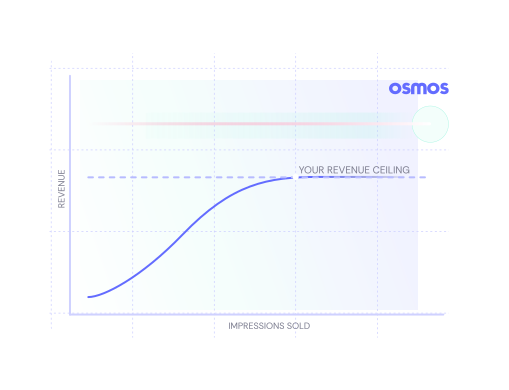
Osmos is a white-label retail media operating system for retailers and marketplaces. Its modular apps for onsite, offsite and in-store ads sit over your existing stack, so you can break your monetisation ceiling faster without rebuilding it.
1. Every Action a Shopper Takes Becomes a Behavioral Signal
Retailers possess deterministic, transaction-backed data that no open-web platform can replicate. When shoppers browse deeply within a category, return to specific brands, repeatedly purchase similar products, or show consistent price sensitivity, those actions form patterns, patterns become signals, signals become segments. This is the foundation of high-quality behavioral targeting within retail media ecosystems.
Example: The Protein Buyer
Imagine a shopper who consistently purchases high-protein snacks, vegan protein powders, and low-carb meal kits. Individually, those are transactions. Together, they indicate a defined lifestyle pattern. When enriched properly, this behavior automatically feeds into:
- Health and wellness audience segments
- Relevant product recommendations during search
- Premium nutrition brand placements
- Affinity-based cross-category discovery
Even if no ad appears immediately, the audience graph strengthens over time. The retailer’s dataset becomes more structured and monetizable within its retail media network. Unlike open-web behavioral models that infer intent from browsing, retailer-driven behavioral targeting is grounded in verified purchase behavior.
2. Contextual Signals Make Behavioral Data Actionable
Behavior shows what happened, while context reveals why it happened. Without contextual enrichment, even strong behavioral data can mislead targeting systems. With context layered in, retailers move from reaction to precision. Retailers enhance shopper intelligence using:
- Real-time search intent
- Session-level engagement
- Current shopping mission
- RFM (Recency–Frequency–Monetary) scoring
- Replenishment timing
- Seasonal or gifting signals
This enrichment powers effective contextual targeting inside retail media environments.
Example: Sleep Mission vs Supplement Browsing
A shopper browsing supplements might appear broadly health-focused. But contextual enrichment could reveal repeated searches for melatonin, deeper browsing within sleep categories, and prior purchases of calming teas.
Standard behavioral targeting might show just generic vitamin ads here. Enriched contextual targeting recognizes a sleep-health mission and surfaces relevant nighttime solutions. The difference is precision, and precision drives performance across retail media placements. Behavior without context is an assumption, behavior with context is intelligence…
3. Loyalty & LTV Segmentation: Retailers’ Untapped Advantage
Most retailers already segment customers internally for CRM and retention strategies. They identify high-LTV customers, loyal category buyers, premium spenders, deal-sensitive shoppers, and seasonal purchasers. The missed opportunity?
Activating those segments for retail media monetization. Retailer-derived audiences such as high-value beauty shoppers, weekly grocery households, premium chocolate buyers, or lapsed high-LTV customers are commercially powerful because they are transaction-backed.
These segments outperform open-web clusters built on inferred behavior. By enriching loyalty and lifetime value insights, retailers elevate both behavioral targeting and contextual targeting within their retail media ecosystems. Retailers already own the advantage. Enrichment turns it into revenue.
4. Clean Rooms: Privacy-Safe Data Collaboration
As privacy standards tighten globally, collaboration must evolve. Retailers increasingly use clean rooms to enrich first-party data securely. Within a clean room, brands and retailers can match audiences, identify overlap, build shared segments, and measure incrementality; all of this without exposing user-level data. This enables enriched segments such as:
- High-frequency category buyers aligned with a specific brand
- Premium shoppers who haven’t tried a competing product
- Loyal customers with strong cross-category affinity
Such collaboration strengthens behavioral targeting precision and contextual targeting alignment inside the retailer’s retail media network, making privacy-safe enrichment a competitive differentiator.
5. Lookalike Modeling: Expanding High-Value Shoppers Responsibly
Retailers can responsibly scale their most valuable audiences using machine learning trained on enriched first-party signals. Instead of relying on inferred social lookalikes, retailers build predictive expansions using:
- Verified purchase frequency
- Spend patterns
- Category depth
- Loyalty signals
- RFM scoring
For example, if a retailer identifies a core group of high-value premium coffee buyers, it can expand this audience to similar shoppers who share comparable purchase behavior and spending patterns. This creates scalable behavioral targeting without sacrificing contextual relevance inside retail media environments. Predictive expansion rooted in real transactions is fundamentally stronger than interest-based guesswork.
6. Enriching First-Party Data with External Partners
While first-party data is the foundation, strategic partnerships can add additional depth. Retailers may collaborate with trusted data providers to layer demographic signals, household attributes, life-stage indicators, or offline purchase behavior onto existing shopper profiles.
When carefully integrated, this produces hybrid segments such as high-income organic grocery shoppers, wellness-focused families with strong RFM scores, or tech-forward premium households. External signals complement retailer-owned intelligence, not replace it.
This blended dataset strengthens both behavioral targeting and contextual targeting, enabling more refined acquisition strategies and improved predictive modeling across retail media campaigns.
7. The Result: Smarter, Sharper, More Responsible Retail Media
When first-party data is enriched intelligently, retailers unlock measurable advantages:
- Higher ROAS
- Stronger relevance
- More precise segmentation
- Increased conversion rates
- Improved new-to-brand discovery
- More efficient media spend
Importantly, this targeting model is responsible by design: No cross-site tracking, third-party cookies, or behavioral surveillance. Retail media operates within consent-based, voluntarily shared purchase environments…
Retailers already leveraging structured enrichment frameworks are demonstrating measurable performance improvements across monetization metrics. You can explore real-world examples in these Osmos powered retail media success stories.
Conclusion: Enriched First-Party Data Is Retail Media’s Strategic Moat
Every retailer already owns the raw components of a powerful targeting engine. The differentiator lies in how those signals are structured, enriched, segmented, and activated.
Retailers that invest in behavioral enrichment, contextual intelligence, loyalty segmentation, clean room collaboration, lookalike modeling, and selective external partnerships will build retail media networks that outperform traditional advertising ecosystems!
Platforms like Osmos help retailers efficiently structure, enrich, and activate their first-party data to unlock scalable retail media revenue across different verticals like grocery retailers, fashion and beauty marketplaces and restaurant aggregators!
Smarter behavioral targeting and sharper contextual targeting do not require more surveillance, they require better signal refinement. If you’re ready to transform enriched first-party data into a scalable revenue engine, request a tailored demo with Osmos today!
SEE IT IN ACTION
See what's above your ceiling.
Your score, your peer benchmark, and the levers that close the gap.
Commitment-free consultation on your top needs and challenges. Discover product capabilities and how Osmos may help.