Retail Media Concepts
The Future of Data Ownership in Retail Media Ecosystems
Data has become the most valuable asset in digital commerce. In retail media networks (RMNs), it is the fuel that powers targeting precision, campaign performance, and long-term monetisation. But as retailers, brands, and technology partners deepen their collaboration, one question is becoming increasingly important:
Who owns the data?
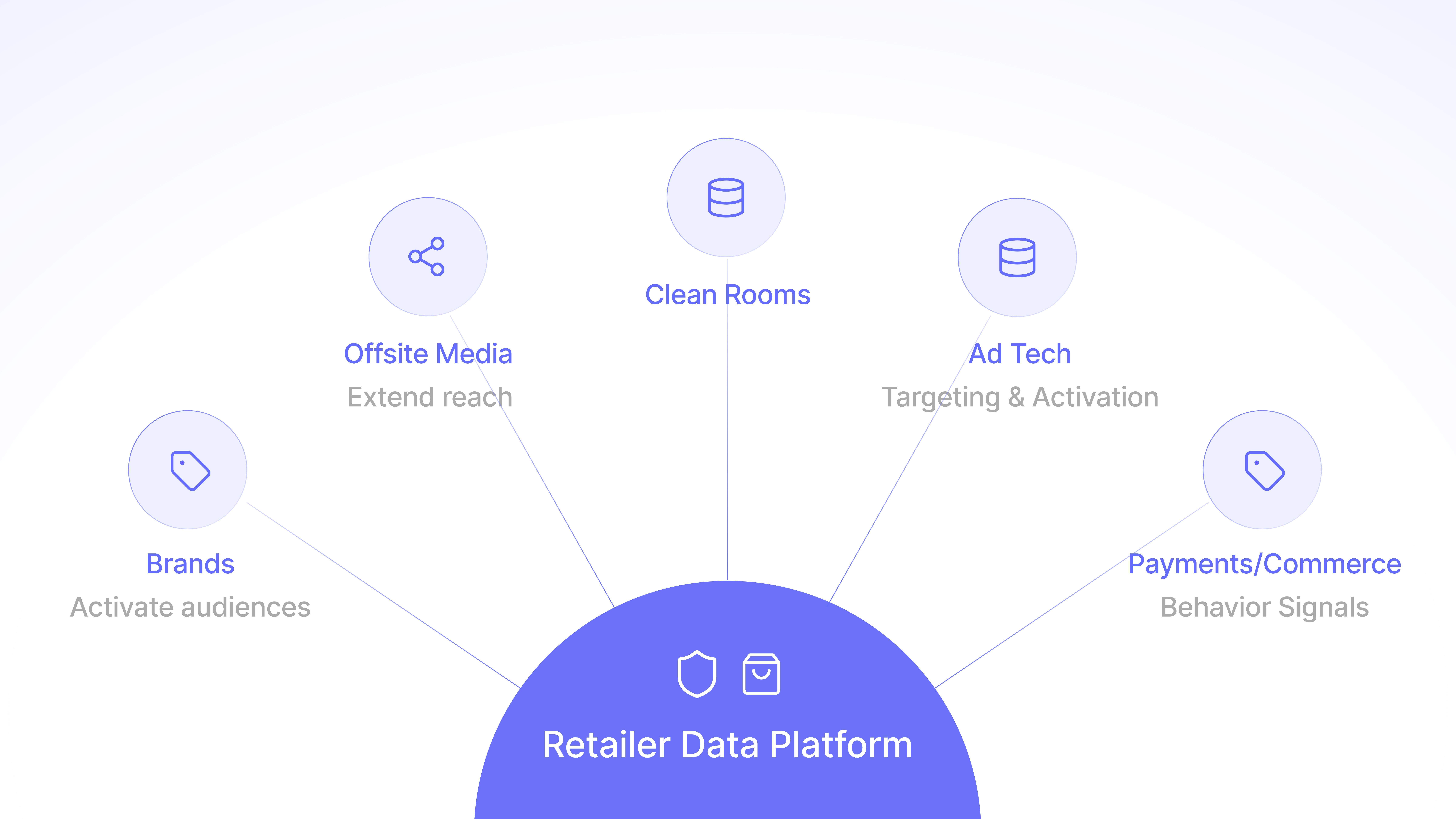
Retail media sits at the intersection of commerce and advertising. Retailers hold purchase data, brands hold customer insights, and ad technology platforms provide the infrastructure that activates both. As these systems become more interconnected, data ownership is evolving into one of the most strategic issues shaping the future of retail media.
The next phase of the industry will not simply be about ad placements or sponsored listings. It will be defined by how data is shared, governed, activated, and monetised across retail ecosystems.
Retailers and brands are already combining first-party signals, behavioural targeting algorithms, and advanced ad technology to deliver relevant advertising experiences. But emerging architectures — such as data clean rooms, audience licensing models, and commerce-media partnerships — are pushing the industry toward a more sophisticated approach to data ownership.
The core insight is simple: in retail media, the data asset is often more valuable than the ad placement itself.
Why Data Ownership Matters in Retail Media
Every retail media network operates across a value chain that includes:
• Shopper traffic
• Advertising inventory
• Ad placements and formats
• Campaign measurement
• And most importantly, data
Among these elements, data is foundational because it enables everything else to function.
Data Powers Precision Through Behavioral Targeting
Retail media thrives on behavioral signals. Every search query, product view, add-to-cart action, and purchase contributes to a dataset that allows retailers to understand how shoppers actually buy.
This transaction-level intelligence enables behavioral targeting models that are significantly more accurate than traditional advertising signals derived from content consumption or browsing behaviour across unrelated websites.
Data Enables Advanced Ad Technology
Modern retail media relies on increasingly sophisticated ad technology stacks. These platforms manage:
• Targeting and segmentation
• Real-time bidding decisions
• Ad serving and placement logic
• Attribution and measurement
Without access to high-quality data, even the most advanced ad technology cannot deliver meaningful targeting or optimization.
Data Controls Long-Term Monetisation
Advertisers do not simply pay for impressions. They pay for performance and targeting accuracy.
The value of a retail media network ultimately comes from the insights it can provide advertisers — understanding shopper behaviour, predicting purchase intent, and identifying high-value audiences.
This means the platform that controls the data layer often controls the monetisation opportunity.
Data Determines Ecosystem Control
Retail media ecosystems include multiple stakeholders:
• Retailers
• Brands
• Advertising technology providers
• Large tech platforms
• Commerce and payments partners
Whoever owns the data sits at the centre of this ecosystem. Ownership determines who can monetise the insights, who controls activation, and who ultimately shapes the market.
If retailers control purchase history, loyalty signals, and session behaviour, they possess the most valuable dataset in the advertising ecosystem.
If they relinquish control of that data, they risk becoming inventory providers rather than media owners.
Ownership therefore matters for two critical reasons:
Monetisation rights
The entity that controls the data can license it, activate it, or create derivative products built on top of it.
Strategic independence
Owning the data ensures retailers remain independent players in the advertising ecosystem rather than becoming dependent on external platforms.
Retail media delivers its full strategic value only when retailers control both inventory and data.
The New Models of Data Collaboration and Ownership
Retail media ecosystems are becoming more collaborative, and several emerging models are reshaping how data is shared while still preserving ownership.
Retailer–Brand Clean Rooms
Data clean rooms are quickly becoming one of the most important infrastructures in modern retail media.
A clean room allows multiple parties to combine datasets securely while ensuring that raw data never leaves the controlled environment.
Inside a clean room:
• The retailer retains ownership of its first-party shopper data
• The brand contributes its own CRM or audience data
• Both parties derive insights for targeting, measurement, and attribution
• Sensitive data remains anonymised and protected
This model enables highly accurate behavioral targeting and contextual targeting while maintaining strong privacy safeguards.
Industry research suggests that a growing share of retail media teams are already adopting clean room architectures to facilitate retailer-brand collaboration.
The advantage is clear: both sides gain insight without sacrificing ownership.
Audience Renting: Retailer-Owned Data Licensing
Another emerging model is audience renting, where retailers license segments of their own data to advertisers while retaining full ownership of the underlying asset.
In this model, retailers define audience segments such as:
• High-value shoppers
• Frequent category buyers
• Premium brand purchasers
• Price-sensitive households
Advertisers can activate these segments for campaigns, but the retailer maintains control of the dataset itself.
For example, a coffee brand might activate a segment of “premium coffee buyers.” Each impression delivered to that segment generates revenue for the retailer, but the advertiser never receives direct access to the underlying data.
This model allows retailers to monetise behavioral targeting insights repeatedly while protecting the long-term value of their data asset.
Platform and Big Tech Partnerships
Large technology platforms are increasingly partnering with retailers to access signals that they do not possess themselves — particularly purchase data and cart behaviour.
These partnerships typically combine:
• Retailer supply and commerce signals
• Platform reach and ad technology
• Cross-channel campaign activation
• Advanced measurement capabilities
For example, offsite advertising campaigns might use retailer inventory data to connect ads served on platforms such as YouTube or social media with real retail purchase behaviour.
These collaborations can significantly expand reach and measurement capabilities.
However, they also raise complex questions about who ultimately controls the data and monetisation rights.
Without clear governance, retailers risk allowing external platforms to extract value from their most important asset.
Commerce Media and Payments Data Partnerships
Retail media ecosystems are also expanding beyond traditional retail.
Payments platforms, fintech companies, and digital wallets hold rich commerce data that exists outside retailer environments.
For example, a payments platform may understand that a household spends:
• $500 per month on groceries
• $200 per month on restaurants
• Regularly purchases beauty products
When these platforms collaborate with retailers, they can contribute additional behavioural insights and expand targeting possibilities.
But this also complicates the ownership question.
If a payments company contributes behavioural signals and a retailer combines them with its own purchase data to create a new audience segment, who owns that segment?
Retail media networks must therefore develop governance frameworks that ensure the retailer remains the data custodian, even when external signals are incorporated.
Why Data Ownership Should Be Anchored at the Retailer
For retail media to scale sustainably, data ownership must remain anchored with the retailer.
There are several structural reasons for this.
First, the most valuable behavioral signals originate inside the retailer environment. Searches, product views, cart additions, and purchases all occur within the retailer’s ecosystem.
Second, the retailer controls the advertising inventory. Sponsored listings, category placements, and product page ads exist on retailer-owned properties.
Third, ad technology functions as a layer that activates data and inventory. While it provides critical capabilities, the underlying commerce signals remain retailer-generated.
If data ownership shifts toward external platforms or ad networks, the retailer risks being reduced to a supply-side participant in someone else’s advertising ecosystem.
To maintain strategic control, retailers should retain:
• Data ownership rights
• Monetisation rights
• Activation control over audience segments
• Oversight of how data is used and shared
Only under these conditions can behavioral targeting and contextual targeting scale in ways that deliver sustained value.
Strategic Steps for Retailers to Future-Proof Data Ownership
Retailers that want to maintain control of their retail media ecosystem must design their data strategy intentionally.
Build a Data Architecture That Retains Control
Retailers should implement a customer data platform (CDP) and identity framework that keeps the core shopper graph inside their environment.
External ad technology partners can connect to this infrastructure, but the retailer must remain the owner of the identity layer.
Clean room architectures allow collaboration without compromising control.
Develop a Clear Data Licensing Framework
If retailers plan to monetise their audiences through segment activation or audience renting, they must define clear usage policies.
This includes:
• What segments can be activated externally
• Who can access them
• How impressions are priced
• How revenue sharing is structured
By licensing audiences rather than transferring ownership, retailers protect their long-term data asset.
Align Ad Technology With Retailer Strategy
Ad technology should support both behavioral targeting and contextual targeting while ensuring that insights flow back into the retailer platform.
If the technology layer captures insights but stores them externally, the retailer gradually loses control of its own data advantage.
Retailers must therefore ensure the data layer remains beneath the ad technology layer, not the other way around.
Form Strategic Partnerships, Not Dependencies
Partnerships with big tech platforms, payments companies, or advertising networks can unlock scale and reach.
However, these collaborations should always include clear agreements regarding:
• Data ownership
• Monetisation rights
• Audience activation
• Attribution and reporting
The goal is collaboration — not dependency.
Prioritise Governance and Privacy
Retail media relies on consumer trust. Data governance frameworks must incorporate privacy-enhancing technologies such as:
• Anonymisation
• Data hashing
• Secure clean rooms
• Aggregated audience reporting
Transparent governance ensures that behavioral targeting can continue to deliver value without compromising shopper confidence.
What the Future of Retail Media Data Ownership Looks Like
Over the next three to five years, retail media ecosystems will likely evolve toward several structural trends.
Retailers and brands will collaborate through shared data environments where both parties contribute signals while retailers retain ownership.
Audience renting marketplaces may emerge where advertisers license retailer-owned audience segments for campaign activation, paying impression-based royalties tied to segment performance.
Commerce and advertising technology platforms will increasingly integrate, enabling joint activation of campaigns across retail and media environments.
Ad technology stacks will evolve to prioritise purchase signals, cart behaviour, replenishment cycles, and session context rather than relying on legacy interest graphs.
Most importantly, the value of behavioral targeting segments may rival — or even exceed — the value of traditional advertising inventory.
Retailers that recognise this shift early will position themselves as data custodians and media owners within the ecosystem.
Conclusion
The future of retail media is not defined solely by advertising formats or sponsored placements.
It is defined by data ownership, collaboration models, and technological architecture.
Behavioral targeting and advanced ad technology will continue to deliver the precision advertisers demand. But retailers that relinquish control of their data risk losing the strategic advantage that retail media provides.
The retailers that lead the next phase of the industry will:
• Own their data assets
• Architect open yet controlled partnerships
• Monetise behavioural segments intelligently
• Combine contextual targeting with advanced ad technology
• Build retail media networks that outperform traditional advertising ecosystems
In the retail media economy of the future, data ownership equals strategic advantage.
And the retailers who control that data will control the ecosystem.
SEE IT IN ACTION
See what's above your ceiling.
Your score, your peer benchmark, and the levers that close the gap.
Commitment-free consultation on your top needs and challenges. Discover product capabilities and how Osmos may help.