Retail Media Concepts
AI-Driven Targeting in Retail Media: Smarter Personalization
It’s about time we acknowledged that shoppers don’t think in keywords, they type whatever their thumbs can manage before the kettle boils.
Their fingers slip, and half the time they don’t even finish the full product name. The searches are mostly quick, scrolls are unpredictable, and even with all this, the expectation to get exactly what they intended to get is always there. When retail media runs on static keyword lists, that expectation breaks…
Keyword-based targeting was built for a world where search was simple. That world doesn’t exist anymore. Most shoppers today make spelling errors, compare, abandon carts, switch languages, and come back with different intent; all in a single session.
AI-Driven Targeting in Retail Media reflects that complexity. It uses behavioral targeting and intelligent ad technology to interpret context, not just keywords. The result? Smarter monetization, stronger advertiser outcomes, and a media business that keeps pace with modern shopper behavior.
Why Keyword-Based Targeting Fails in Modern Retail Media
Retail media has officially stepped foot in its precision era. Yet many retailers are still powering their networks with keyword-driven ad technology that feels stuck in 2015.
Manual keyword mapping once worked. Today, it leaks revenue. Shoppers don’t search the way brands expect. And when your system relies purely on static keywords, you miss the intent hiding behind imperfect text. Let’s unpack why keyword-based targeting simply cannot keep up.
People Rarely Type Perfect Queries!
A shopper doesn’t carefully draft a product description before searching. They type things like:
- “iphone 15 pro cam lense”
- “4mm ball chain necklce”
- “sugarfree ketchup”
Traditional ad technology tries to match exact phrases. When spelling breaks, targeting breaks.
AI-Driven Targeting in Retail Media doesn’t panic over typos. It interprets intent; it understands that “cam lense” relates to smartphone accessories, and knows “sugarfree” and “sugar free” are identical in meaning. It maps messy language to real product categories, a shift from keyword matching to behavioral targeting powered by intelligence.
High Bids Override Relevance
Here’s a familiar scenario.
A shopper searches for “iPhone case.” But because a brand bids aggressively on “iPhone,” the shopper sees ads for the actual device instead of accessories.
Keyword systems only understand the word “iPhone.” They don’t understand the context. AI-powered contextual targeting recognizes that the shopper wants an accessory, not a ₹1 lakh phone. It weighs intent signals, browsing history, and category alignment before awarding the impression.
For retailers, this matters. Poor relevance hurts conversion rates, damages shopper trust, and reduces GMV. Letting high bids override context may boost short-term ad revenue, but it erodes long-term retail media value.
No Support for Language or Semantic Variation
A single product can be searched in multiple ways:
- “milk”/ “Doodh” / “Leche” / “dairy”
- “no sugar” / “sugar free”
Keyword-based ad technology fragments under this complexity. It struggles with:
- Synonyms
- Multilingual queries
- Regional variations
- Slang
- Product equivalents
AI-driven behavioral targeting understands semantic meaning. It recognizes patterns across languages and cultural contexts. That’s essential for marketplaces operating across regions or serving diverse audiences. If your retail media network cannot interpret variation, it cannot scale.
Zero Understanding of Shopper Behavior
Keyword targeting treats every shopper the same. Behavioral targeting recognizes:
- Repeat chocolate buyers
- Protein-focused fitness shoppers
- Budget-sensitive households
- High-AOV customers
- Brand-loyal shoppers
This is where AI-Driven Targeting in Retail Media truly differentiates itself. It doesn’t just react to text, but to behavior. Contextual targeting becomes fool-proof when combined with purchase history, recency-frequency-monetary scores, and category affinity. That’s something manual keyword lists can never achieve.
AI-Driven Targeting in Retail Media: How Modern Ad Technology Works
So what does modern ad technology actually look like inside a retail media platform?
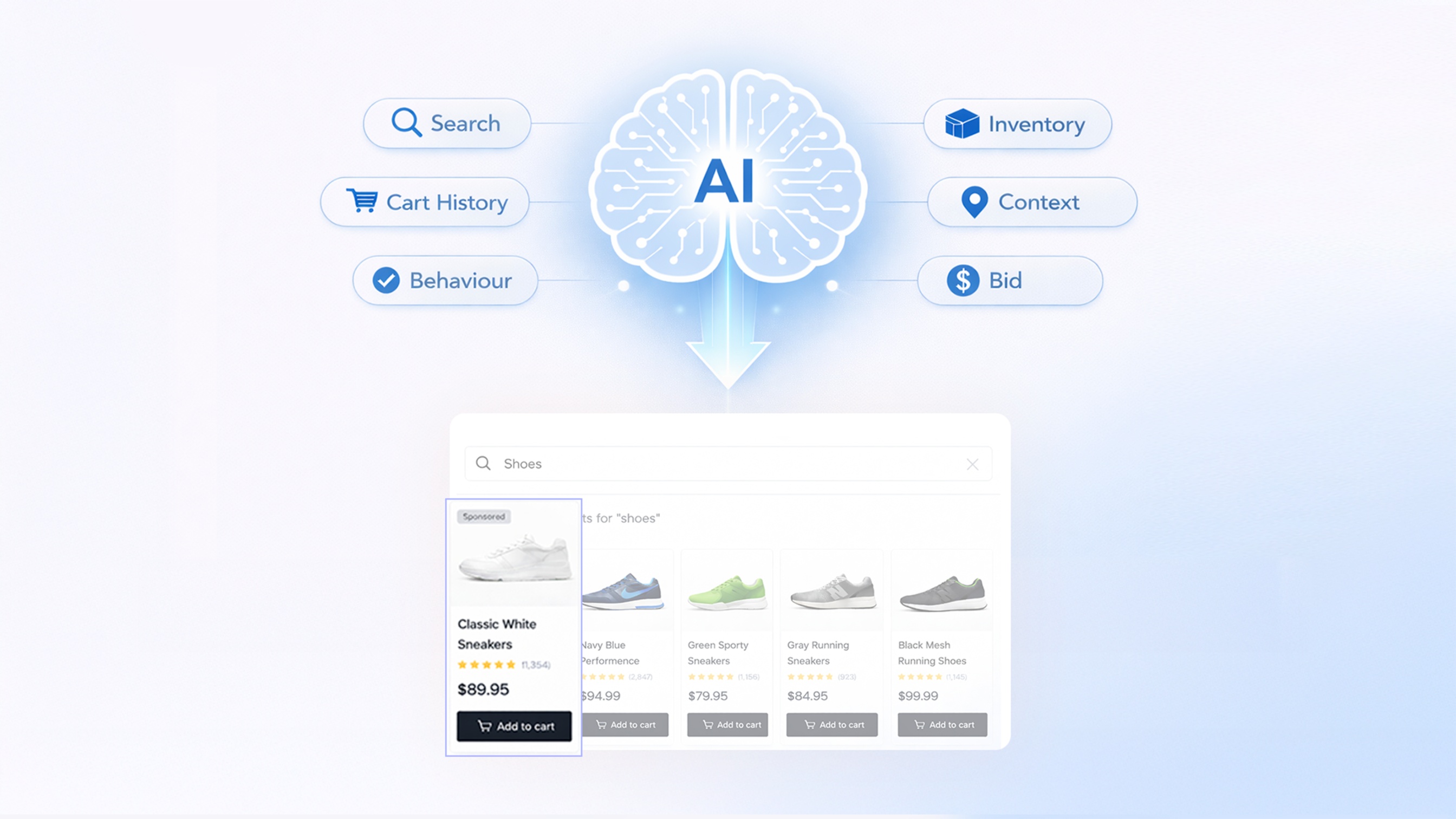
It’s more of a real-time decision engine, where every ad impression is evaluated against dozens of signals simultaneously.
Shopper Signals Power Behavioral Targeting
AI systems analyze:
- Browsing history
- Purchase behavior
- RFM scores
- Item affinities
- Category exploration patterns
This is behavioral targeting at scale. It transforms retail media into a predictive engine rather than a reactive one. Instead of asking, “What keyword did they type?” The system asks, “What are they likely to buy next?”
Merchandise and Campaign Intelligence
AI-Driven Targeting in Retail Media also processes:
Catalog variations
Ensures the most relevant size, color, pack type, or SKU variation is promoted based on shopper preference and availability.
In-stock status
Prevents ads from driving traffic to unavailable products, protecting both conversion rates and shopper trust.
Price elasticity
Understands how sensitive demand is to price changes, helping balance profitability with competitiveness in ad delivery.
Promotions
Prioritizes products with active offers or discounts to align media exposure with sales acceleration goals.
Campaign objectives
Aligns ad serving with whether the brand or seller wants awareness, conversion, basket growth, or new customer acquisition.
Creative performance
Optimizes toward ads that historically generate stronger engagement and conversion within similar contexts.
Bid strategies
Evaluates how aggressively advertisers are bidding, while balancing revenue with relevance.
On top of that, it incorporates:
Seasonal trends
Adjusts targeting based on time-sensitive demand shifts like holidays, weather changes, or festive buying patterns.
Category momentum
Detects rising or declining interest in product categories and adapts ad exposure accordingly.
Click-through rates (CTR)
Measures how often shoppers engage with an ad, signaling immediate relevance.
Conversion rates (CVR)
Tracks how often clicks turn into purchases, indicating true performance impact.
Auction win rates
Monitors how frequently a campaign secures placements, helping optimize bid efficiency and inventory allocation.
This intelligence turns ad serving into merchandising optimization. Retailers using platforms like Osmos are already moving toward AI-native infrastructure where ad technology continuously learns from performance data and refines targeting automatically!
What AI-Driven Targeting Enables for Retailers
The power of AI-Driven Targeting in Retail Media isn’t theoretical. It shows up in measurable business outcomes.
Smarter Interpretation of Incomplete Searches
When a shopper types “Iphone 15 pro max lens,” AI maps it to:
- Compatible accessories
- SKU variations
- Relevant substitutes
- Cross-sell bundles
Keyword systems fail here whereas AI adapts. For grocery networks exploring AI-based targeting, see how tailored solutions work for building high-intent media inventory.
Understanding Product Similarity and Category Intent
Consider: “4mm ball chain stainless steel necklace”
AI recognizes jewelry, material type, size variation, and potential substitutes. This is contextual targeting enhanced by behavioral data. Fashion and beauty marketplaces can unlock this depth through solutions designed for fashion and beauty retailers who rely heavily on catalog nuance.
Brand Detection and Intelligent Conquesting
Misspelled brand names? No problem. AI recognizes brand signals even when typed incorrectly. It also prevents competitor bids from distorting relevance.
Instead of rewarding the highest bidder blindly, AI balances:
- Intent alignment
- Behavioral likelihood
- SKU relevance
- Campaign performance
This solves the classic brand-bidding distortion problem in legacy ad technology.
Learning Co-Purchase Patterns
If a shopper buys milk regularly, AI predicts related basket items:
- Butter
- Eggs
- Bread
This transforms retail media into recommendation-driven monetization. Restaurant and delivery platforms can leverage these insights through AI tailored for restaurant aggregators, where basket behavior is rich and frequent. Keyword targeting cannot infer cross-category relationships. Behavioral targeting thrives on them.
Always-On Learning
If Product A receives impressions but no clicks, while Product B performs well, AI adjusts in real time. It reallocates inventory toward performance.
That means:
- Better advertiser ROI
- Higher conversion rates
- Improved GMV
- Smarter monetization
And unlike keyword systems, it never stops learning. See Osmos-powered retailers bring out measurable impact from AI-powered ad technology through these real-world success stories!
Why AI-Driven Targeting Is Now Mandatory
Search Behavior Is Too Complex
Across digital platforms, nearly half of searches are new or unique variations, manual keyword mapping cannot scale to this volatility, and hence, retailers need ad technology that interprets meaning, not just text.
Brands Expect Smarter Ad Technology
Brands now demand:
- AI-based bidding
- Contextual targeting
- Behavioral segmentation
- Predictive forecasting
They understand that keyword targeting is outdated. If your retail media network cannot offer intelligence, budgets will migrate elsewhere. From the retailer’s lens, that means lost monetization opportunity.
Shopper Experience Must Be Protected
Retail media works only when relevance remains high.
Irrelevant ads equals:
- Reduce trust
- Lower conversion
- Depress GMV
- Create banner blindness
AI ensures:
- No spammy placements
- No unrelated brands
- No poor search matches
- Higher personalization without violating privacy
That balance; monetization plus experience is almost impossible with static targeting.
Competing With Google, Meta, and TikTok
Retailers now compete with platforms like Google, Meta, and TikTok for brand budgets. But there’s an advantage: retailers own purchase data. That means stronger behavioral targeting, richer contextual targeting and better closed-loop attribution.
However, without AI-driven ad technology, that advantage stays unused. Keywords alone cannot compete with algorithmic ecosystems…
AI Ad Servers: The Future of Retail Media Relevance
AI transforms the ad server into a real-time merchandising engine.
It:
- Analyzes behavior
- Understands context
- Optimizes relevance
- Balances GMV and ad revenue
- Maximizes advertiser ROI
- Protects shopper experience
A keyword-based system, more than outdated, is risky. Retail media is now a precision game. The winners will be retailers and marketplaces whose ad technology thinks, learns, adapts, and improves automatically.
If you’re building or modernizing your retail media stack, start with a conversation through a personalized demo to see how AI-driven behavioral targeting works in practice.
Conclusion: The Next Decade Belongs to AI-Native Retail Media
AI-Driven Targeting in Retail Media is the foundation of modern media monetization.
Retailers and marketplaces sit on the most valuable asset in digital commerce: real purchase data. But data alone does nothing without intelligence layered on top. Behavioral targeting converts signals into strategy,contextual targeting converts intent into relevance and modern ad technology converts impressions into revenue.
If your platform still relies on keyword lists, you are not just behind, you are leaking opportunities every single day. The next decade will belong to retailers who modernize their ad technology, adopt adaptive intelligence, and build networks that understand intent, not just syntax!
SEE IT IN ACTION
See what's above your ceiling.
Your score, your peer benchmark, and the levers that close the gap.
Commitment-free consultation on your top needs and challenges. Discover product capabilities and how Osmos may help.