Retail Media Concepts
How Marketplaces Can Build Their Own Ad Platforms Without the Big Tech

If your marketplace still thinks of ad monetization as a side hustle, trust us, you’re selling yourself short. The world’s shifting fast… and retail media is no more just a sprinkle-on extra income. With the right ad technology, your platform can become a media engine, tapping into first-party data, building brand partnerships, and turning your digital real estate into a full-throttle revenue stream. In this blog, let’s break down how to make that shift, and why it’s now or never!
1. The Hidden Ceiling of Third-Party Retail Media Platforms
Why Plug-and-Play Feels Comfortable, and Limiting
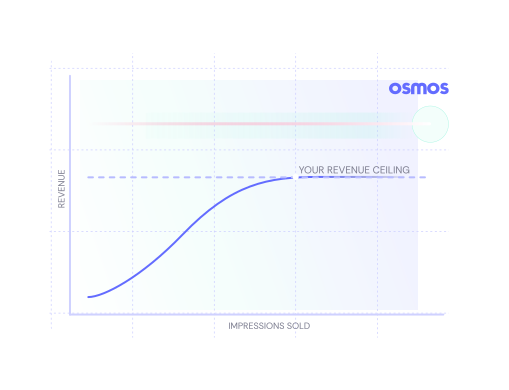
Riding on a third-party ad platform, say, like a Criteo, Epsilon Retail Media or The Trade Desk Marketplace feels like borrowing someone else’s bike: good enough to get started or get you going, but you’re never truly free. Sure, you avoid building the entire system, demand is ready, infrastructure exists. But you surrender control. Your ad formats? Locked. Your bidding logic? Pre-set. Your user experience? A mirror image of every other retailer using that network. That’s a safe bet, if you’re fine being bland in a sea of sameness.
Indirect Brand Relationships Weaken Your Position
On these platforms, brands don’t buy from you — they buy via the intermediary. That means you don’t own the brand relationship. You can’t easily run custom or co-branded campaigns, tailored sponsorships, or long-term media partnerships. That middleman doesn't just cut into your margin, but also into your strategic autonomy.
When "Shared Demand" Means Shared Compromise
These networks promise higher demand while pooling numerous retailers together. But this does not mean that the demand is equally distributed. Advertisers often funnel spend to only a few big names, and your platform may simply be another stop in a long ad list. So while the network touts “access to scale,” your site may see inconsistent or underwhelming campaign volume. In other words, you're sharing demand, but also sharing the risk.
Platforms like Osmos offer white-label retail media systems built exactly for retailers who want to scale without losing control.
2. Taking Control: Why Owning Your Ad Platform Is a Game-Changer
First-Party Data Is Gold, Or More Like Money
When brands advertise on your turf, they’re not just paying for eyeballs, they’re buying into your shoppers. With your own retail media platform, you retain full control over your first-party data. That means audience targeting, personalization, and insights all live under your roof, not someone else’s. Use it wisely, and you can charge a premium, drive ROI for brands, and turn data into a corner-office profit center.
Direct Brand Relationships equals Better Margins and Loyalty
If a middleman takes away a considerable percentage of the ad spend, you’re cutting your own paycheck. But when brands work directly with you, you become more than just a billboard, you become a partner. This opens the door for custom sponsorships, product launches, or ad packages. You're not just another slot in an ad network; you're the platform brands want to lean into for long-term value.
This shift is especially powerful for fashion and beauty retailers, where shopper intent signals can be extremely granular.
3. What a Modern Retail Media Platform Looks Like
Forget monolithic legacy systems. A modern retail media platform is modular: ad serving, auction engine, targeting, measurement, and self-serve all plug into a stack as clean as Lego. By keeping things flexible, you’re ready to innovate, scale, or pivot without tears, tech debt, or back-breaking rewrites.
Modular Architecture for Scalability and Flexibility
Here’s a breakdown of what a modern retail media platform can consist of:
- Ad Serving: Deliver ads on owned channels (app & website), across the open web, and even in-store (if you operate omnichannel).
- Auction Engine: Run your own monetization logic — dynamic pricing, hybrid auction formats, or AI-driven bid floors.
- Targeting Layer: Leverage first-party shopper data — behavioral, contextual, and segment-based targeting.
- Measurement & Attribution: Use incrementality testing, multi-touch attribution, and sales-lift analysis to prove value.
- Self-Serve Interface: Give brands or internal teams the tools to launch campaigns, manage budgets, and view live analytics.
This modular approach means you can start lean and then scale: or quite simply put, you don’t need to build every layer at once, but you design for what you will need in future. Even nontraditional retail ecosystems such as restaurant aggregators are adopting this modular approach to scale media revenue.
Self-Serve and Transparency for Better Brand Trust
Today’s brands want speed, autonomy, and clarity. A self-serve interface lets them:
- Spin up campaigns quickly
- Monitor performance in real time
- Optimize campaigns mid-flight
For you, this means less manual work, fewer support tickets, and more scalable operations. Also, transparency builds trust, which means brands are more likely to keep spending.
4. Ad Technology That Lets You Compete Without Big Tech
AI Bidding, Real-Time Optimisation, and Yield Control
Today’s ad technology is no longer guesswork; it’s smart, adaptive, and driven by AI. Auto-bidding systems react to shopper behaviour in real time and auction engines can shift floor prices based on inventory and demand. This level of precision lets you maximize yield, increase ROI for brands, and run your media business like something engineered, not something left to luck.
This kind of sophistication lets you squeeze more revenue from your inventory while delivering strong ROI to brands.
Dynamic Creative Optimization (DCO)
Ads don’t have to be static. With DCO, creatives can change in real time depending on who’s viewing, what they’ve bought, or where they are in their journey. This kind of relevance boosts engagement, improves conversion, and increases ad effectiveness.
Clean-Room & Privacy-First Data Integrations
With privacy regulations tight and shoppers becoming increasingly wary of third-party cookies, clean-room technology is critical. It lets you share aggregated, actionable audience data with brands in a way that preserves user privacy. This not only builds trust but also ensures compliance in a post-cookie world.
Unified Dashboards: One Glass for All
Your teams and brands shouldn’t have to juggle multiple dashboards for performance, spend, creative, and audience insights. A unified interface gives everyone the same real-time data, whether you choose a managed-service model or a self-serve setup. This alignment speeds up decision-making, reduces operational friction, and delivers full transparency across your media investments.
5. Lessons from Shared-Network Models: What Works and What Doesn’t
The rise of shared retail media networks shows how tempting scale can be… but also highlights why owning your stack is so powerful.
Shared Demand Doesn’t Always Deliver…
Take networks that aggregate multiple retailers under one demand pool. While they sound great on paper, many retailers don’t actually benefit equally. Some get heavy brand activity; others see very little. In many cases, demand looks “pooled,” but spending isn’t fairly distributed. That makes your revenue less predictable and less in your control.
The Commodity Trap: When You’re “Just Another Node”
If you're part of a big shared network, there’s a real risk of becoming generic, just one more inventory source in a massive ad catalog. To brands, that might look like “another retailer ad spot,” rather than a unique, valuable media partner. But if you own your retail media platform, you define your value proposition, tailor your offering, and position yourself as a strategic asset, not just as check-box inventory.
6. The Future of Marketplaces: From Commerce Platforms to Media Powerhouses
The world of retail media is evolving, and fast. Here’s what’s ahead, and why building your own ad platform is a future-proof move.
Why Ownership Is the Strategic Win
- Full Revenue Capture
You don’t share margins with third parties. You own 100% of your ad revenue, maximizing profitability. - Data Sovereignty
Your first-party data stays in your hands. You decide how it's used, monetized, and shared. - Brand Partnerships with Depth
You move beyond tactical campaigns. You build media relationships, sponsorships, and deep co-marketing partnerships. - Agile Innovation
You launch new formats and pricing models on your own timeline, without waiting for vendor roadmaps. - Long-Term Enterprise Value
A successful media business isn’t just a profit center, it's a strategic asset with long-term value.
Macro Trends Backing This Shift
- Retail media is skyrocketing: Global retail media ad spend is projected to hit ~$196.7 billion in 2026.
- Growth is maturing: While growth rates are decelerating, the market is stabilizing, pushing retailers to build sustainable media models.
- New formats are taking over: The shift from just “sponsored search” to a full-funnel media experience is underway, including display, off-site placements, and AI-driven activation.
- Privacy + data hygiene matter more than ever: Clean-room integrations are now a non-negotiable for first-party data activation
6. Conclusion
The numbers don’t lie: the world of retail media is booming. Global ad investment in retail media is projected to reach nearly US$ 175 billion in 2025, with predictions pushing it to over US$ 196 billion by 2026.
If you’re a marketplace or retailer treating media as a side hustle, it’s time to flip the script. Build your own ad platform, own your data, own the advertiser relationships, and turn your digital real estate into a strategic growth engine. With the right ad technology, retailers big and small can compete without depending on Big Tech.
Want to explore how a white-label solution can get you started? Check out how platforms like Osmos let you launch your own retail media business with enterprise-grade capabilities, all without losing your identity. See more of how we helped brands report significantly faster go-to-market cycles and higher revenue per impression in our success stories.
SEE IT IN ACTION
See what's above your ceiling.
Your score, your peer benchmark, and the levers that close the gap.
Commitment-free consultation on your top needs and challenges. Discover product capabilities and how Osmos may help.