Ad Revenue Growth
Introduction: Retail Media Is Expanding Beyond Onsite Ads

Sponsored ads were retail media’s opening act, and boy it was a strong one! High-margin, easy to understand, and perfectly placed inside the shopping journey, they gave retailers a clean way to monetize onsite traffic without breaking a sweat!
But even good things have limits. Shoppers don’t browse forever, pages don’t stretch infinitely, and ad slots eventually fill up. As retail media matures, retailers are realizing that growth can’t rely only on who shows up onsite and where ads can fit.
That realization is pushing retail media into its next phase: audience monetization. Instead of making money only when someone sees an ad, retailers earn revenue by letting brands use their shopper data, no matter where the ad runs or whether the shopper comes back to the site.
Osmos is a white-label retail media operating system for retailers and marketplaces. Its modular apps for onsite, offsite and in-store ads sit over your existing stack, so you can break your monetisation ceiling faster without rebuilding it.
1. Sponsored Ads: The First Layer of Retail Media Monetization
Sponsored ads are still the workhorse of retail media. Sponsored listings, category placements, and PDP modules remain the most familiar, and reliable ways for retailers to generate revenue through their ad platform. From a retailer’s point of view, sponsored ads check all the right boxes:
- Exceptionally high margins, often landing in the 80–90% range
- Revenue that scales with traffic, not inventory or fulfillment
- Clear, familiar reporting that brands trust
- Natural placement inside the browsing experience
A well-run retail media platform can generate roughly 5% of GMV through onsite sponsored ads alone. For many retailers, that’s no longer a side number, it’s a material revenue line.
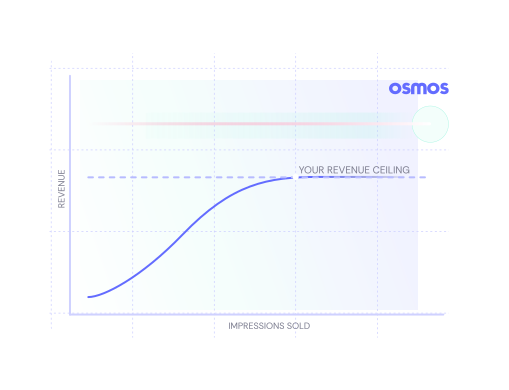
Still, sponsored ads come with a built-in ceiling. They only monetize when shoppers are present, and only as long as there’s room to place them. Once pages get crowded or traffic plateaus, growth slows. Sponsored ads don’t fail here, they simply hit their natural limit.
2. Audience Monetization: Revenue That Doesn’t Wait for Traffic
Audience monetization breaks that dependency on onsite sessions. Instead of selling ad placements, retailers allow brands to activate authenticated first-party audiences, built from real purchase behavior, across external media channels. Here’s the key difference:
Audience monetization does not require traffic to return to the retailer.
Revenue is generated when brands use retailer audiences on social, programmatic, or CTV platforms. The retailer earns from audience usage itself, not from clicks, visits, or page views.
How it works in practice:
- Retailers define audience segments using transaction and behavior data
- Brands select those segments inside an ad platform or retail media platform
- Audiences are activated across external channels
Unlike offsite retail media designed to pull shoppers back onsite, audience monetization stands on its own; showing that performance isn’t judged by just immediate conversion, it’s measured by reach, efficiency, and downstream impact.
3. Two Paths to Audience Monetization
A. Retailer-Controlled Audience Activation
Some retailers keep audience activation tightly inside their own retail media platform. Brands don’t upload their own data or build segments from scratch. They activate retailer-owned audiences built on actual purchase behavior. This approach gives retailers the extra edge.
Why it works:
- Brands get deterministic, purchase-based targeting they can’t replicate elsewhere
- Retailers earn beyond sponsored ads without adding new onsite inventory
- Audiences can be activated across social and CTV
- The retailer controls segmentation, access, and measurement
Here, the ad platform evolves from a placement engine into an intelligence layer…
B. Audience Monetization Marketplaces
Other retailers integrate with third-party platforms that specialize in privacy-safe audience collaboration. These environments allow retailer audiences to be activated across the open web while maintaining strict data controls.
Examples include:
- FlowPlatform.com, where retailers earn whenever audiences are activated anywhere
- LiveRamp Safe Haven, enabling paid activation through clean rooms
- Snowflake Media Data Cloud, supporting secure audience licensing
- The Trade Desk Retail Data Graph, connecting retailer data to UID-based media
- InfoSum, offering privacy-preserving audience exchange models
In these setups, retailers earn revenue every time their audience is used, no matter where ads run or where traffic ends up. Monetization becomes fully decoupled from site visits.
4. Why Advertisers Keep Choosing Retailer Audiences
Retailer audiences are valuable because they’re deeply rooted in reality. They reflect what people actually buy, not what algorithms guess they might like. From a brand’s perspective, retailer audiences deliver:
- Higher accuracy than probabilistic segments
- Stronger performance across acquisition and retargeting
- Freedom to activate across channels, from social to CTV
- Consistency, even when retailer traffic fluctuates
For retailers, this preference is strategic. As brands increasingly plan media around retailer audiences, retailers capture budgets that once lived entirely outside the retail ecosystem.
5. Why Retailers Are Leaning Into Audience Monetization
a) Revenue That Doesn’t Depend on Browsing Peaks
Sponsored ads rise and fall with traffic. Audience monetization rises with advertiser demand.
b) No Reliance on Finite Ad Surfaces
Pages fill up. Audiences don’t. Monetization is no longer constrained by layout.
c) Stronger, Stickier Brand Relationships
Retailers move from selling exposure to enabling outcomes.
d) Built for Compliance and Trust
Modern retail media platforms support privacy-safe activation without exposing PII.
e) Scalable by Design
As data depth improves, monetization potential compounds, without redesigning a single page.
Why Infrastructure Decides Who Gets To Be On Top
Audience monetization isn’t a slide deck strategy. It lives or dies on infrastructure. Segmentation, activation, measurement, and billing all need to work at enterprise scale.
That’s why retailers increasingly rely on platforms like Osmos to unify sponsored ads, audience monetization, and measurement into one operational layer.
The approach adapts across verticals, whether enabling data-led growth for grocery retailers, discovery-driven activation for fashion and beauty retailers, or high-velocity environments like restaurant aggregators. Audience monetization works best when it’s designed into the system, and not bolted on later.
Sponsored Ads Built the Base. Data Builds the Scale.
Sponsored ads will always matter. They’re efficient, proven, and profitable. But they’re only the beginning.
Retailers that move beyond sponsored ads unlock a second revenue engine, one that earns without waiting for traffic, without crowding shelves, and without compromising shopper experience. With the right retail media platform, audience monetization turns retail media from a placement business into a scalable data business. Retail media isn’t just about selling visibility anymore, but also selling certainty, certainty built on real shopper behavior and real transactions!
SEE IT IN ACTION
See what's above your ceiling.
Your score, your peer benchmark, and the levers that close the gap.
Commitment-free consultation on your top needs and challenges. Discover product capabilities and how Osmos may help.