Retail Media Concepts
Contextual Targeting vs Behavioral Targeting: Delivering Relevance Responsibly
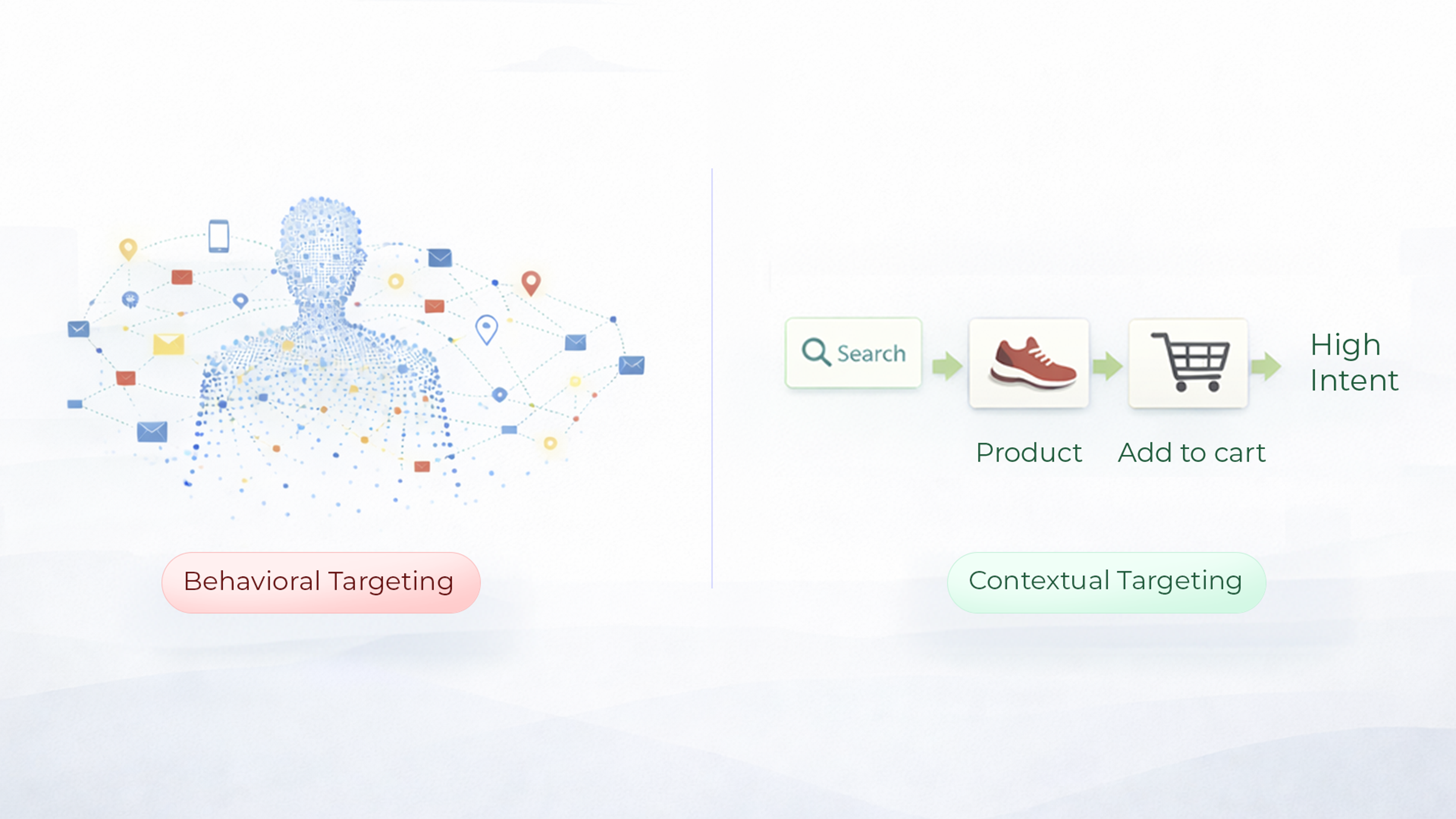
If you’ve spent enough time over the internet, you already know the drill. Click an ad once, and you’re followed everywhere for the next few weeks by ads. For years, digital advertising chased people instead of intent. Behavioral targeting followed users across the internet, guessing what they might want based on crumbs of past activity.
As privacy rules tighten and signal quality drops, relevance is being rebuilt closer to the moment of purchase. Contextual targeting flips the model by focusing on what shoppers are doing right now, not what they did three weeks ago.
Behavioral Targeting: Built on Inference, Not Certainty
Sure, behavioral targeting has shaped digital advertising for over a decade. Platforms like Meta and Google built powerful systems by observing what users did across the open web, and then guessing what they might want next. At its core, behavioral targeting relies on signals like:
- Websites visited
- Content liked or shared
- Videos watched
- Search history
- Retargeting pixels
- Engagement-based interest clusters
From a distance, it looks sophisticated. In reality, it’s built on inference.
Why Behavioral Targeting Struggles in Commerce
The biggest weakness of behavioral targeting isn’t scale, it’s accuracy. Especially when the goal is conversion and not awareness.
Weakness 1: Behavior Is Not the Same as Intent
Two shoppers can look identical through a behavioral lens. Both:
- Consume dessert content
- Browse chocolate gifts
- Visit snack category pages
- Click chocolate ads
Behavioral systems happily label both as “chocolate lovers.” But one prefers vegan, sugar-free chocolate, while the other buys premium dark chocolate for gifting. Behavioral targeting can’t see that difference. It captures activity, not preference.
Weakness 2: Behavioral Noise Creates Bad Assumptions
Consider a shopper browsing health supplements. Behavioral systems may respond with:
- Protein powder ads
- Generic vitamin ads
- Fitness influencer content
- Retargeting from supplement brands
But what if the shopper was actually searching for sleep support? Behavioral targeting doesn’t understand why someone is browsing, it just keeps adding more ads to the pile.
Weakness 3: Behavioral Targeting Creates Media Waste
Because behavioral profiles persist, users often see:
- The same “healthy chocolate” ads repeatedly
- Keto snack promotions they never buy
- Supplement ads long after interest has passed
The profile exists. The relevance doesn’t. For retailers and marketplaces, this means wasted impressions, lower conversion efficiency, and frustrated sellers and brands. That’s exactly where contextual targeting begins to outperform.
Contextual Targeting: Relevance Rooted in Real Intent
If behavioral targeting asks “What has this person done before?”, contextual targeting asks a better question: “What is this shopper trying to do right now?”
Contextual targeting operates inside the shopping moment. It doesn’t rely on tracking people across the web. It uses signals shoppers intentionally generate inside the retailer’s ecosystem. These include:
- Real-time search queries
- Product-level browsing behavior
- Cart and wishlist activity
- Verified purchase history
- RFM (recency, frequency, monetary) signals
- Price sensitivity
- Category and brand affinities
- Product attributes
This makes contextual targeting deterministic, privacy-safe, and grounded in commerce—not content consumption.
The Chocolate Example
Two shoppers browse chocolate on a retailer’s app.
Shopper A
- Buys dark chocolate monthly
- Higher average order value
- Prefers premium brands
- Frequently purchases gifts
Shopper B
- Buys milk chocolate occasionally
- Lower basket value
- Prefers value brands
- Shops mainly for household snacks
Behavioral targeting sees: “Chocolate lovers.” Both get premium chocolate ads. Contextual targeting sees purchase context where only Shopper A gets premium chocolate promotions and shopper B sees value packs or fun-size options. Same category, but completely different relevance. That’s the difference between inferred interest and actual intent.
Why Contextual Targeting Wins in Retail Media
Contextual targeting exists everywhere, but retail media is where it becomes powerful. That’s because retailers and marketplaces sit closest to the transaction. They own signals no third-party platform can access. Retail media platforms operate with:
- Verified purchase data
- Item-level transaction history
- Replenishment cycles
- Actual spending power
- Category depth and loyalty patterns
These signals create context that’s commercially meaningful, not speculative.
Example: Supplements, Sleep, and Intent
A shopper searches for magnesium glycinate. Behavioral targeting interprets this as:
- Health enthusiast
- Fitness content consumer
- Supplement interest
Contextual targeting sees something deeper:
- Likely addressing sleep or stress
- Prior purchases of herbal sleep aids
- High engagement with nighttime wellness products
- Strong purchase frequency in wellness
A contextual engine responds with:
- Melatonin alternatives
- Bedtime teas
- Calmness supplements
Behavioral systems keep showing:
- Generic vitamins
- Old retargeting ads
- Broad health content
Context doesn’t just understand what, it understands why. For retailers, that means higher conversion efficiency and less wasted inventory exposure.
Behavioral Targeting vs Contextual Targeting: What Retailers Should Care About
From a retailer or marketplace perspective, the difference isn’t philosophical, it’s economic. Behavioral targeting:
- Relies on third-party data
- Delivers moderate accuracy
- Works best for upper-funnel awareness
- Carries higher privacy risk
- Produces inconsistent conversion outcomes
Contextual targeting:
- Uses first-party signals
- Delivers deterministic accuracy
- Excels in mid- and lower-funnel use cases
- Aligns with privacy expectations
- Produces predictable performance
Retail media is structurally designed for contextual targeting because it operates at the exact moment behavioral systems fail, the moment of purchase. This is why retailers increasingly invest in platforms like Osmos that are built specifically to activate first-party contextual signals across sponsored listings, onsite placements, and offsite extensions.
RFM Targeting: The Contextual Multiplier Retailers Underuse
Context doesn’t stop at search or browsing. Retail media unlocks RFM segmentation:
- Recency: How recently did the shopper purchase?
- Frequency: How often do they buy in this category?
- Monetary: How much do they typically spend?
This turns contextual targeting into predictive targeting.
Why RFM Changes Everything
Two shoppers browse protein shakes. Behavioral targeting labels both as “fitness shoppers.” Contextual targeting with RFM reveals:
- Shopper A buys monthly and prefers premium brands
- Shopper B buys infrequently and waits for discounts
Now the retailer can:
- Show premium SKUs to Shopper A
- Surface value packs to Shopper B
Same page, but different relevance. Better outcomes for sellers, better experience for shoppers, and stronger retail media revenue. This is especially valuable for:
- Grocery retailers managing replenishment cycles
- Fashion and beauty retailers handling seasonal demand
- Restaurant aggregators predicting repeat ordering behavior
Why Contextual Targeting Is the Responsible Path Forward
Contextual targeting isn’t just more effective, it’s aligned with how advertising should work in a privacy-first world. It does not:
- Track users across the internet
- Build cross-site identity graphs
- Depend on third-party cookies
- Follow shoppers after intent expires
Instead, it uses signals shoppers knowingly create inside a retailer’s environment. This is why sellers and brands increasingly shift lower-funnel budgets into retail media:
- Higher ROAS
- Better relevance
- Higher new-to-brand contribution
- Lower impression waste
- Responsible use of customer data
For retailers, this translates into:
- Higher advertiser trust
- Stronger long-term partnerships
- Sustainable media monetization
Explore real-world success-stories of this shift across multiple Osmos powered retail media networks.
Why Retailers Win When Context Comes First
The advertising power balance is changing. Behavioral targeting once dominated because retailers didn’t have the tools to activate their own data at scale. That’s no longer true.
Modern retail media platforms allow retailers to:
- Activate contextual signals in real time
- Continuously learn from purchase behavior
- Optimize relevance over raw bids
- Monetize insight, not just inventory
This is how retail media becomes a core revenue engine, and no more a vague sideline experiment.
Conclusion: Relevance Comes From Context, Not Surveillance
Behavioral targeting tries to predict shoppers by watching them everywhere. Contextual targeting already knows, because it meets them at the moment of intent.
As third-party signals fade and privacy expectations rise, retailers who invest in contextual targeting will capture more advertiser spend, deliver better shopper experiences, and build defensible media businesses. Contextual targeting isn’t just an alternative to behavioral targeting. It’s the next era of relevance in retail media.
If you’re ready to activate first-party context responsibly, and turn it into predictable revenue, book a demo here with Osmos!
SEE IT IN ACTION
See what's above your ceiling.
Your score, your peer benchmark, and the levers that close the gap.
Commitment-free consultation on your top needs and challenges. Discover product capabilities and how Osmos may help.