Retail Media Concepts
How to Build a Scalable Ad Tech Stack Without Relying on Third-Party Vendors

The Growing Pains of Retail Media Tech
The truth is, retail media grew too fast, and the tech underneath wasn’t built to grow with it!
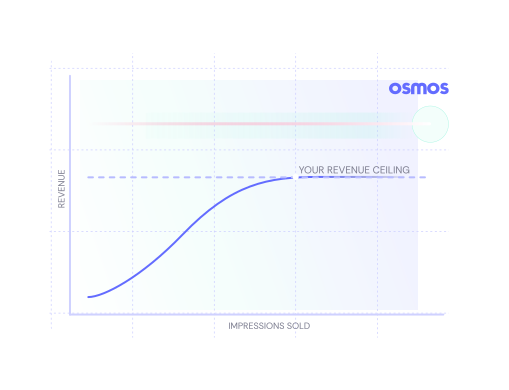
Many retailers launch their retail media programs with borrowed tools, borrowed rules, and borrowed roadmaps. At first, it works like a dream because it’s fast, proven, and promises quick monetization. But as retail media matures, that same shortcut often becomes a ceiling. Limited flexibility, slow innovation, and growing dependence start to clash with the very idea of owning a media business.
The question is no longer can you run ads? But who really controls the ad server powering your retail media business, you, or your vendor? The global retail media spend is projected to cross $140 billion by 2026, making it one of the fastest-growing digital advertising channels worldwide. And at the heart of every successful retail media network sits the foundation; ad technology.
So the question remains: how do you build a scalable ad tech stack without handing over control of your future?
When Speed Turns Into Structural Dependency
The convenience trap of third-party retail media platforms
Third-party ad tech vendors shine at one thing: speed. They help retailers launch retail media programs quickly by offering plug-and-play ad servers, predefined formats, and ready-made dashboards.
Early on, this works. You validate demand. Brands show interest. Sellers start spending. Revenue flows. But here’s the catch: most of these platforms aren’t designed for your long-term strategy. They’re designed for scale across many retailers.
As a result, your retail media network begins to inherit the same targeting logic, reporting limitations, and campaign structures as everyone else using that vendor. What started as acceleration turns into standardization. And in retail media, sameness kills scaling.
When your vendor also runs an ad network
The bigger red flag appears when your ad technology provider is also running its own ad network. Now incentives blur. Instead of helping you build deep advertiser relationships with your brands and sellers, the platform prioritizes pooled demand. Advertisers gravitate toward the largest properties in the network. Smaller or mid-sized retailers become just another endpoint for surplus demand.
In this setup, your first-party data flows through someone else’s pipes, and your inventory competes with platforms that may not even share your commercial priorities. You’re technically hosting ads, but not fully owning the business.
Customization: Where “Quick Launch” Starts Slowing You Down
Why retail media can’t run on generic logic
Every retailer operates differently. Some prioritize private labels. Some want to balance endemic and non-endemic brands.
Marketplaces juggle thousands of sellers, each with different margins and budgets. But most off-the-shelf ad platforms are built on rigid assumptions. Want to tweak auction logic based on inventory health? That’s a roadmap request. Need category-level controls for sellers vs brands? That’s an add-on. Experimenting with new placements tied to commerce signals? Not supported.
Over time, retailers find themselves negotiating their own strategy with their vendor’s product limitations. Speed to launch doesn’t equal speed to evolve.
The hidden cost of “supported but not flexible”
Many retailers assume these constraints are temporary. They’re not. As retail media revenue grows, the cost of slow experimentation compounds. You lose time testing formats. Brands lose patience. Sellers feel boxed in. Internal teams rely on workarounds instead of innovation!
Fragmentation: When One Vendor Becomes Five Tools
The silent complexity behind retail media stacks
No single third-party solution truly covers everything. One tool handles ad serving across onsite, another offsite, a different one for instore, 4th to try to consolidate reporting.
Soon, retailers are stitching together multiple systems that don’t speak the same language. For advertisers, this creates friction. For internal teams, it creates data inconsistency. For leadership, it blurs visibility into what’s actually driving revenue. Outsourcing complexity doesn’t eliminate it. It just spreads it across vendors.
Why the Biggest Retailers Move In-House…
Vendor reliance doesn’t scale forever
Almost every major retail media network started with third-party ad technology. That’s not a mistake; it’s smart. But when retail media becomes a meaningful revenue line, dependency turns into strategic risk.
We’ve seen this shift clearly across the industry:
- Lowe’s brought operations for its One Roof Media Network in-house in early 2023, stepping away from CitrusAd to gain direct control over campaign operations, data, and advertiser experience.
- Kroger, through Kroger Precision Marketing, announced the build-out of its own self-serve ad platform the same year, replacing external tools like PromoteIQ to reduce advertiser friction and strengthen product-level monetization.
- And Walmart, via Walmart Connect, continues to expand its internal ad tech capabilities, adding self-service APIs and campaign tools as it progressively reduces reliance on third-party platforms.
Large retailers have brought their ad operations in-house to gain direct control over data, advertiser experience, and monetization logic. Others have replaced rigid third-party tools with flexible foundations that allow internal teams to build faster.
The takeaway is consistent: you can’t outsource long-term ad tech strategy. The more valuable your retail media network becomes, the more essential ownership becomes too.
The Smarter Path: Build With Experts, Not From Scratch
Why retailers shouldn’t build an ad server alone
Let’s be clear: retailers are not ad tech companies. Building an ad server from the ground up requires years of engineering effort, constant iteration, and deep ad infrastructure expertise. For most retailers, that path delays monetization more than it enables it.
The smarter alternative is collaboration. Retailers are increasingly partnering with specialists who offer retailer-owned ad platforms, not black-box systems.
This model delivers:
- Full ownership of your ad technology
- Open APIs for extensibility
- Commerce-aware ad serving logic
- Faster launches without long-term lock-in
Platforms like Osmos follow this approach, working alongside internal teams so retailers retain control while accelerating time to revenue. The best ad tech stacks aren’t bought or built. They’re co-created.
Building on Open Foundations for Long-Term Scale
When internal teams want control without reinvention
For retailers with strong technical teams, modular ad technology offers the best of both worlds.
Instead of rebuilding core components like ad servers, campaign management, or reporting layers, teams can build on proven foundations, customizing logic where it matters most.
This approach allows your ad platform to:
- Scale across categories and formats
- Support both brands and sellers seamlessly
- Adapt as your retail media strategy evolves
It’s not about rejecting external expertise. It’s about rejecting rigid third party systems.
Retail Media Isn’t One-Size-Fits-All, and Neither Is Ad Tech
Different commerce businesses face different realities. Some are focused on grocery retail media networks with high-frequency purchases and tight margins.
Others operate fashion and beauty marketplaces where discovery and storytelling drive value. Many manage restaurant aggregators where location, timing, and repeat behavior matter more than impressions.
A scalable ad tech stack must adapt to these differences, not flatten them. That’s why flexibility, ownership, and commerce-awareness matter far more than feature checklists.
Proof in Practice: Retailers Who Took Control
These success stories show how retailers across categories are moving beyond plug-and-play platforms to gain real control of their ad technology; and the impact is measurable. From improved monetization efficiency to more transparent brand relationships, the pattern is consistent: ownership accelerates growth.
Conclusion: Control Is the New Competitive Advantage
Third-party ad tech vendors played a critical role in helping retail media get off the ground. But the next phase of growth belongs to retailers who own their ad technology, or at the very least, co-own it with partners who align with their long-term goals.
Scalability in retail media won’t come from outsourcing your stack. It’ll come from building it intelligently, on open foundations, with the right expertise, and on your own terms. Because in retail media, control isn’t just power. It’s profit.
Launch your omnichannel retail media stack in weeks and start getting profitable with Osmos.
SEE IT IN ACTION
See what's above your ceiling.
Your score, your peer benchmark, and the levers that close the gap.
Commitment-free consultation on your top needs and challenges. Discover product capabilities and how Osmos may help.