Retail Media Concepts
The Role of AI in Optimizing Ad Delivery and Targeting
Introduction: From Keywords to Context (and Common Sense)
There was a time when digital advertising lived and died by keywords.
Retailers and advertisers manually listed search terms, mapped them to campaigns, and hoped shoppers typed exactly what they expected.
That world no longer exists.
Today, nearly 40% of Google searches are completely new queries—phrases that have never been typed before. Shoppers misspell, mix languages, shorten phrases, and describe the same intent in wildly different ways.
“doodh” instead of milk.
“budget smartphone” instead of cheap phone.
“iphone” when they really want an iPhone case.
Traditional keyword-based ad serving struggles here. It can’t keep up with how humans actually search, browse, and shop.
This is why modern retail media networks are shifting away from rigid keyword logic—and toward AI-driven ad technology and behavioral targeting that understands intent, not just text.
1. Why Keyword-Based Ad Serving Breaks at Scale
Keyword-based ad serving was designed for a simpler internet. One where searches were predictable, language was standardized, and intent was obvious.
Commerce today is none of those things.
In a traditional setup, the ad server matches a shopper’s query to a predefined list of advertiser keywords. On paper, it sounds logical. In reality, it creates three fundamental problems.
First: rigid matching logic.
Misspellings, slang, partial words, or synonyms immediately reduce relevance. If the keyword doesn’t match exactly, the ad logic breaks.
Second: bid power overrides intent.
The advertiser willing to pay more for a broad keyword often wins—even if their product doesn’t make sense in that moment. Budget beats relevance.
Third: zero understanding of context.
A keyword like “Apple” could mean fruit, a phone, or a charger—yet the ad server treats it as a single static trigger.
The outcome is predictable. Ads appear where they shouldn’t, and fail to appear where they should.
A shopper searching for “affordable phone under $300” might see a premium device simply because that brand bid aggressively on “phone.” That’s not targeting. That’s educated guesswork.
2. How AI Rewrites the Rules of Ad Targeting
AI fundamentally changes how ad serving works—not by reacting to words, but by interpreting signals.
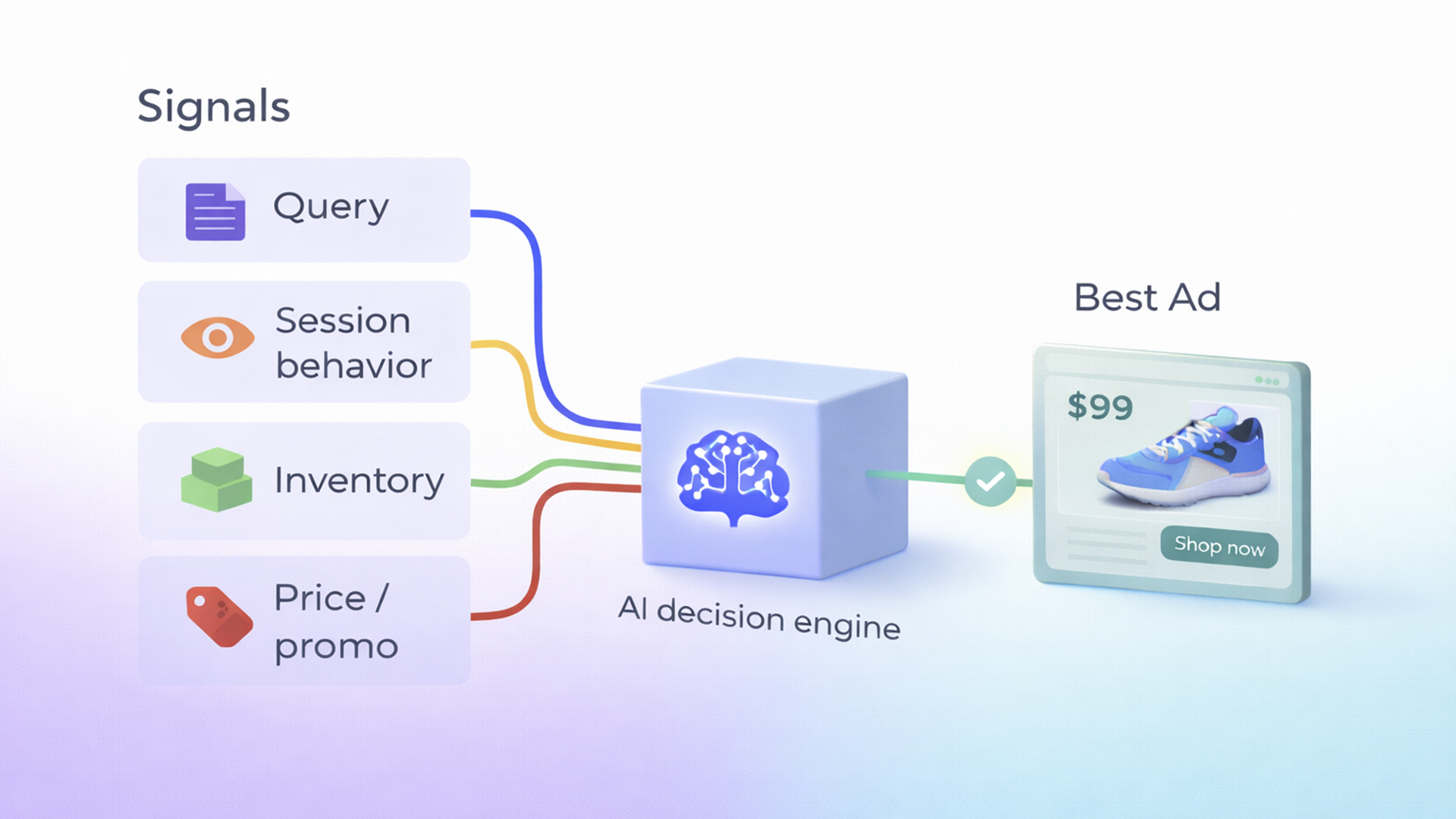
Instead of matching text to text, AI-driven ad technology evaluates behavior, context, product data, and historical outcomes to predict what should be shown right now.
This is where modern retail media platforms begin to separate themselves from publisher-style ad tech.
Platforms like Osmos apply intelligence across dozens of real-time signals to dramatically improve relevance and yield. These signals don’t operate in isolation—they reinforce each other.
On the shopper side, AI looks at browsing paths, navigation patterns, repeat behavior, and category affinity.
On the merchandise side, it evaluates catalog structure, pricing, promotions, and stock availability.
On the campaign side, it considers objectives, bids, creative performance, and pacing.
On the context side, it accounts for seasonality, time of day, and demand spikes.
AI connects all of this before the ad is served—deciding what makes sense for the shopper and what maximizes retailer revenue.
This is ad serving that thinks, not reacts.
3. What AI-Driven Targeting Actually Fixes (That Keywords Never Could)
When AI is embedded into ad serving and behavioral targeting, entire classes of problems disappear.
Incomplete and misspelled searches stop being a problem.
A query like “iphon ca” doesn’t confuse the system. AI infers intent and surfaces iPhone cases—not cables, not phones, not random accessories.
Brand intent becomes visible.
AI recognizes brand signals inside queries and sessions, enabling smarter conquesting—like showing relevant alternatives when shoppers explore competing brands.
Out-of-stock dead ends are avoided.
When a searched product isn’t available, AI automatically maps the nearest relevant category or SKU, keeping shoppers engaged instead of hitting a wall.
Intent follows the shopper beyond search.
AI understands session continuity. If someone searches for protein powder, relevant ads continue across category pages, PDPs, and recommendations—until intent resolves.
Bidding becomes context-aware, not budget-driven.
AI evaluates competing and complementary bids to ensure the most relevant ad wins—not just the most expensive one.
Language stops being a limitation.
From “no sugar” to “sugar-free,” or “milk” to “doodh,” AI models map synonyms and multilingual expressions automatically—critical for global and regional marketplaces.
In short: AI doesn’t just match keywords.
It understands shopping behavior.
4. Why Context Has Replaced Keywords Entirely
Behavioral targeting today isn’t about tracking people—it’s about predicting intent inside a live shopping moment.
Modern ad servers don’t rely on cookies or static keyword lists. They learn from hundreds of micro-signals in real time to deliver ads that feel natural, relevant, and timely.
Consider how this plays out in real retail environments.
A shopper who browsed running shoes last week and searches for “breathable socks” today might see ads for socks and complementary footwear—because AI connects past intent with current context.
Someone adding baby food to their cart could be shown diapers or organic snacks—not because of keywords, but because AI understands basket logic and lifecycle patterns.
This is behavioral targeting without surveillance.
Relevance driven by context, not intrusion.
For retailers, this shift is powerful. It increases ad performance while protecting shopper trust—something legacy ad technology was never designed to do.
5. AI-Powered Ad Serving Is No Longer Optional
As retail media networks mature, AI-powered ad serving is becoming the baseline—not the differentiator.
A modern ad server must be able to:
- Learn continuously from performance data
- Adapt in real time to shopper behavior and campaign goals
- Understand multiple languages, synonyms, and contextual relationships
- Optimize every impression for relevance and yield
AI doesn’t replace ad tech—it makes it adaptive.
Instead of static rules and one-size-fits-all logic, each ad placement becomes a prediction. One that balances shopper experience with monetization outcomes.
This is why retailers across categories—from grocery platforms to fashion and beauty marketplaces and restaurant aggregators—are rebuilding their retail media stacks around intelligence, not keywords.
Conclusion: From Guesswork to Intelligence-Led Growth
Manual keyword mapping had its moment. That moment is over.
Retail media has entered an era where AI-driven ad technology understands intent better than static rules ever could. Every search, scroll, and interaction becomes a signal. And when those signals are interpreted correctly, ad serving stops being a gamble—and becomes a growth engine.
Retailers that invest in AI-powered behavioral targeting see higher relevance, stronger yield, and better shopper experiences—all at the same time.
If you want to see how this intelligence-first approach works in practice, explore how Osmos-powered retail media networks are already delivering smarter monetization outcomes across categories.
Because in the next phase of retail media, the winners won’t be the loudest bidders.
They’ll be the smartest systems.
SEE IT IN ACTION
See what's above your ceiling.
Your score, your peer benchmark, and the levers that close the gap.
Commitment-free consultation on your top needs and challenges. Discover product capabilities and how Osmos may help.