Retail Media Concepts
Ad Serving for Retail Media: Why Publisher Ad Tech Falls Short
Same Ad Server, Very Different Job
Most people don’t think twice about ads while shopping online. They type a search, scroll a page, click a product, and move on. What they don’t see is the split-second decision happening behind the scenes; deciding which product shows up, where it appears, and why that one won over the rest. That decision is made by an ad server. Ad servers have always been the quiet operators of digital advertising. Invisible to users, indispensable to revenue. They decide which ad appears, where it appears, and who gets to see it; all in fractions of a second.
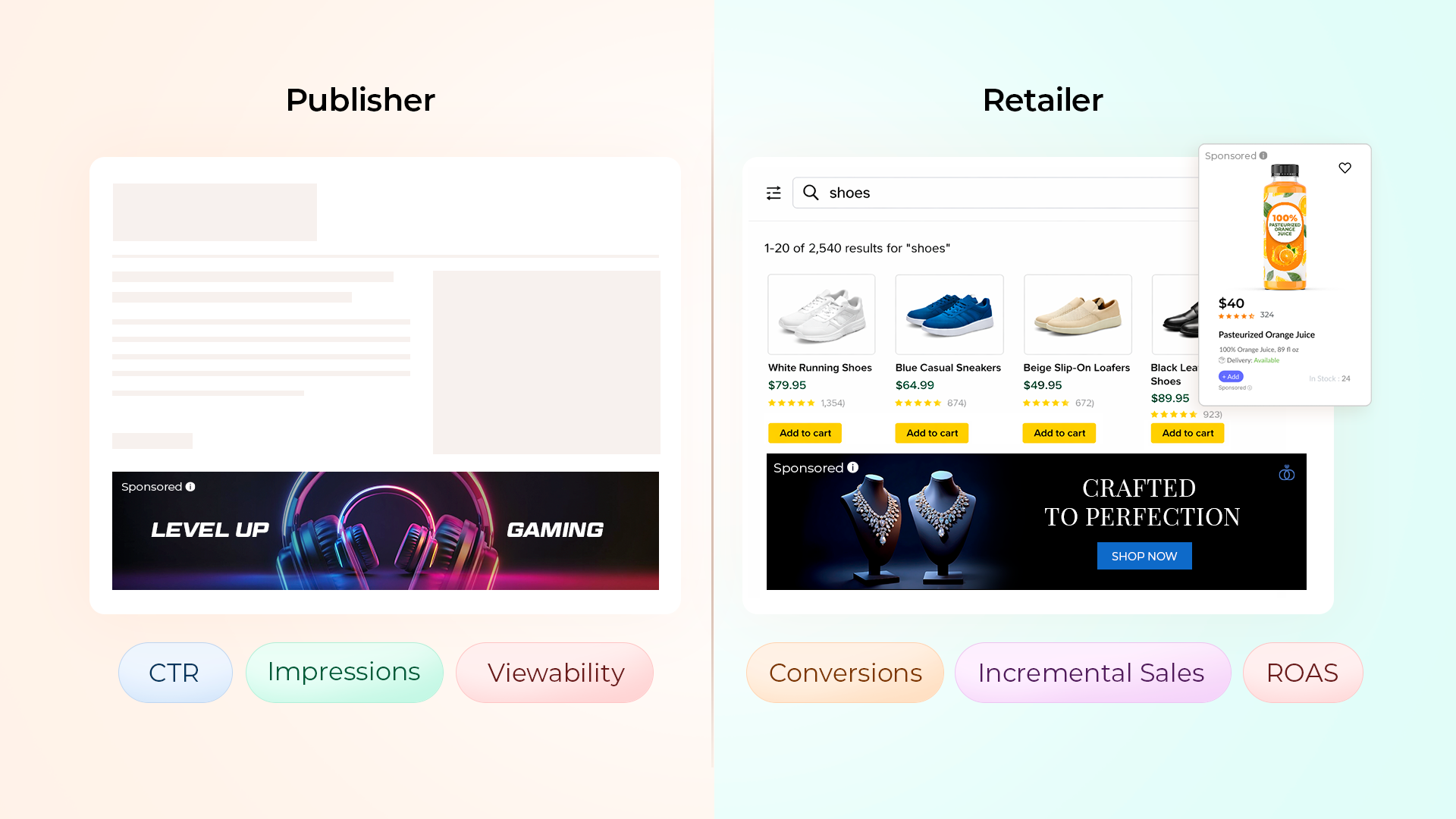
Traditional digital ads were made for websites and apps that just want people to look at things, read articles, watch videos, scroll pages. The goal there is attention: Did someone see the ad? Did they click it?
Retail media works very differently. When someone is shopping online, they’re not just browsing; they’re planning to buy something. That means ads aren’t fighting for eyeballs anymore; they’re trying to match what the shopper already wants. So when ads appear inside a shopping app or website, the system deciding which ad to show can’t think like a news site or video platform. It can’t just ask, What ad will get the most clicks? But instead, what product actually makes sense for this shopper right now?
That’s why ad serving for retail media works very differently from traditional publisher ad tech; and why using the wrong logic can quietly hurt revenue, relevance, and shopper trust. As retail media accelerates into a core revenue engine for retailers and marketplaces, the gap between publisher ad serving and commerce-native ad technology is no longer theoretical; but operational, financial, and strategic. Let’s break down why ad serving for retail media is fundamentally different, where publisher ad tech breaks down, and what retailers should expect from a modern ad server built for commerce.
Publisher Ad Tech: Built for Pages, Not Purchases
Publisher ad servers were born in a simpler time; when the goal was to monetize eyeballs, not baskets.
At their core, traditional publisher ad servers were designed to:
- Manage ad inventory across pages, feeds, articles, or video players
- Maximize yield through auctions, demand sources, and fill rates
- Track impressions, clicks, and viewability for reporting
In this world, every impression is a unit, and the page is the product.
If an ad shows up slightly late? Annoying, but tolerable. If it’s irrelevant? Still counts as an impression. If it never leads to a transaction? That’s someone else’s problem.
This logic works beautifully for publishing. It breaks, quickly, inside retail media networks. Because in commerce, an ad isn’t something you tolerate between paragraphs. It’s something that either helps a shopper buy or gets in the way.
Why Ad Serving in Retail Media Is a Different Beast Entirely
Retail media ad serving doesn’t live next to content. It lives inside the transaction path. That single reality changes everything…
Inventory Isn’t a Slot; It’s a Product
In publisher environments, inventory is static: Header slot. Sidebar slot. Pre-roll slot. In retail media, inventory is alive.
Ads appear inside:
- Search results
- Product listing pages
- Recommendation carousels
- Category grids
Each placement is tied to a real product; one with stock levels, pricing rules, seller eligibility, and margin implications. A product can go out of stock in minutes. Prices can change drastically and sellers can lose eligibility instantly. Publisher ad servers were never built for this volatility. Retail media ad servers must stay in constant sync with:
- Product catalogs
- Inventory systems
- Pricing engines
- Seller or brand eligibility rules
If an ad server can’t see commerce reality in real time, it shouldn’t be making monetization decisions.
Whether you’re a grocery retailer, a fashion and beauty marketplace, or a restaurant aggregator, the right ad serving foundation makes the difference between monetization friction and monetization scale.
The Audience Is Known; Not Guessed
Publishers infer audiences. Retailers know them. Traditional ad serving relies on:
- Cookies
- Contextual signals
- Modeled demographics
Retail media operates on first-party shopper data:
- Purchase history
- Browsing behavior
- Category affinity
- In-session intent
That difference is massive. In retail media networks, ad serving logic isn’t guessing who someone might be, it’s responding to what they’re actively trying to buy right now.
This is why ad technology built for retail can align ads with moments like:
- Price comparison
- Category exploration
- Cart-building
- Repeat purchase behavior
Performance Is Measured in Sales, Not Scrolls
Publisher ad servers obsess over:
- CPMs
- CTRs
- Viewability
Retail media ad serving is all about:
- Conversion rate
- ROAS
- Incremental sales
Because the ad lives inside the buying journey, the ad server must connect delivery directly to outcomes. That means deep integration with:
- Checkout flows
- Order confirmation data
- Attribution systems
This is where traditional ad technology shows its limits. It was never meant to prove revenue impact, only exposure. Retail media demands more!
Speed Isn’t Nice-to-Have; It’s Critical
In publishing, latency is a UX problem. In commerce, latency is a revenue leak. A delay of even 100–200 milliseconds can disrupt product discovery, slow scrolling, or cause page abandonment. That’s why modern retail media ad servers are engineered to deliver ads in under 35 milliseconds, blending seamlessly into the experience. If an ad loads slower than the product grid around it, it’s already failed.
Learn how retailers across categories are building modern retail media platforms with Osmos; designed for performance, precision, and real commerce outcomes.
What Smart Retail Media Ad Servers Do Differently
This is where the split becomes obvious. Smart ad serving for retail media isn’t about more features, it’s about better alignment with commerce reality.
Intent Beats Keywords
Publisher ad tech reacts to words. Retail media ad servers interpret intent… and words. A shopper searching for “after-work snacks” doesn’t want a literal keyword match, they want convenience, health, maybe a deal.
Retail ad serving uses:
- Category understanding
- Session behavior
- Historical signals
Real-Time Commerce Sync Is Non-Negotiable
A retail media ad server should automatically:
- Remove out-of-stock products
- Adjust eligibility when prices change
- Deprioritize low-margin SKUs
- Respect seller or brand rules
Ads that ignore commerce signals don’t just waste impressions; they erode trust.
AI Does the Heavy Lifting, Retailers Set the Rules
AI plays a growing role in ad serving:
- Bid optimization
- Placement decisions
- Pacing adjustments
But in retail media, automation must respect business logic. Retailers need control over:
- Category balance
- Margin protection
- Brand or seller commitments
The smartest ad technology combines automation with guardrails, letting AI optimize without overriding commercial priorities. Platforms like Osmos with AI assistants like Sofie, exemplify this balance, where intelligence enhances monetization without disconnecting it from retail realities.
Integration Over Reinvention
Retailers shouldn’t rebuild their stack to run ads. A commerce-native ad server integrates with:
- Existing product catalogs
- Checkout systems
- Analytics and reporting layers
This modularity is what allows retail media networks to scale without slowing down the core shopping experience…
Why Ad Technology Choice Is a Strategic Decision for Retailers
Choosing an ad server is nothing short of a vital business decision. The wrong ad serving foundation leads to:
- Irrelevant ads
- Lost conversions
- Frustrated brands and sellers
- Missed revenue opportunities
The right one turns retail media into a predictable, high-margin business. Retailers should demand ad technology that:
- Syncs with real-time product data
- Supports business-rule customization
- Scales onsite without performance loss
- Reports revenue impact, not vanity metrics
This is where purpose-built retail media platforms outperform retrofitted publisher stacks.
If you want to see how this plays out in practice, explore our real-world success stories.of Osmos-powered retail media networks using commerce-native ad serving to build scalable, future-ready retail media networks.
Key Takeaways Retailers Should Remember
- Retail media is not publishing. The same ad server cannot serve both well.
- Commerce context drives relevance. Product, price, and inventory matter more than impressions.
- Speed is a revenue metric. Slow ads cost conversions.
- Ad serving must prove sales impact. Clicks alone don’t cut it anymore.
Ad Serving That Understands Commerce Wins
Retail media networks are redefining what ad serving actually means. Publishers built ad servers to sell attention. Retailers are building them to convert intent. The future of ad technology belongs to systems that understand products, shoppers, and transactions, not just placements and pixels.
A smart ad server doesn’t chase impressions. It anticipates need. It respects context. It moves at commerce speed. And for retailers and marketplaces looking to turn traffic into a durable monetization engine, that difference isn’t technical; it’s transformational!
If you’re exploring how to power a retail media network that’s built for monetization, measurement, and long-term growth, discover how Osmos is helping retailers modernize ad serving for commerce-first outcomes.
SEE IT IN ACTION
See what's above your ceiling.
Your score, your peer benchmark, and the levers that close the gap.
Commitment-free consultation on your top needs and challenges. Discover product capabilities and how Osmos may help.